
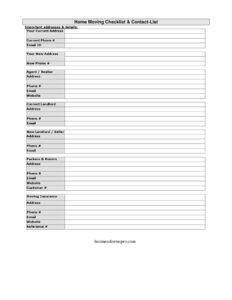
Home Moving Checklist
Stay organized with this free Home Moving Checklist template that tracks addresses, movers, and utilities — free download in PDF and DOCX.
PDF
DOCX
4 downloads
0
likes
Download Files
- DOCX
A Home Moving Checklist is a single organized document that keeps every address, contact, and utility task for your move in one place, so nothing slips through the cracks on moving day. Most people use it to track who needs to be notified, what services to switch off and on, and which accounts still have pending dues. It’s free to download here in both PDF and DOCX formats with no signup required.
What Is a Home Moving Checklist?
A Home Moving Checklist is a planning and contact-management form used by anyone relocating from one home to another. It combines two functions: a record of important contacts — your realtor, current and new landlords, packers and movers, and your moving insurer — and a tracker for utilities and services that must be disconnected at your old address and connected at your new one. Rather than scattering details across notes, emails, and phone calls, the checklist consolidates current and new addresses, account numbers, turn-off dates, and outstanding balances into one reference sheet. It’s especially useful for households juggling multiple service providers and deadlines during a tight relocation window.
When Do You Need a Home Moving Checklist?
This form is valuable in almost any relocation, but it becomes essential in these situations:
- Moving to a new home or apartment — when you need to coordinate addresses, movers, and a move-out date all at once.
- Transferring or canceling utilities — to track electricity, gas, water, sewerage, garbage, internet, and cable disconnections and reconnections without missing a provider.
- Settling final bills — to record any pending dues so you don’t get hit with surprise charges or collection notices after you’ve left.
- Working with a realtor or landlord — to keep agent, landlord, and seller contact details handy for closing or lease handover.
- Filing a moving insurance claim — to have your customer number and reference number ready if items are damaged in transit.
- Updating your address everywhere — to systematically notify each service provider of your new phone number, email, and address.
What a Home Moving Checklist Should Have
A complete moving checklist captures both the people you need to reach and the services you need to manage. Key elements include your current and new addresses with matching phone numbers and email; contact blocks for your agent or realtor, current landlord, and new landlord or seller; movers’ details including a customer number; moving insurance information with a reference number; and a full utilities section. The utilities portion should list each provider, the relevant account, a turn-off or transfer date, and any pending dues. Leaving space for both current and new utilities lets you confirm that every service is properly closed at the old home and active at the new one.
How to Fill Out a Home Moving Checklist
- Under important address & details, enter your current address, current phone #, and email ID.
- Record your new address and new phone # so every provider can be updated.
- Fill in the agent/realtor section with their address, email, and website for quick reference during closing or lease handover.
- List your current landlord and your new landlord/seller contact details.
- Add the packers & movers company, your customer #, and your moving insurance provider along with the reference #.
- Under current utilities and services details, complete each line: electricity with its turn off date and any pending dues, then gas supplier, water utility, sewerage, garbage collection, telephone services, mobile service provider, internet service, cable tv, and gardening.
- Repeat the relevant entries under new utilities and services to confirm each is connected at your new address.
- Review every line, note transfer dates, and keep the sheet accessible throughout your move.
Organizing Your Utilities Transfer
The utilities section is the heart of this checklist, because gaps here cause the most stress. Aim to schedule disconnections at your old home for the day after you move out, and connections at your new home for the day before you arrive — that overnight overlap means you never sit in the dark or without internet. For each provider, note the account or customer number so you can verify the right service when you call. Some utilities, like electricity, gas, water, and internet, may require advance notice of several days or a final meter reading, so start early. Keep the pending dues column updated as you settle each account; a zero balance confirmed in writing protects you from later disputes.
Keeping Your Contact List Useful After the Move
Don’t discard the checklist once boxes are unpacked. The contact list — realtor, landlords, movers, and insurer — remains valuable for weeks afterward. If a moving box turns up damaged, your moving insurance reference number is right there. If a deposit refund is delayed, your former landlord’s details are on hand. Store the completed form digitally and as a printout so you can reach the right person quickly without digging through email threads.
Common Mistakes to Avoid
- Forgetting to record turn-off dates — leading to double billing on services at two addresses.
- Leaving pending dues blank — unpaid final bills can hurt your credit or trigger collection calls.
- Overlooking minor services like garbage collection, sewerage, or gardening that don’t get separate bills but still need notice.
- Not updating your new phone number and email with every provider, causing missed final statements.
- Misplacing your movers’ customer number or insurance reference, which slows down any claim.
- Starting too late — many utilities need several days’ notice for connection or final readings.
Frequently Asked Questions
What is a Home Moving Checklist used for? It is a planning sheet that keeps all your relocation contacts and utility tasks in one place. It tracks current and new addresses, your realtor, landlords, movers, and insurer, plus the turn-off and connection of each service. The goal is to make sure nothing is forgotten during a busy move.
How do I fill out the utilities section? For each service — electricity, gas, water, sewerage, garbage, telephone, mobile, internet, cable, and gardening — list the provider, the relevant account number, the turn-off or transfer date, and any pending dues. Then repeat for the new address to confirm each service is active there. Updating it as you go keeps everything accurate.
When should I start using the checklist before moving? Ideally a few weeks before your move date, since utilities like electricity, gas, water, and internet often require advance notice or a final meter reading. Starting early gives you time to schedule disconnections and connections so there’s no gap in service. It also lets you settle final bills before you leave.
Is a Home Moving Checklist a legal document? No, it is a personal organizational tool, not a contract or legal agreement. It simply helps you track contacts, dates, and balances during your move. The actual obligations come from your lease, purchase agreement, and service contracts.
How much does this template cost? It is completely free to download here in both PDF and DOCX formats, with no signup required. The DOCX version can be edited to add or remove fields, while the PDF can be printed and filled in by hand. You can reuse it for future moves.
Should I keep the checklist after the move? Yes, keep it for at least a few weeks afterward. It holds your moving insurance reference, movers’ customer number, and former landlord details, all of which are useful if a claim, a deposit refund, or a billing question comes up later.
This Home Moving Checklist template is a general example provided for informational purposes only and is not legal, financial, or tax advice. Service requirements, notice periods, and provider procedures vary by location and company — consult the relevant providers and a qualified professional for guidance specific to your situation.
Related Forms
- Auction Bid Sheet
- Backstage Pass
- Corporate Minutes
- Obedience School Intake Form
- Entry Form White
- Driving Directions
Browse more in Miscellaneous.