
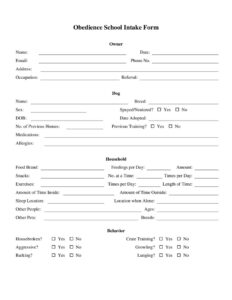
Obedience School Intake Form
Download a free Obedience School Intake Form template in PDF and DOCX to gather dog details, training goals, and owner info before classes begin.
PDF
DOC
0
likes
Download Files
- DOC
An Obedience School Intake Form is the document a dog training school or trainer uses to collect a new client’s information before the first class, capturing the dog’s history, behavior, and training goals. It’s the most common way to ensure every dog is matched to the right program and handled safely from day one. You can download this form free in both PDF and DOCX formats, with no signup required.
What Is an Obedience School Intake Form?
An Obedience School Intake Form is a structured questionnaire completed by dog owners when enrolling their pet in a training program. It’s typically issued by the obedience school, trainer, or behaviorist and filled out by the dog’s owner or guardian. The form documents essential details such as the dog’s breed, age, vaccination status, behavioral concerns, and the owner’s training objectives. Its purpose is twofold: it gives trainers the background needed to design an effective and safe class plan, and it creates a record of the client relationship. A complete intake form helps the school flag potential issues like aggression or health limitations and ensures expectations are aligned before training begins.
When Do You Need an Obedience School Intake Form?
This form is useful any time a dog is being welcomed into a structured training environment. Common scenarios include:
- Enrolling a puppy in a basic obedience or socialization class for the first time.
- Registering an adult dog for advanced training, agility, or off-leash work.
- Onboarding a rescue or adopted dog whose history and triggers are unknown.
- Booking private, one-on-one behavior consultations for issues like leash reactivity or separation anxiety.
- Adding a dog to a board-and-train or day-training program where the dog stays on-site.
- Documenting vaccination and health information required before group classes for the safety of all participants.
Types of Training Programs This Form Supports
The same intake form can serve a range of training offerings. Group puppy classes focus on socialization and foundational cues, so the form helps gauge a puppy’s exposure and temperament. Group adult obedience emphasizes manners and reliability around distractions. Private sessions and behavior modification programs rely heavily on the detailed history section, since the trainer needs to understand triggers, past incidents, and the home environment. Board-and-train programs use the form to record feeding schedules, medications, and emergency contacts because the dog is away from its owner. Adapting one clear intake form across these formats keeps your enrollment process consistent and professional.
What an Obedience School Intake Form Should Have
A thorough intake form balances administrative details with behavioral and medical insight. Strong forms include owner contact information, the dog’s identifying details (name, breed, age, sex, spay/neuter status), vaccination and veterinarian information, a behavior and bite history section, feeding and medication notes, the owner’s specific training goals, and an emergency contact. Many schools also add a liability waiver or consent statement, a photo-release line, and a signature with date. Including a section for prior training experience and what has or hasn’t worked saves the trainer valuable time and reduces guesswork in the first session.
How to Fill Out an Obedience School Intake Form
- Owner information: Enter your full name, mailing address, phone number, and email so the school can reach you about scheduling.
- Emergency contact: Provide an alternate person and number in case you can’t be reached during a session.
- Dog details: Write the dog’s name, breed (or best guess for mixes), age or date of birth, sex, and whether the dog is spayed or neutered.
- Veterinarian and health: List your vet’s name and phone number, the dog’s vaccination status, and any allergies, medications, or medical conditions.
- Behavior history: Note any past biting, fear, or reactivity toward people or other dogs, and describe the situations that trigger it.
- Daily routine: Record feeding times, diet, exercise habits, and the dog’s home environment.
- Training goals: Describe what you hope to achieve and any prior training the dog has received.
- Program selected: Indicate the class or service you’re enrolling in.
- Acknowledgment: Read any waiver or policy text, then sign and date the form.
Health and Safety Notes
Vaccination records are often the gatekeeper for group classes. Most schools require proof of core vaccines and may exclude dogs who are ill or unvaccinated to protect the rest of the group. Be honest about any bite history or fear-based aggression; withholding this information can put trainers, other dogs, and other handlers at risk, and it undermines the very plan you’re paying for. If your dog has a medical condition that limits physical activity—such as joint problems or a heart condition—flag it clearly so the trainer can adapt exercises. Accurate health and behavior reporting is what allows a school to keep classes safe and productive.
Common Mistakes to Avoid
- Leaving the behavior history blank or glossing over past incidents, which prevents the trainer from preparing properly.
- Forgetting to attach or note current vaccination records, delaying enrollment in group classes.
- Listing vague training goals like “better behavior” instead of specific outcomes like “reliable recall” or “no jumping on guests.”
- Providing an outdated phone number or email, making it hard for the school to confirm scheduling.
- Skipping the emergency contact field, especially important for board-and-train programs.
- Signing the waiver without reading the cancellation, refund, or liability terms.
Frequently Asked Questions
What is an Obedience School Intake Form used for? It collects a dog’s background, health, and behavior information along with the owner’s contact details and training goals. Trainers use it to design a safe, effective program and to keep accurate client records before classes start.
Do I need to include my dog’s vaccination records? Most obedience schools require proof of core vaccinations before a dog can join a group class, since close contact among dogs raises the risk of illness. The form usually asks for vaccination status and your veterinarian’s contact information so the school can verify it.
Why does the form ask about bite or behavior history? Knowing whether a dog has shown fear, reactivity, or aggression lets trainers plan for everyone’s safety and tailor the approach. Honest answers help the school place your dog in the right setting, whether that’s a group class or a private session.
Is this intake form legally binding? The intake portion is primarily informational, but many schools attach a waiver, consent, or policy section that becomes binding once you sign. Read any attached terms carefully, particularly clauses about liability, cancellations, and refunds.
Can I use this form for a private trainer or a board-and-train program? Yes. The same template works for group classes, private one-on-one sessions, and board-and-train arrangements; for overnight programs, pay special attention to the feeding, medication, and emergency contact fields.
How much does this template cost? This Obedience School Intake Form is completely free to download in PDF and DOCX formats with no signup required. You can use the PDF as-is or edit the DOCX version to match your school’s branding, programs, and policies.
This template is provided as a general example for informational purposes only and does not constitute legal, veterinary, or business advice. Requirements for waivers, liability, and vaccination policies vary by jurisdiction and by individual business—consult a qualified professional to ensure your intake process meets local rules and your school’s needs.
Related Forms
- Military Time Chart
- Visitor Badges
- Credit Information Release Authorization
- US Time Zones Chart
- Nomination Card
- Letter to Legislator Showing Concern
Browse more in Miscellaneous.