
Set List
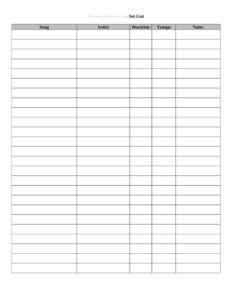
Plan your performance with our free Set List template — organize songs, timing, and notes for any gig. Download free in PDF and DOCX, no signup required.
PDF
DOCX
0
likes
Download Files
- DOCX
A set list is the ordered lineup of songs a band, DJ, or solo performer plays during a single show, written out so everyone on stage and behind the scenes knows what comes next. Musicians most often use it to keep a live performance tight, avoid awkward pauses, and stay within the time slot a venue allots. You can download this free Set List template in PDF and DOCX formats with no signup required.
What Is a Set List?
A set list is a planning document that maps out the songs, their order, and supporting details for a live performance. It is typically created by the band leader, music director, or performer in advance and shared with bandmates, the sound engineer, lighting crew, and sometimes the venue. Beyond simply naming songs, a good set list captures the flow of an evening — which numbers open with energy, which slow things down, and which close on a high note. It also doubles as a reference for tempo, key, and any cues that need to happen during transitions. Printed and taped to the stage floor or a monitor, the set list keeps the whole team aligned through the noise and adrenaline of a live show.
When Do You Need a Set List?
Anytime a performance involves more than a couple of songs or more than one person, a written set list earns its keep. Common situations include:
- Club and bar gigs: Venues often assign a strict time slot, so a set list keeps you from running long or short and ensures you fit the room’s vibe.
- Weddings and private events: Couples request specific songs for the first dance, ceremony, and reception, and a set list locks those moments in place.
- Festivals and multi-band bills: When stage changeovers are timed to the minute, a clear set list helps you hit your slot precisely.
- Rehearsals: Practicing in performance order builds muscle memory for transitions, count-ins, and key changes.
- Open mics and showcases: Even three or four songs benefit from a planned order that shows your range.
- Recurring residencies or cover gigs: Rotating set lists week to week keeps repeat audiences engaged and your repertoire fresh.
What a Set List Should Have
An effective set list balances readability with detail. At a glance, performers should see the song order in large, legible text. Supporting columns can carry the information a band needs without cluttering the page. Key elements include the performance or event name, the date and venue, the ordered list of songs, and the artist or original performer where covers are involved. Many bands add the musical key, tempo, lead vocalist, and approximate duration of each song. A running total of time helps you confirm the set fits the slot. Finally, leave room for transition notes, encore options, and any cues — a key change, a tuning break, or a spoken introduction. The cleaner the layout, the easier it is to read under stage lighting.
How to Fill Out a Set List
This template is flexible, so adapt the columns to your group’s needs. Follow these steps:
- Add the event details: At the top, write the performance or band name, the date, and the venue so the printed sheet is easy to identify later.
- Note the time slot: Record your total allotted performance time so you can budget song lengths against it.
- List songs in order: Number each song and write its title in the order you intend to play it, starting with a strong opener.
- Record the artist or key: For cover bands, add the original artist; for any set, note the musical key to speed up transitions.
- Add tempo and lead vocals: Indicate fast or slow and who sings lead, which helps with pacing and mic setup.
- Estimate durations: Write each song’s length and keep a running total to ensure you finish on time.
- Mark transitions and breaks: Note instrument swaps, tuning stops, banter, or segues between songs.
- Plan an encore: List one or two extra songs in case the crowd calls you back.
Building a Set List That Flows
The order of songs shapes the entire experience. Open with a familiar, high-energy number to grab attention, then build and release tension throughout the set rather than playing everything at the same intensity. Group songs by key to make smooth, in-tune transitions, and place slower ballads where the audience needs a breather — usually in the middle third. Save a crowd favorite or your strongest original for the closer so people leave on a high. For longer shows, plan deliberate pacing peaks and valleys, and place any technical breaks (a guitar change or a new tuning) at natural pauses. Reading the room and adjusting on the fly is part of the craft, but a thoughtful starting plan gives you something solid to deviate from.
Sharing and Using It on Stage
Once your set list is complete, print multiple copies — one for each performer, the sound engineer, and the lighting operator. Use large font so it is readable from a distance under colored lights, and tape it securely to the stage so it does not blow away or shift. Keep a digital copy on your phone or tablet as a backup. After the show, jot quick notes about what worked and what dragged; those observations make your next set list even better.
Common Mistakes to Avoid
- Print too small: Tiny text is unreadable on a dim stage — use large, bold type.
- Ignoring the time limit: Failing to total song durations leads to running over and frustrating the venue.
- Poor pacing: Stacking all the slow songs together kills momentum; alternate energy levels.
- No transition notes: Forgetting to mark tuning changes or key shifts causes dead air between songs.
- Skipping the encore plan: Scrambling for a song when the crowd cheers for more looks unprepared.
- Only one copy: Without copies for the engineer and bandmates, cues get missed.
Frequently Asked Questions
What is a set list? A set list is the ordered lineup of songs a performer or band plans to play during a single show. It typically includes song titles in performance order along with optional details like key, tempo, and timing. It keeps everyone on stage and in the crew coordinated throughout the performance.
How do I fill out a set list? Start with the event name, date, and venue, then list your songs in the order you’ll play them. Add columns for the artist, key, lead vocalist, and song length, and keep a running time total so you fit your slot. Finally, note any transitions, breaks, or encore songs.
How long should a set list be? That depends entirely on your time slot. A typical bar set runs 45 minutes to an hour, which is roughly 10 to 15 songs, while a festival slot might be just 30 minutes. Estimate each song’s length and add them up to match the time you’ve been given.
Is there a standard format for a set list? There is no official format — bands customize set lists to their needs. The only essentials are clear song titles in order and large, readable text. This template gives you a flexible starting layout you can adjust for any genre or gig.
How much does this set list template cost? Nothing. You can download this Set List template completely free in both PDF and DOCX formats, with no signup or account required. Edit the DOCX in your word processor or print the PDF as-is.
Should I bring extra copies to the show? Yes. Print a copy for each performer plus the sound engineer and lighting operator, and keep a digital backup on your phone. Extra copies ensure everyone follows the same plan and that cues aren’t missed mid-set.
This Set List template is provided as a general example for informational and organizational purposes only. It is not legal, contractual, or professional advice, and performance or venue requirements vary by event and location. Confirm any contractual obligations directly with your venue, agent, or event organizer.
Related Forms
Browse more in Miscellaneous.