
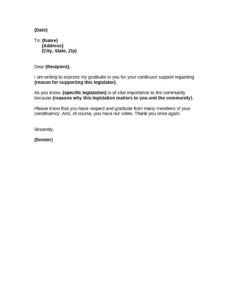
Letter to Legislator Giving Support
Use this free Letter to Legislator Giving Support template to thank your representative and back specific legislation — free PDF and DOCX download.
DOCX
0
likes
Download Files
- DOCX
A Letter to Legislator Giving Support is a short, courteous note a constituent sends to an elected official to thank them and express backing for a particular bill, vote, or policy position. People most often use it to encourage a representative to keep championing legislation they care about — and you can download this template free in PDF and DOCX, with no signup required.
What Is a Letter to Legislator Giving Support?
A Letter to Legislator Giving Support is a piece of constituent correspondence written to a member of a city council, state legislature, or national assembly. Unlike a complaint or a request for change, its purpose is affirmative: it tells the lawmaker that you appreciate their stance, that specific legislation matters to your community, and that you stand behind them. Anyone in a legislator’s district can write one — individuals, small business owners, members of advocacy groups, or families affected by a policy. The letter documents grassroots approval in a way phone calls and form emails sometimes do not, giving the official a tangible signal that their position has real support among the voters they represent.
When Do You Need a Letter to Legislator Giving Support?
This letter fits any moment when you want to reinforce a positive position rather than push for change. Common situations include:
- A legislator has sponsored or co-sponsored a bill you care about and you want to encourage them to keep fighting for it.
- An official cast a vote you agree with and you want to thank them publicly and personally.
- A community organization is running a coordinated support campaign and needs a clean template members can personalize.
- A piece of pending legislation is up for debate and you want your representative to know constituents are watching and approving.
- You attended a town hall or read a public statement and want to follow up with written appreciation.
- You want to build goodwill with an office before asking for help on a future issue, establishing yourself as an engaged, constructive constituent.
What a Support Letter Should Have
A strong letter to a legislator is brief, specific, and respectful. It should clearly identify who you are and that you are a constituent, name the exact legislation or position you are supporting, explain why that issue matters to you and your community, and close with a sincere note of thanks. Specificity is what makes the letter land: a generic “keep up the good work” carries far less weight than naming a bill and describing its real effect on your neighborhood. The tone should be warm and confident, and the message should be short enough that a busy staffer can read it in under a minute.
How to Fill Out a Letter to Legislator Giving Support
- Enter the Date you are writing the letter at the top.
- In the To block, fill in the legislator’s Name, then their official Address and City, State, Zip — use the district or capitol office address as appropriate.
- Open the greeting with Dear {Recipient}, using the proper title such as Senator, Representative, Councilmember, or Delegate followed by the surname.
- State your reason for supporting this legislator — for example, their leadership on a specific cause or their responsiveness to the district.
- Name the specific legislation you support, ideally with its bill number or official title so there is no ambiguity.
- Explain the reasons why this legislation matters to you and the community, drawing on a concrete local example if you can.
- Leave the closing lines of thanks and the assurance of your vote as written, or adjust them to your voice.
- Sign off as the Sender, adding your full name and, optionally, your home address so the office can verify you live in the district.
Tips for Writing an Effective Support Letter
Legislative offices receive enormous volumes of mail, so a few habits help your letter stand out. Keep it to a single page — the template is intentionally short. Mention the bill by number whenever possible; staffers sort correspondence by issue, and a clear reference routes your message correctly. Personalize the “why it matters” section with a real story from your life or neighborhood rather than abstract talking points, because lawmakers remember constituents, not slogans. Always confirm you are a resident of the official’s district, since out-of-district mail typically carries less influence. If you are part of a campaign, encourage others to personalize their copies rather than send identical text, as offices weight individualized letters more heavily than mass duplicates.
Mailing, Email, and Following Up
You can send the finished letter by postal mail to a district or capitol office, deliver it through the legislator’s official website contact form, or attach the PDF to an email to the staff. Physical mail to capitol buildings is sometimes delayed by security screening, so the district office or an email often reaches the team faster. Keep a copy for your records. If the issue you support comes up for a vote, a brief follow-up reaffirming your position can be a welcome reminder. Because this is an expression of support and not a binding document, there is no filing, notarization, or formal procedure involved — just clear, sincere communication.
Common Mistakes to Avoid
- Being vague about which bill or position you support, leaving staff unsure how to log your letter.
- Forgetting to identify yourself as a constituent, which weakens your influence with the office.
- Letting the tone slip into demands or criticism when the goal is genuine appreciation.
- Writing several pages — long letters often go unread, while a focused note gets noticed.
- Omitting your name or contact details, so the office cannot verify or respond to you.
- Sending an unedited mass-campaign copy that reads as a template rather than a personal message.
Frequently Asked Questions
What is a Letter to Legislator Giving Support? It is a short note from a constituent thanking an elected official and expressing backing for a specific bill, vote, or position. Its purpose is to reinforce a stance you agree with rather than to request a change. Offices use such letters to gauge how their district feels about an issue.
How do I fill out this support letter? Add the date and the legislator’s name and address, open with a proper title in the greeting, then state your reason for supporting them, name the specific legislation, and explain why it matters to your community. Close with thanks and sign as the sender. The template walks you through each field in order.
Does this letter need to be notarized or witnessed? No. A support letter is personal correspondence, not a legal instrument, so it requires no notary, witnesses, or official filing. You simply write it, sign it, and send it to the official’s office.
Should I include the bill number? Yes, whenever you know it. Legislative staff sort mail by issue and bill, so naming the exact legislation — by number or official title — ensures your letter is counted under the right topic and reaches the relevant policy team.
Will one letter actually make a difference? A single letter is one data point, but offices do track constituent sentiment, and supportive mail is comparatively rare, so it often stands out. Personalized letters carry more weight than form messages, and your note adds to the record an official considers when deciding how to act.
Is this template free to download? Yes. You can download the Letter to Legislator Giving Support free from Business Forms Pro in both PDF and DOCX formats, with no signup required. Edit the fields to fit your situation and send it however is most convenient.
This template is provided as a general example for informational purposes only and does not constitute legal, political, or professional advice. Rules and customs for contacting elected officials vary by jurisdiction and office; consult the legislator’s official guidance or a qualified professional if you have specific questions.
Related Forms
- Basic Entry Form White
- Housesitting Instructions
- Travel Itinerary
- Auction Bid Sheet
- Business Report Template
- Backstage Pass
Browse more in Miscellaneous.