
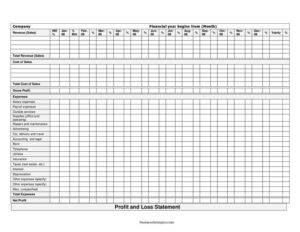
Profit And Loss Statement
Download a free Profit and Loss Statement template in PDF and DOCX to summarize revenue, expenses, and net profit — free download, no signup needed.
PDF
DOCX
1 downloads
0
likes
Download Files
- DOCX
A Profit and Loss Statement is a financial report that summarizes your business’s revenue, costs, and expenses over a set period to reveal whether you earned a profit or took a loss. Most people use it to track financial performance, prepare for taxes, or show lenders and investors how the business is doing. This template is free to download in PDF and DOCX, with no signup required.
What Is a Profit and Loss Statement?
A Profit and Loss Statement — often called a P&L or income statement — is a document that lists all the money a business takes in and all the money it spends across a defined period, such as a month, quarter, or financial year. Business owners, bookkeepers, and accountants prepare it to calculate gross profit (revenue minus the cost of sales) and net profit (what remains after all operating expenses). It documents the company name, the start of the financial year, every category of income and expense, and the final bottom line. In short, it answers a simple but vital question: did the business make money during this period, and where did that money go?
When Do You Need a Profit and Loss Statement?
This statement comes up far more often than once a year. Common situations include:
- Filing taxes — to report business income and deductible expenses to tax authorities or your accountant.
- Applying for financing — banks and lenders almost always request recent P&L statements before approving a loan or line of credit.
- Seeking investors or buyers — anyone considering putting money into or buying your business will study your profitability.
- Monthly or quarterly reviews — to spot trends, control rising costs, and compare performance against earlier periods.
- Budgeting and forecasting — using past results to plan realistic targets for the next period.
- Partnership or board reporting — to keep co-owners and stakeholders informed about how the company is performing.
What a Profit and Loss Statement Should Have
A complete P&L starts with identifying details: the company name and the month the financial year begins. From there it follows a clear top-to-bottom flow. First comes revenue (sales) and a total revenue line. Next is the cost of sales and its total, which subtracted from revenue produces gross profit. Below that sits a detailed list of operating expenses — each category itemized — followed by total expenses. The final line, net profit, shows what is left after everything is accounted for. A well-built statement keeps these sections separate and clearly labeled so any reader can follow the math from the first dollar earned to the last dollar of profit.
How to Fill Out a Profit and Loss Statement
- Enter the company name and the month your financial year begins from at the top.
- List your revenue (sales) by line item, then add them up in total revenue (sales).
- Record your cost of sales — the direct costs of producing what you sold — and enter the total cost of sales.
- Subtract total cost of sales from total revenue to calculate gross profit.
- Work through each operating expense: salary expenses, payroll expenses, outside services, supplies (office and operating), repairs and maintenance, advertising, car, delivery and travel, accounting and legal, and rent.
- Continue with telephone, utilities, insurance, taxes (real estate, etc.), interest, and depreciation.
- Use other expenses (specify) for anything that does not fit a named category, and misc. (unspecified) for small odd items.
- Add every expense to get total expenses, then subtract it from gross profit to arrive at your net profit.
Understanding Gross Profit vs. Net Profit
It helps to keep two figures clearly in mind. Gross profit measures how efficiently you produce and sell your product or service — it is revenue minus the direct cost of sales only, before overhead. Net profit is the true bottom line: gross profit minus every operating expense, from salaries and rent to interest and depreciation. A business can show strong gross profit yet still post a net loss if overhead is too high. Reviewing both numbers side by side tells you whether a problem lies in pricing and production costs, or in controlling general expenses like advertising, travel, or outside services.
Tips for an Accurate Statement
Pick a consistent period and stick to it so your statements are comparable over time. Categorize expenses the same way each period — if you put fuel under car one month, do not move it to delivery and travel the next. Reconcile your figures against bank statements and receipts before finalizing, and keep supporting documents for anything you list under other expenses (specify). Many owners prepare a P&L monthly, then roll the months into a yearly summary that aligns with the financial year start you entered at the top.
Common Mistakes to Avoid
- Mixing personal and business expenses — only business costs belong on the statement.
- Forgetting non-cash items like depreciation, which affects net profit even though no cash leaves the account.
- Double-counting a cost in both cost of sales and an expense line.
- Leaving the misc. line bloated — large unexplained amounts raise questions from lenders and tax authorities.
- Math errors in the totals — always re-check that revenue, expense, and profit lines actually add up.
- Inconsistent periods — comparing a three-month period to a full year gives a misleading picture.
Frequently Asked Questions
What is a Profit and Loss Statement used for? It summarizes a business’s income and expenses over a period to show whether it made a profit or a loss. Owners use it for tax preparation, loan applications, investor reporting, and ongoing performance reviews. It is one of the core financial documents every business should maintain.
How do I calculate net profit? Start with total revenue, subtract total cost of sales to get gross profit, then subtract total expenses from gross profit. The result is your net profit. If expenses exceed gross profit, the figure is negative, indicating a net loss for the period.
What is the difference between a P&L and a balance sheet? A Profit and Loss Statement covers performance over a period of time — what you earned and spent. A balance sheet is a snapshot of what the business owns and owes at a single moment. They serve different purposes and are usually reviewed together.
Does a Profit and Loss Statement need to be notarized? No. A P&L is an internal financial report and does not require notarization or witnesses. It should, however, be accurate and supported by your underlying records in case a lender, accountant, or tax authority asks to verify it.
How often should I prepare one? Many businesses prepare a P&L monthly or quarterly to monitor trends, then compile an annual statement for taxes and year-end reporting. The right frequency depends on your size and how closely you need to watch cash flow and expenses.
How much does this template cost? Nothing — this Profit and Loss Statement template is completely free to download in both PDF and DOCX formats, with no signup or payment required. You can fill it in digitally or print it and complete it by hand.
This template is a general example provided for informational purposes only and does not constitute financial, accounting, tax, or legal advice. Reporting requirements and accepted formats vary by jurisdiction and by the organization requesting the statement. Consult a qualified accountant or financial professional before relying on it for tax filings or formal financial decisions.
Official resource: for the rules that apply to your situation, see the Consumer Financial Protection Bureau.
Related Forms
- Utilities Cash Envelope
- Utilities Annual Use Tracker
- Budget Revision Request
- Financial Worksheet
- Debit Register Wallet
- Tax Refund Planner
Browse more in Money.