
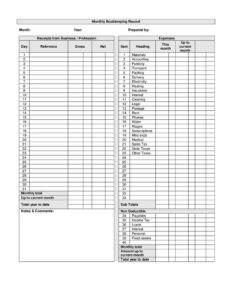
Monthly Bookkeeping Record
Track income and expenses with our free Monthly Bookkeeping Record template—organize receipts, costs, and totals in a free PDF or DOCX download.
PDF
DOCX
3 downloads
0
likes
Download Files
- DOCX
A Monthly Bookkeeping Record is a single-page worksheet that captures every dollar of income and expense your business handles in a calendar month. Most people use it to keep an organized, running tally of receipts and outgoings so tax time and bank reconciliation are far less painful. You can download it free in PDF or DOCX, with no signup required.
What Is a Monthly Bookkeeping Record?
A Monthly Bookkeeping Record is a structured summary that lists, for one month, all money received from your business or profession alongside every category of expense you incurred. It is typically prepared by a business owner, freelancer, or in-house bookkeeper, and it documents gross and net receipts, itemized costs such as rent, wages, and utilities, plus subtotals and a year-to-date roll-up. Unlike a full ledger, this record condenses activity into a readable monthly snapshot. It serves as a working document that feeds your annual accounts, supports your tax return, and gives you a clear, month-by-month picture of cash flow and profitability without specialized accounting software.
When Do You Need a Monthly Bookkeeping Record?
This worksheet earns its keep whenever you need to keep finances tidy without an elaborate system. Common situations include:
- You run a sole proprietorship or small partnership and want a simple way to track income and costs each month.
- You are a freelancer or contractor who needs to separate deductible expenses from non-deductible and personal spending.
- You prepare your own taxes and want categorized totals ready to transfer onto a return.
- You hand records to an accountant and want to reduce billable hours by arriving organized.
- You need to monitor cash flow, spot rising costs, and compare this month against the year-to-date trend.
- You must substantiate expenses for a loan application, grant, or business review and want clean monthly documentation.
What a Monthly Bookkeeping Record Should Have
A complete record begins with identifying details—the month, year, and the name of the person who prepared it—so each sheet stands on its own. It should clearly separate receipts (with gross and net figures) from expenses, and break expenses into recognizable headings such as materials, rent, wages, and utilities. Strong records include subtotals, a monthly total, and an up to current month or year-to-date column so you can see cumulative figures at a glance. Finally, sections for non-deductible items, payables, loans, personal draws, fixed assets, and a notes area round out the picture, ensuring nothing falls through the cracks between months.
How to Fill Out a Monthly Bookkeeping Record
- Enter the month and year at the top, then add prepared by with the name of whoever compiled the figures.
- In the receipts section, record income from your business or profession by day, noting a reference (invoice or receipt number), the gross amount, and the net after any sales tax.
- Move to expenses and log each item under its heading—materials, accounting, publicity, transport, packing, delivery, electricity, heating, insurance, interest, cleaning, legal, postage, rent, phones, water, wages, subscriptions, misc expenses, medical.
- Enter tax-related costs separately: sales tax, state taxes, and other taxes.
- Record each category amount in the this month column and add it to the up to current month running figure.
- Calculate sub totals, the monthly total, and the total year to date.
- List non-deductible spending, payables, income tax, loans, personal withdrawals, and fixed assets.
- Use notes & comments to flag anything unusual for follow-up.
Understanding the Expense Categories
The strength of this template lies in its detailed expense headings, which mirror the real costs most small operations face. Materials covers stock and supplies, while packing and delivery capture fulfillment costs that are easy to overlook. Overhead lines—rent, electricity, heating, water, phones, and cleaning—keep fixed running costs visible month to month. Professional services appear under accounting and legal, and marketing falls under publicity. Separating interest, insurance, and subscriptions helps you see recurring commitments clearly. Keeping wages on its own line is especially important if you employ staff, since payroll often demands additional reporting beyond your bookkeeping summary.
Deductible vs. Non-Deductible and Personal Items
One of the most useful distinctions on this record is the separation of business expenses from non-deductible, personal, and capital items. Money you take out for yourself belongs in the personal column, not in expenses, because it is a draw rather than a cost. Fixed assets—equipment, vehicles, or furniture—are usually recorded separately because they may be depreciated over time rather than expensed in full. Loans and payables reflect financing and obligations rather than operating costs. Keeping these lines clean protects the accuracy of your profit figure and prevents you from accidentally overstating deductions, but tax treatment varies, so confirm categories with a qualified professional.
Common Mistakes to Avoid
- Mixing personal spending into business expense lines, which distorts your true profit and complicates tax filing.
- Forgetting to carry forward the up to current month totals, leaving the year-to-date column inaccurate.
- Recording gross receipts without separating out sales tax, so income looks higher than it really is.
- Leaving the reference field blank, making it hard to trace an entry back to its receipt or invoice.
- Treating fixed asset purchases as ordinary monthly expenses instead of recording them separately.
- Skipping months and trying to reconstruct figures later from memory rather than entering them as they occur.
Frequently Asked Questions
What is a Monthly Bookkeeping Record used for? It is used to summarize one month of business income and expenses in a single, organized worksheet. The record helps you track cash flow, categorize deductible costs, and build a running year-to-date total. Many owners use it to feed their annual accounts or hand clean figures to an accountant.
Is this template free to download? Yes. The Monthly Bookkeeping Record is completely free to download in both PDF and DOCX formats, with no signup or payment required. You can print the PDF to fill in by hand or edit the DOCX version on your computer to suit your business.
How do I fill in the gross and net columns? Enter the full amount received as the gross figure, then record the net amount after subtracting any sales tax you collected on behalf of the tax authority. Keeping these separate ensures your reported income reflects what your business actually earned rather than tax that simply passes through.
What is the difference between deductible and non-deductible items? Deductible expenses are ordinary, necessary costs of running your business that may reduce taxable profit, while non-deductible items are payments that tax rules do not allow you to subtract. Personal draws and certain fixed asset purchases are handled separately. Because rules differ by location and situation, check with a tax professional before classifying anything.
Can I use this instead of accounting software? For a small or simple operation, this worksheet can serve as your primary monthly record, especially when paired with kept receipts and invoices. As your transaction volume grows, you may find software more efficient, but many owners use this template alongside software as a quick monthly summary.
Do I need to keep the supporting receipts? Yes. The record summarizes your figures, but you should retain the underlying invoices, receipts, and bank statements that support each entry. Use the reference field to link entries to those documents, and keep them for as long as your jurisdiction requires for tax purposes.
This template is a general example provided for informational purposes only and does not constitute legal, financial, accounting, or tax advice. Bookkeeping requirements, deductible categories, and record-keeping rules vary by jurisdiction. Consult a qualified accountant or tax professional before relying on this record for tax or financial decisions.
Official resource: for the rules that apply to your situation, see the Consumer Financial Protection Bureau.
Related Forms
- Debit Register Wallet
- Debt Snowball Form
- Household Cash Envelope
- Childrens Allowance Budget
- Profit And Loss Worksheet
- Lump Sum Payment Planning Form
Browse more in Money.