
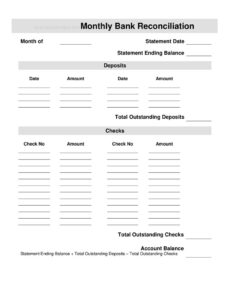
Monthly Bank Reconciliation
Use this free Monthly Bank Reconciliation template to match your bank statement to your books and catch errors fast — free PDF and DOCX download.
PDF
DOCX
13 downloads
0
likes
Download Files
- DOCX
A Monthly Bank Reconciliation is a worksheet that compares your bank statement to your own accounting records so you can confirm every transaction matches and account for anything that hasn’t cleared yet. Businesses and individuals use it most often to verify their true cash balance at month-end and to catch errors, missing deposits, or bank fees before they snowball. You can download this Monthly Bank Reconciliation template free in PDF and DOCX with no signup required.
What Is a Monthly Bank Reconciliation?
A Monthly Bank Reconciliation is a financial control document that reconciles the ending balance on a bank statement with the cash balance recorded in your books for the same period. It is typically prepared by a bookkeeper, accountant, business owner, or treasurer at the close of each month. The form documents the statement ending balance, then adjusts it for outstanding deposits that have not yet posted and outstanding checks that have not yet cleared. The goal is a reconciled figure that should agree with your general ledger or checkbook balance. When the two sides match, you have proof your records are accurate; when they don’t, the form helps you isolate the discrepancy.
When Do You Need a Monthly Bank Reconciliation?
Reconciling is a routine habit for anyone managing a bank account responsibly. Common situations include:
- Closing the books each month for a small business, nonprofit, or sole proprietorship before producing financial statements.
- Verifying cash on hand when your bank balance and accounting software show different numbers.
- Catching bank errors or fraud, such as unauthorized withdrawals, duplicate charges, or checks you didn’t write.
- Tracking outstanding checks that recipients haven’t yet deposited so you don’t overdraw the account.
- Preparing for tax season or an audit, when accurate, documented cash balances are essential.
- Managing multiple accounts across a household or organization where each needs its own monthly check.
What a Monthly Bank Reconciliation Should Have
A complete reconciliation captures three moving parts and ties them together into one balanced figure. At minimum it should include the reconciliation period (the month and statement date), the statement ending balance as printed by the bank, an itemized list of outstanding deposits (deposits in transit), an itemized list of outstanding checks (those issued but not yet cleared), and the final reconciled account balance. Each outstanding item should be listed with a date and amount so the totals can be traced and verified. The clearer the itemization, the easier it is to spot the single transaction causing a mismatch next month.
How to Fill Out a Monthly Bank Reconciliation
- Month of: Enter the calendar month you are reconciling, such as “March 2025.”
- Statement date: Record the closing date printed on the bank statement you are working from.
- Statement ending balance: Copy the ending balance exactly as shown on that statement.
- Deposits / date / amount: List each deposit you recorded that has not yet appeared on the statement, entering the date and amount for each one.
- Total outstanding deposits: Add those amounts together and enter the sum, then add it to the statement ending balance.
- Check no. / amount: List every check you’ve written that hasn’t cleared the bank, recording each check number and its amount.
- Total outstanding checks: Sum the uncleared checks and subtract that total.
- Account balance: Statement ending balance plus outstanding deposits minus outstanding checks equals your reconciled account balance — this should match your books.
How to Read a Reconciliation That Doesn’t Balance
If your reconciled account balance does not match your ledger, work through the gap methodically rather than forcing the numbers. Start by re-checking the statement ending balance for a transposed digit, then confirm each outstanding deposit and check was copied correctly. Look for transactions the bank recorded that you forgot to enter in your books — service fees, interest earned, automatic payments, or returned checks are the usual culprits. Compare the size of your difference to recent transactions; a discrepancy equal to a single check or deposit usually points to one missing or duplicated entry. If the difference is divisible by nine, you likely transposed two digits somewhere. Document any adjustments you make so next month’s starting point is clean.
Tips for Faster, Cleaner Reconciliations
Reconcile on the same day each month, right after the statement closes, so transactions are fresh in memory. Keep prior months’ reconciliations on file — each one’s outstanding items become a checklist for the next period, since a check that was outstanding last month should clear this month. Carry forward stale outstanding checks and follow up on any that remain uncleared for several months, as the payee may have lost or never received them. Finally, store the completed form with the matching bank statement so the supporting documentation always travels together.
Common Mistakes to Avoid
- Using the wrong statement ending balance — always reconcile to the closing balance, not the current available balance shown online.
- Forgetting bank-side entries such as monthly fees, interest, or automatic drafts that need to be recorded in your books.
- Listing a deposit or check twice, which throws off the totals and creates a phantom discrepancy.
- Ignoring old outstanding checks that have lingered for months instead of investigating them.
- Rounding amounts instead of entering exact figures to the cent.
- Skipping months, which compounds errors and makes the eventual cleanup far harder.
Frequently Asked Questions
What is a Monthly Bank Reconciliation? It is a worksheet that compares your bank statement’s ending balance to your own accounting records for the same month. By adjusting for deposits in transit and uncleared checks, it confirms your true cash balance and surfaces any errors or missing transactions.
How do I fill out a bank reconciliation? Enter the month and statement date, copy the statement ending balance, list outstanding deposits and add them, list outstanding checks and subtract them, then record the resulting account balance. That final figure should match your ledger or checkbook balance.
What’s the difference between an outstanding deposit and an outstanding check? An outstanding deposit is money you’ve recorded and deposited that hasn’t yet posted to the bank, so you add it back. An outstanding check is one you’ve written that the recipient hasn’t cashed, so you subtract it because the bank hasn’t yet reduced your balance for it.
What do I do if my reconciliation doesn’t balance? Recheck your math and the figures you copied, then look for bank-side items like fees or interest you forgot to record in your books. A difference equal to one transaction usually means an entry is missing or duplicated; a difference divisible by nine often signals a transposed number.
How often should I reconcile my account? Most businesses and careful individuals reconcile monthly, as soon as each bank statement closes. Reconciling on a consistent schedule keeps errors small and easy to trace, and it ensures your financial records are always current.
Is this Monthly Bank Reconciliation template free? Yes. You can download it free in both PDF and DOCX with no signup required, fill it in by hand or on your computer, and reuse it every month for as many accounts as you manage.
This Monthly Bank Reconciliation template is a general example provided for informational purposes only and is not financial, accounting, or tax advice. Requirements and best practices vary by organization and jurisdiction — consult a qualified accountant or bookkeeper for guidance specific to your situation.
Official resource: for the rules that apply to your situation, see the Consumer Financial Protection Bureau.
Related Forms
- Household Cash Envelope
- Debt Repayment Plan
- Lump Sum Payment Planning Form
- Pocket Discount Calculator
- Irregular Income Plan
- Debt Worksheet
Browse more in Money.