
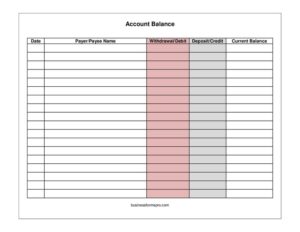
Account Balance
Track deposits, withdrawals, and running totals with our free Account Balance template—download as PDF or DOCX free, no signup needed.
PDF
DOCX
4 downloads
0
likes
Download Files
- DOCX
An Account Balance form is a simple running record that tracks every deposit and withdrawal so you always know how much money is in an account. People most often use it to reconcile a checkbook, monitor a petty cash fund, or keep a clear running total for a personal or small-business account. You can download it free in PDF or DOCX, with no signup required.
What Is an Account Balance Form?
An Account Balance form is a ledger-style document that lists each transaction in date order and calculates a current balance after every entry. It is used by individuals, bookkeepers, treasurers, and small-business owners to document money moving in and out of a single account. Each row captures who the money came from or went to, the amount withdrawn or deposited, and the resulting balance. The purpose is to create a clear, chronological trail that can be compared against bank or institution statements, making it easy to spot errors, missing transactions, or unexpected charges. Because it shows a continuously updated total, the form answers the most important question at a glance: how much is available right now.
When Do You Need an Account Balance Form?
This form is useful any time you need to keep an accurate, ongoing tally of funds. Common situations include:
- Reconciling a checking account against monthly bank statements to confirm every deposit and debit was recorded correctly.
- Managing petty cash in an office, so each small purchase and replenishment is logged and the drawer always balances.
- Tracking a club, team, or HOA treasury where a treasurer must report a current balance to members.
- Monitoring a personal savings goal by recording each contribution and withdrawal toward a target.
- Keeping a simple business ledger for a sole proprietor who does not yet use accounting software.
- Documenting a shared household or roommate fund where multiple people contribute and spend.
What an Account Balance Form Should Have
A complete and useful Account Balance form needs a few core elements working together. First, a date column establishes the chronological order of transactions, which is essential for matching against statements. Second, a payer/payee name field identifies the source or destination of each amount. Third, separate withdrawal/debit and deposit/credit columns keep money out and money in clearly distinct, preventing confusion. Finally, a current balance column shows the cumulative total after each line is applied. Together these create a transparent, self-checking record where any single row can be verified by adding the deposit to or subtracting the withdrawal from the previous balance.
How to Fill Out an Account Balance Form
- Enter the date of the transaction in the date field. Use a consistent format (such as MM/DD/YYYY) throughout so entries sort correctly and match statement dates.
- Record the payer or payee name. For a deposit, write who the money came from; for a withdrawal, write who or what it was paid to (a vendor, person, or purpose).
- Fill in the withdrawal/debit column if money left the account, entering the exact amount. Leave it blank if the transaction was a deposit.
- Fill in the deposit/credit column if money came in, entering the exact amount. Leave it blank for a withdrawal.
- Calculate the current balance by taking the previous balance, adding any deposit, and subtracting any withdrawal. Write the result in the current balance column.
- Repeat for each transaction, working down the page in date order so the running balance stays accurate line by line.
Start the first row with your opening balance so every figure that follows builds on a verified starting point.
Tips for Keeping an Accurate Running Balance
The value of this form comes from its accuracy, so build good habits. Record transactions as soon as they happen rather than relying on memory, since delayed entries are the most common source of mistakes. Double-check each balance calculation before moving on—an error in one row carries forward to every row below it. Keep the form alongside receipts or confirmation slips so you can verify amounts later. If you maintain several accounts, use a separate sheet for each so balances never get mixed. At the end of each month, compare your final balance to the official statement and investigate any difference immediately while the details are still fresh.
Account Balance Form vs. a Bank Statement
It helps to understand how this form differs from a bank statement. A bank statement is issued by your financial institution and reflects only what has cleared on their end, often with a delay. Your Account Balance form, by contrast, is something you maintain in real time, capturing transactions the moment they occur—including checks written but not yet cashed. Because of this timing difference, the two figures may not match exactly on any given day, which is exactly why reconciliation matters. Comparing your form to the statement reveals outstanding items, fees you forgot to record, or transactions that posted incorrectly.
Common Mistakes to Avoid
- Skipping entries—even a single unrecorded debit or deposit throws off every balance that follows it.
- Mixing up the columns by entering a deposit as a withdrawal or vice versa, which doubles the error in the running total.
- Forgetting bank fees, interest, or automatic payments that the institution applies without a prompt from you.
- Doing math in your head instead of carefully adding and subtracting, especially with cents.
- Using inconsistent date formats, which makes it hard to sort transactions or match them to statements.
- Failing to start with the correct opening balance, which makes the entire ledger inaccurate from the first line.
Frequently Asked Questions
What is an Account Balance form used for? It is used to keep a running record of every deposit and withdrawal in an account so you always know the current balance. People use it to reconcile checkbooks, manage petty cash, and track personal or small-business funds. The running total makes it easy to catch errors and confirm available money at any moment.
How do I calculate the current balance? Take the previous balance, add any deposit/credit on that line, and subtract any withdrawal/debit. Write the result in the current balance column, then use it as the starting point for the next transaction. Doing this for every row keeps the balance accurate throughout the sheet.
Is this Account Balance form legally binding? The form itself is a record-keeping tool, not a contract, so it is not legally binding on its own. However, an accurate and consistent ledger can serve as helpful supporting documentation in disputes, audits, or tax preparation. Always keep it alongside receipts and official statements for verification.
Does an Account Balance form need to be notarized? No, this form does not require notarization or witnesses. It is an internal tracking document maintained for your own reference or for reporting to members of a group. Simply keep it accurate and store it securely.
How much does this template cost? It is completely free to download from Business Forms Pro in both PDF and DOCX formats. There is no signup, subscription, or payment required. You can print it or fill it in digitally as often as you need.
Can I use it for more than one account? Yes, but use a separate copy of the form for each account to keep balances clear and avoid mixing transactions. Label each sheet with the account name so you can tell them apart. This makes reconciliation against individual statements much simpler.
This template is a general example provided for informational purposes only and does not constitute legal, financial, accounting, or tax advice. Requirements and best practices vary by situation and jurisdiction—consult a qualified professional for guidance specific to your circumstances.
Official resource: for the rules that apply to your situation, see the Consumer Financial Protection Bureau.
Related Forms
- Profit And Loss Worksheet
- Fun Cash Envelope
- Fixed Expenses Worksheet
- Customer Order Tracker
- Income Sources
- Miscellaneous Cash Envelope
Browse more in Money.