
Balance Sheet
Download a free Balance Sheet template to list assets, liabilities, and equity in one clean statement — free PDF and DOCX download, no signup.
PDF
DOCX
3 downloads
0
likes
Download Files
- DOCX
A balance sheet is a financial statement that summarizes what a business owns, what it owes, and the owners’ stake at a single point in time. The most common reason people use it is to show, in one place, that total assets equal total liabilities plus equity — for lenders, investors, partners, or your own planning. This template is free to download in PDF and DOCX, with no signup required.
What Is a Balance Sheet?
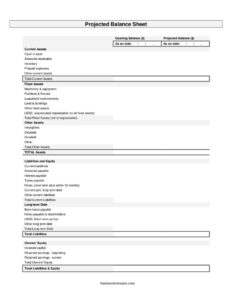
A balance sheet is one of the three core financial statements, alongside the income statement and the cash flow statement. It is typically prepared by a business owner, bookkeeper, or accountant and is built on the fundamental accounting equation: assets equal liabilities plus owners’ equity. Rather than showing activity over a period, it captures a snapshot as of a specific date. This particular template is structured for a project balance sheet, with both an opening balance and a projected balance column, so you can compare where you started against where you expect to end. It documents current assets, fixed assets, other assets, liabilities, and equity in a single organized layout.
When Do You Need a Balance Sheet?
A balance sheet comes up any time someone needs a clear picture of a company’s financial position. Common scenarios include:
- Applying for a loan or line of credit — banks review your assets, liabilities, and equity before approving financing, and the opening versus projected columns help illustrate repayment capacity.
- Pitching to investors or partners — a clean statement shows net worth and how capital is invested in the business.
- Year-end accounting and tax preparation — an accurate balance sheet supports your books and reconciles retained earnings.
- Project budgeting and forecasting — the projected balance column lets you model how a new project changes your financial position.
- Buying, selling, or valuing a business — buyers and appraisers rely on the balance sheet to assess goodwill, intangibles, and accumulated depreciation.
- Internal monitoring — owners track inventory, receivables, and payables over time to spot trends before they become problems.
What a Balance Sheet Should Have
A complete balance sheet always balances: total assets must equal total liabilities and equity. To get there, it needs three clearly separated groups. The asset side lists current assets (cash, receivables, inventory), fixed assets (machinery, buildings, equipment) net of accumulated depreciation, and other assets such as intangibles and goodwill. The liability side separates current liabilities due within twelve months from long-term debt. The equity section captures invested capital and retained earnings. Each subtotal — total current assets, total fixed assets, total current liabilities, total long-term debt, and total owners’ equity — should be visible so the reader can trace how the bottom line was reached. A clear statement date is essential.
How to Fill Out a Balance Sheet
- Enter the opening balance column with current figures, and use the projected balance column for your forecast or post-project estimate.
- Under current assets, record cash in bank, accounts receivable, inventory, prepaid expenses, and other current assets, then add them into total current assets.
- List fixed assets: machinery & equipment, furniture & fixtures, leasehold improvements, land & buildings, and other fixed assets. Subtract accumulated depreciation to reach total fixed assets.
- Add other assets — intangibles, deposits, goodwill, and other — to get total other assets, then sum all three groups for total assets.
- Record current liabilities: accounts payable, interest payable, taxes payable, short-term notes, the current part of long-term debt, and other items, totaling total current liabilities.
- Enter bank loans payable, notes payable to stockholders, and other long-term debt, less the short-term portion, for total long-term debt.
- Under owners’ equity, list invested capital, retained earnings – beginning, and retained earnings – current to reach total owners’ equity. Confirm total liabilities & equity matches total assets.
Understanding the Two Sides
The reason it’s called a balance sheet is that the two halves must mirror each other. Everything the business owns (assets) was financed either by borrowing (liabilities) or by the owners (equity). If the two totals don’t match, an entry has been omitted, double-counted, or miscategorized. A frequent source of imbalance is depreciation — remember this template subtracts accumulated depreciation from gross fixed assets, so enter that figure as a reduction, not as a positive value. Likewise, the current part of long-term debt should appear under current liabilities while the remainder sits under long-term debt, and the short-term portion is then deducted from the long-term total to avoid counting it twice.
Using the Projected Column
Because this is a project balance sheet, the projected column turns a static statement into a planning tool. Use it to model the impact of a decision: a new equipment purchase increases machinery and fixed assets but may also add to notes payable; a strong sales quarter raises cash and current retained earnings. Comparing the opening and projected balances side by side helps you and any lender see whether the project strengthens or weakens your financial position before money is committed.
Common Mistakes to Avoid
- Forgetting the statement date — a balance sheet is only meaningful as of a specific point in time.
- Entering depreciation as a positive number — it must reduce total fixed assets, not add to them.
- Double-counting debt — the current portion of long-term debt belongs in current liabilities and must be removed from the long-term total.
- Mixing personal and business figures — only include accounts that belong to the entity.
- Skipping subtotals — leaving out total current assets or total liabilities makes the statement hard to verify.
- Not reconciling retained earnings — beginning plus current retained earnings should tie back to your income statement.
Frequently Asked Questions
What is a balance sheet used for? It shows a business’s financial position at a single date by listing assets, liabilities, and owners’ equity. Lenders, investors, and owners use it to judge solvency, net worth, and how a business is financed.
How do I make sure my balance sheet balances? Total assets must equal total liabilities plus owners’ equity. If they differ, check for an omitted entry, depreciation recorded incorrectly, or debt counted in both the current and long-term sections.
What is the difference between a balance sheet and an income statement? A balance sheet is a snapshot of what you own and owe on one date, while an income statement reports revenue and expenses over a period. The current retained earnings line connects the two statements.
Does a balance sheet need to be notarized or signed? No notarization is required. Some lenders or investors may ask the owner or an accountant to sign or certify it, but it is primarily an internal and financial reporting document.
What does the projected balance column mean? It lets you forecast your financial position after a planned project or period, alongside the current opening balance. This makes it easy to compare where you are now with where you expect to be.
How much does this balance sheet template cost? It is completely free to download here in both PDF and DOCX formats, with no signup required. You can edit the DOCX version in your word processor or print the PDF to fill in by hand.
This balance sheet template is a general example provided for informational purposes only and is not legal, financial, accounting, or tax advice. Reporting standards and requirements vary by jurisdiction and situation — consult a qualified accountant or financial professional before relying on it for lending, tax, or business decisions.
Official resource: for the rules that apply to your situation, see the Consumer Financial Protection Bureau.
Related Forms
- Open Orders Tracker
- Brokerage Accounts Ledger
- Insurance Coverage Record
- Saving Cash Envelope
- Accounts Receivable Ledger
- Tax Records
Browse more in Money.