
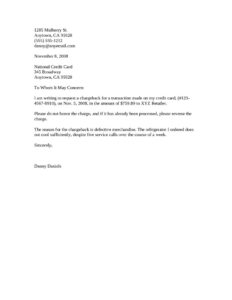
Request Credit Card Chargeback
Download a free Request Credit Card Chargeback letter template to dispute a charge with your card issuer — free PDF and DOCX download, no signup needed.
DOCX
0
likes
Download Files
- DOCX
A Request Credit Card Chargeback letter is a written notice you send to your credit card issuer asking them to reverse a specific charge — most often because the merchandise was defective, never delivered, or fraudulently billed. It creates a dated paper trail of your dispute and triggers the issuer’s formal review process. You can download this template free in PDF and DOCX, with no signup required.
What Is a Request Credit Card Chargeback Letter?
A Request Credit Card Chargeback letter is a formal communication from a cardholder to their credit card company asking that a disputed transaction be reversed or not honored. It is issued by the consumer and directed to the bank or card network that processed the charge. The letter documents the exact transaction in question — the date, amount, merchant, and card number — and states a clear reason for the dispute. While a phone call can start a dispute, a written request like this one protects you by establishing a permanent, time-stamped record. It is one of the simplest yet most important tools a consumer has when a purchase goes wrong and the merchant refuses to resolve the problem.
When Do You Need a Request Credit Card Chargeback Letter?
People reach for this letter whenever a card transaction needs to be formally disputed. Common scenarios include:
- Defective merchandise — like the refrigerator in the sample that won’t cool despite repeated service calls.
- Goods never delivered — you paid for an item or service that never arrived.
- Unauthorized or fraudulent charges — a transaction you did not make or authorize appears on your statement.
- Billed the wrong amount — the merchant charged more than the agreed price or double-billed you.
- Canceled subscriptions still charging — recurring fees continue after you canceled.
- Refund never issued — the merchant promised a credit that never posted to your account.
In each case, a written letter signals that you intend to pursue the dispute seriously and want the issuer to investigate.
What a Chargeback Request Should Have
A complete and persuasive chargeback letter contains a handful of essential elements. Leaving any out can slow the review or weaken your case:
- Your full name, mailing address, phone number, and email.
- The date of the letter.
- The card issuer’s name and address.
- The credit card number (or last four digits, depending on the issuer’s preference).
- The transaction date, the exact dollar amount, and the merchant’s name.
- A clear, specific reason for the chargeback.
- A direct request that the charge be reversed or not honored.
- Your signature.
How to Fill Out a Request Credit Card Chargeback Letter
- Add your contact block. At the top, enter your name and address (e.g., 1285 Mulberry St., Anytown, CA 95928), along with your phone number and email so the issuer can reach you.
- Date the letter. Use the date you are sending it; this anchors the dispute timeline.
- Address the card issuer. Write the issuer’s name and address — for example, National Credit Card, 345 Broadway, Anytown, CA 95928 — followed by a salutation such as “To Whom It May Concern.”
- State your request. Open by saying you are requesting a chargeback for a transaction on your card, and include the card number (e.g., #123-4567-8910).
- Identify the charge. Specify the transaction date (Nov. 5, 2008), the amount ($759.89), and the merchant (XYZ Retailer).
- Make the ask explicit. Request that they not honor the charge and reverse it if already processed.
- Explain the reason. Describe the problem in detail — defective merchandise, the refrigerator that won’t cool despite five service calls.
- Sign and send. Close with “Sincerely,” your signature, and your printed name.
Tips for a Stronger Dispute
The most successful chargeback requests are specific and well-documented. Reference any prior contact you had with the merchant — in the sample, the five service calls over a week show a good-faith effort to resolve the issue directly before escalating. Attach copies (never originals) of receipts, order confirmations, emails, warranty documents, and service records. Keep your tone factual and unemotional; you are presenting evidence, not venting. Send the letter promptly, because card networks and consumer protections generally impose time limits for filing disputes. Mailing it with tracking or delivery confirmation, and keeping a copy for your files, gives you proof of when the issuer received your request.
Chargeback vs. Refund: Know the Difference
A refund is voluntary — you ask the merchant directly, and they return your money. A chargeback is involuntary from the merchant’s perspective: you ask your card issuer to forcibly reverse the funds, and the issuer pulls the money back from the merchant after reviewing your claim. Because chargebacks involve the bank and card network, they are usually a last resort after a merchant has refused or failed to make things right. This letter is the formal way to begin that process, and it works best when you can show you already tried to resolve the issue with the seller.
Common Mistakes to Avoid
- Omitting the transaction details — without the exact date, amount, and merchant, the issuer cannot locate the charge.
- Being vague about the reason — “I’m unhappy” is far weaker than “the refrigerator does not cool despite five service calls.”
- Waiting too long — dispute windows are limited, so send the letter quickly.
- Skipping the merchant first — issuers expect you to have attempted resolution with the seller.
- Sending originals — always keep your receipts and records; include copies only.
- Forgetting to sign — an unsigned letter may be treated as incomplete or ignored.
Frequently Asked Questions
What is a credit card chargeback? A chargeback is the reversal of a credit card transaction initiated by the cardholder’s bank. You request it when a purchase was defective, undelivered, unauthorized, or otherwise problematic, and the bank investigates before deciding whether to return your money.
How do I fill out this chargeback request letter? Enter your contact information, the date, and the issuer’s name and address, then identify the disputed charge by date, amount, and merchant. Clearly state that you want the charge reversed, explain the reason in detail, and sign it. The template provides a tested structure so you only fill in your own specifics.
Does this letter need to be notarized or witnessed? No. A chargeback request to your card issuer does not require notarization or witnesses. Your signature and accurate transaction details are what matter; the issuer verifies the dispute through its own investigation.
Is a chargeback the same as a refund? No. A refund comes voluntarily from the merchant, while a chargeback is forced by your bank reversing the funds. A chargeback is generally appropriate after the merchant has refused or failed to resolve the issue directly.
Is there a deadline to request a chargeback? Yes, time limits apply and vary by card network and issuer, though disputes are often filed within a set number of days of the statement or transaction. Because the exact window differs, send your letter as soon as the problem becomes clear and check your issuer’s rules.
How much does this template cost? Nothing. This Request Credit Card Chargeback letter template is completely free to download in both PDF and DOCX formats, with no signup or account required.
This template is a general example provided for informational purposes only and is not legal, financial, or consumer-protection advice. Chargeback rules, dispute deadlines, and consumer rights vary by card issuer, network, and jurisdiction. For guidance on your specific situation, consult your card issuer’s dispute procedures or a qualified professional.
Official resource: for the rules that apply to your situation, see the Consumer Financial Protection Bureau.
Related Forms
- Brokerage Accounts Ledger
- Investment Record
- Personal Care Envelope
- List of Accounts
- Utilities Tracker
- Charity Tax Deduction Log
Browse more in Money.