
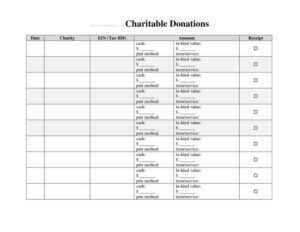
Charity Tax Deduction Log
Track every donation accurately with a free Charity Tax Deduction Log template, an easy PDF and DOCX download to organize gifts for tax season.
PDF
DOCX
0
likes
Download Files
- DOCX
A Charity Tax Deduction Log is a simple record-keeping sheet you use to track every charitable donation you make during the year so you can claim accurate deductions at tax time. Most people reach for one because scattered receipts, online confirmations, and cash gifts are nearly impossible to reconstruct in April. This free Charity Tax Deduction Log is available to download instantly in PDF and DOCX, with no signup required.
What Is a Charity Tax Deduction Log?
A Charity Tax Deduction Log is a running ledger that documents the charitable contributions an individual or business makes over a tax year. It is used by anyone who itemizes deductions — donors, freelancers, small-business owners, and households — to capture the date, recipient organization, amount or value, and supporting documentation for each gift. The log itself is not filed with your return; instead, it is a personal organizing tool that backs up the totals you report and supports those figures if a tax authority ever asks for proof. By recording donations as they happen, you avoid the year-end scramble and reduce the risk of forgetting eligible gifts or overstating what you actually gave.
When Do You Need a Charity Tax Deduction Log?
A log becomes valuable the moment you start giving with the intention of claiming a deduction. Common situations include:
- You make regular cash or check donations to a place of worship, food bank, or community group and want a single running total.
- You donate clothing, furniture, or household goods to a thrift store and need to record their fair market value and condition.
- You give online through multiple platforms and want to consolidate confirmation emails into one place.
- You drive your personal vehicle for volunteer work and want to log charitable mileage.
- You run a small business or sole proprietorship that supports nonprofits and needs clean records for your accountant.
- You make a large one-time gift and want to attach the acknowledgment letter and appraisal details to a clear summary line.
What a Charity Tax Deduction Log Should Have
An effective log captures everything you would need to substantiate a deduction without digging through email. Each entry should identify the date of the donation, the name of the charitable organization, the type of gift (cash, check, card, goods, or mileage), and the amount or estimated fair market value. It should also note the form of receipt or acknowledgment you received, whether the organization is a qualified tax-exempt entity, and any description needed for non-cash items such as quantity and condition. A running year-to-date total and space for notes round out a log that stays useful from January through filing season.
How to Fill Out a Charity Tax Deduction Log
- Enter the donation date. Record the day the gift was made or the payment cleared so entries stay in chronological order.
- Write the organization name. Use the charity’s full legal name as it appears on receipts, and add its tax-exempt status or EIN if you have it.
- Select the donation type. Note whether the gift was cash, check, credit card, in-kind goods, securities, or charitable mileage.
- Record the amount or value. For money, enter the exact figure. For goods, estimate fair market value and briefly describe the items and their condition.
- Document the proof. Indicate the receipt, bank record, or written acknowledgment you have, and file the supporting document with your records.
- Add notes. Capture anything relevant — an event, a matching gift, or a benefit you received in return that may reduce the deductible amount.
- Update the running total. Add each entry to your year-to-date sum so you always know where you stand.
Cash vs. Non-Cash Donations
The log handles both, but each type carries different documentation expectations. Cash, check, and card gifts are generally straightforward: a bank statement, canceled check, or written acknowledgment from the charity supports the amount, and larger single gifts usually require a written statement from the organization. Non-cash donations — clothing, furniture, electronics, or vehicles — require you to estimate fair market value, which is typically what the item would sell for in its current condition, not what you originally paid. Larger non-cash gifts often have heightened substantiation rules, and very high-value items may call for an independent appraisal. Use the notes column to flag any donation where you received something in return, since the deductible portion is reduced by the value of that benefit.
Tips for Staying Audit-Ready
Treat the log as a habit rather than a year-end project. Fill in each entry the same week you donate, while the details are fresh, and keep digital and paper acknowledgments in a labeled folder that matches the log. Photograph donated goods before you drop them off so you have visual evidence of quantity and condition. Reconcile the log against your bank and card statements quarterly to catch missed gifts. Finally, retain your completed log and supporting documents for the period required in your jurisdiction — many people keep records for several years after filing in case questions arise.
Common Mistakes to Avoid
- Relying on memory. Donations forgotten by April are deductions lost; log them as they happen.
- Skipping receipts. An amount with no supporting document is hard to defend, especially for larger gifts.
- Overstating goods value. Estimate fair market value honestly rather than original purchase price.
- Logging gifts to non-qualified groups. Donations to individuals, political campaigns, or non-exempt organizations are generally not deductible.
- Ignoring benefits received. If you got a dinner, merchandise, or tickets, only the portion above that value may be deductible.
- Failing to keep the log with your tax files. Store it alongside the year’s return so it is easy to find.
Frequently Asked Questions
What is a Charity Tax Deduction Log? It is a personal record sheet that tracks each charitable donation you make during the year, including the date, organization, type of gift, and amount. It helps you total your contributions accurately and keep proof in one place for tax season.
How do I fill out a Charity Tax Deduction Log? Add one row per donation with the date, charity name, donation type, amount or fair market value, and the receipt you received. Update the running total as you go and store supporting documents alongside the log.
Is this log filed with my tax return? No. The log is a private organizing tool that supports the deduction totals you report. You keep it with your records and produce it only if a tax authority requests substantiation.
Do I need receipts if I keep a log? Yes, the log works best when paired with receipts or written acknowledgments. The entries summarize your giving, but the underlying documents are what substantiate the deduction, particularly for larger gifts.
Can I include donated goods and not just cash? Absolutely. The log accommodates in-kind donations like clothing and furniture — record a description, condition, and a reasonable estimate of fair market value, and note any appraisal for high-value items.
How much does this template cost? Nothing. The Charity Tax Deduction Log is a free download available in both PDF and DOCX formats with no signup required, so you can start tracking donations right away.
This template is a general example provided for informational purposes only and is not legal, financial, or tax advice. Tax rules and recordkeeping requirements vary by jurisdiction and change over time — consult a qualified tax professional or accountant about your specific situation before claiming any deduction.
Official resource: for the rules that apply to your situation, see the Consumer Financial Protection Bureau.
Related Forms
- Miscellaneous Cash Envelope
- Profit And Loss Worksheet
- Home Business Worksheet
- Account Reconciliation Form
- Loan Deferral Request
- Quarterly Tax Payment Worksheet
Browse more in Money.