
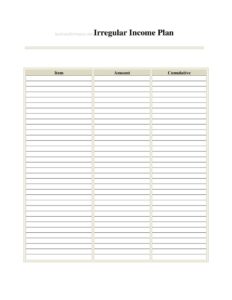
Irregular Income Plan
Use this free Irregular Income Plan template to prioritize expenses and budget on a variable income with confidence — free PDF and DOCX download.
PDF
DOCX
1 downloads
0
likes
Download Files
- DOCX
An Irregular Income Plan is a budgeting worksheet that helps you allocate money in priority order when your earnings change from month to month. People most often use it to make sure essential bills get paid first during a lean month — and it’s free to download here in both PDF and DOCX with no signup required.
What Is an Irregular Income Plan?
An Irregular Income Plan is a simple money-management tool built for anyone whose paycheck isn’t the same every period — freelancers, commission-based salespeople, gig workers, seasonal employees, small-business owners, and tipped workers. Instead of assuming a fixed monthly salary, the plan ranks your expenses from most important to least important, then funds each item in that order as money actually comes in. It documents what you expect to earn, what you must spend, and what gets deferred when income falls short. The goal is straightforward: cover survival needs first, then build cushion and progress toward goals. It turns an unpredictable cash flow into a clear, repeatable decision-making process you can revisit every time you get paid.
When Do You Need an Irregular Income Plan?
This worksheet earns its keep any time your income arrives unevenly and you need a calm way to decide what gets paid first. Common situations include:
- Freelance or contract work where invoices are paid on different schedules and some clients pay late.
- Commission or bonus-based jobs in which a big check one month is followed by a thin one the next.
- Gig and rideshare driving with daily or weekly deposits that swing with demand and season.
- Self-employment and small business where personal pay depends on what the business cleared that month.
- Seasonal employment — landscaping, retail, tourism, tax preparation — with busy stretches and slow ones.
- Tipped service work like serving or bartending, where nightly totals vary widely.
If you have ever stared at a bank balance wondering which bill to pay first, an Irregular Income Plan gives you a pre-decided answer so you don’t have to improvise under pressure.
What an Irregular Income Plan Should Have
A complete plan has a few core parts. First, an expected income figure — a conservative estimate of what you’ll bring in this period. Second, a prioritized expense list ordered from most to least critical, so the must-haves always come before the nice-to-haves. Third, a planned amount for each line so you know how much to set aside. Fourth, a running total or remaining-balance column that shows how far your money stretches as you fund each item. Finally, space for actual amounts so you can compare your plan against reality and adjust next month. Together these elements turn a vague worry into a concrete, prioritized spending map.
How to Fill Out an Irregular Income Plan
- Estimate your income. Write down a realistic, conservative figure for what you expect to receive this period — when income is uncertain, lean low so you’re never overcommitted.
- List every expense. Brain-dump everything you might need to pay: housing, utilities, food, transportation, insurance, debt, savings, and discretionary items.
- Rank by priority. Number the list from 1 (most essential — shelter, food, power, transportation to work) down to the least urgent wants. This order decides what gets funded first.
- Assign a planned amount. Enter the dollar figure you intend to give each line item, starting at the top of your ranking.
- Subtract as you go. Use the running-total column to deduct each planned amount from your expected income, watching the remaining balance shrink toward zero.
- Stop where the money stops. Whatever falls below the line you can fund this period gets deferred to next time or covered when more income arrives.
- Record actuals. When the period ends, note what you actually earned and spent so future plans get more accurate.
How to Prioritize Your Expenses
The heart of the plan is the ranking, and a reliable order keeps you safe during lean weeks. Most people put the “Four Walls” first: food, basic utilities, shelter (rent or mortgage), and transportation — because these keep you fed, housed, and able to keep earning. Next come obligations that protect you if skipped, like essential insurance and minimum debt payments. After that, fund savings or an emergency buffer, which is what eventually smooths out the income swings. Finally, place discretionary spending — dining out, subscriptions, entertainment — at the bottom, where it can be trimmed without disaster. When income is strong, you fund all the way down the list and pad savings; when it’s weak, you simply stop partway and the bottom items wait.
Using the Plan Month After Month
An Irregular Income Plan works best as a habit, not a one-time exercise. Build a small buffer account in good months so a slow month can borrow from a strong one — many people aim to eventually live on last month’s income, which removes the guesswork entirely. Keep separate categories for taxes if you’re self-employed, since no employer is withholding for you; setting aside a percentage of each deposit prevents a painful surprise. Revisit your priority order whenever life changes — a new lease, a paid-off debt, or a new client. Over time, comparing your planned amounts to your actual results reveals your true average income and your real fixed costs, which makes every future plan tighter and less stressful.
Common Mistakes to Avoid
- Overestimating income. Hoping for a big month and budgeting for it leads to overspending; always plan with a conservative figure.
- Skipping the priority ranking. Without a clear order, you’ll fund whatever bill shouts loudest instead of what matters most.
- Forgetting taxes. Self-employed and gig workers who don’t set aside tax money can face a serious shortfall later.
- No savings line. Leaving out an emergency buffer means every slow month becomes a crisis instead of a manageable dip.
- Never recording actuals. If you don’t track what really happened, you can’t sharpen next month’s estimates.
- Treating it as fixed. The plan should be redone each time you get paid, not written once and forgotten.
Frequently Asked Questions
What is an Irregular Income Plan? It’s a budgeting worksheet for people whose income varies, listing expenses from most to least important and funding them in that order as money arrives. It ensures essentials get paid first and discretionary spending waits until there’s enough to cover it.
How is it different from a normal budget? A traditional budget assumes a steady paycheck and assigns a fixed amount to every category. An Irregular Income Plan instead prioritizes expenses so that when income is uncertain, you always know exactly which bills to cover first and which to defer.
How do I estimate income when it changes every month? Use a conservative figure based on your slower months rather than your best ones, and adjust as actual deposits land. Tracking your real earnings over several months gives you a dependable average to plan around.
Should self-employed workers set aside taxes in this plan? Yes — because no employer withholds taxes for you, it’s wise to reserve a percentage of each payment in your priority list. Treating taxes as a top-tier obligation prevents a large unexpected bill.
Is this template legally binding? No, it’s a personal planning tool, not a contract or legal document. It simply helps you organize your own spending decisions and carries no legal obligations to anyone else.
How much does this template cost? Nothing — you can download the Irregular Income Plan free from Business Forms Pro in both PDF and DOCX formats, with no signup required. Edit it digitally or print it and fill it in by hand.
This Irregular Income Plan template is a general example provided for informational purposes only and is not financial, tax, or legal advice. Budgeting needs and tax obligations vary by individual situation and jurisdiction — consult a qualified financial or tax professional for guidance specific to your circumstances.
Official resource: for the rules that apply to your situation, see the Consumer Financial Protection Bureau.
Related Forms
- Truth In Lending Statement
- Zero-Based Budget
- Home Business Worksheet
- Debt Payment Organizer
- Insurance Worksheet
- Cash Receipts
Browse more in Money.