
Customer Credit Analysis
Evaluate a customer's creditworthiness with our free Customer Credit Analysis form template, available as a free download in PDF and DOCX.
PDF
DOCX
6 downloads
0
likes
Download Files
- DOCX
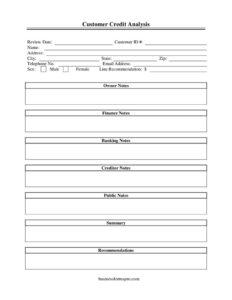
A Customer Credit Analysis form is a structured worksheet a business uses to evaluate whether to extend credit to a customer and how much. Companies most often reach for it when a new client requests payment terms or an existing account asks for a higher credit line, and it gives staff one place to record findings and a recommendation. It’s free to download in both PDF and DOCX, with no signup required.
What Is a Customer Credit Analysis?
A Customer Credit Analysis is an internal document used by credit managers, owners, and finance teams to assess a customer’s ability and willingness to pay before granting trade credit. It pulls together identifying details, banking and creditor references, financial observations, and the reviewer’s professional judgment into a single summary. Rather than approving accounts based on a gut feeling, the form documents the reasoning behind a decision so it can be referenced later, defended if questioned, and updated at the next review. It typically ends with a clear line recommendation — the dollar amount of credit the business is comfortable extending — supported by notes that explain how that figure was reached.
When Do You Need a Customer Credit Analysis?
- A new customer applies for net-30 or net-60 terms instead of paying upfront, and you need to decide whether to approve them.
- An existing account requests a higher credit limit to support growing orders.
- A customer’s payment behavior has changed and you want to reassess their standing before shipping more product.
- You’re onboarding a wholesale or B2B client and your policy requires a documented credit review.
- An annual or periodic re-evaluation of all active accounts is due and each needs a recorded review date.
- A sales rep is pushing to close a large deal on terms and finance wants a formal recommendation on file first.
What a Customer Credit Analysis Should Have
A useful credit analysis captures both the hard facts and the interpretation behind the decision. At minimum it should identify the customer clearly, record where reference information came from, and conclude with an actionable recommendation. The strongest versions separate raw notes (banking, creditor, finance) from the reviewer’s conclusions so anyone reading later can see the evidence and the judgment side by side. Key elements include the customer’s contact and identification details, a dated review, structured notes covering banking and creditor references, a written summary of the customer’s financial position, a recommended credit line, and space for general and owner-level recommendations. A consistent layout makes it easy to compare accounts and to spot accounts that need re-review.
How to Fill Out a Customer Credit Analysis
- Enter the customer’s Name and assign a Customer ID # so the analysis ties back to your records.
- Complete the contact block: Address, City, State, Zip, Telephone No., and Email Address. Add the Sex field only if your records require it.
- Record the Review Date so you know when the analysis was performed and when the next review is due.
- Document references in the dedicated note areas: Banking Notes for account standing and bank references, Creditor Notes for trade reference feedback, and Finance Notes for credit-bureau or financial-statement observations.
- Write the Summary — a concise narrative of the customer’s overall creditworthiness based on the notes above.
- Enter your Line Recommendation (the dollar credit limit you suggest) and expand on it in Recommendations.
- Add Owner Notes for management sign-off and Public Notes for any comment that can be shared more broadly.
Reading the Reference Notes Effectively
The note fields are where the analysis earns its value, so resist the urge to leave them blank or vague. Banking Notes should capture how long the customer has banked with their institution and whether balances support the requested line. Creditor Notes are best filled with specifics from trade references — high credit extended, average days to pay, and whether terms are met. Finance Notes can hold observations from financial statements or a credit report, such as outstanding obligations or recent trends. Keeping these three buckets distinct means a later reviewer can quickly see which area of the customer’s profile is strong and which raised a flag, rather than untangling everything from one block of text.
Turning the Analysis Into a Decision
A credit analysis is only useful if it leads to a clear, defensible outcome. The Summary and Line Recommendation should align: if your notes describe slow payments or thin banking references, the recommended line should reflect that caution. Many businesses use the Recommendations field to set conditions — for example, suggesting a lower starting limit with a review after several on-time payments, or requiring a personal guarantee. The Owner Notes field gives leadership a place to approve, modify, or override the recommendation, creating a clean approval trail. Storing completed analyses lets you compare a customer’s profile over time and adjust limits as their history with you grows.
Common Mistakes to Avoid
- Leaving the note fields blank or writing only “approved” — the value is in the documented reasoning behind the decision.
- Skipping the Review Date, which makes it impossible to know whether the analysis is current.
- Recommending a credit line that doesn’t match the cautions raised in the summary.
- Forgetting to assign or reuse a consistent Customer ID #, leading to duplicate or orphaned records.
- Mixing banking, creditor, and finance observations into one field instead of keeping them organized.
- Failing to route the completed form to an owner or manager for sign-off before extending credit.
Frequently Asked Questions
What is a Customer Credit Analysis used for? It is used to evaluate whether to extend trade credit to a customer and how much credit is appropriate. The form gathers identifying details, reference notes, and a written summary, then concludes with a recommended credit line. It documents the reasoning so the decision can be reviewed and justified later.
How do I fill out a Customer Credit Analysis form? Start with the customer’s name, ID, and contact details, then record the review date. Complete the banking, creditor, and finance note sections with reference findings, write a summary, and finish with your line recommendation and recommendations. Add owner notes for management approval before the credit is extended.
Is a Customer Credit Analysis a legally binding document? No, it is an internal evaluation tool rather than a contract. It records your assessment and recommendation but does not by itself create a binding credit agreement. The actual terms a customer agrees to are usually set out in a separate credit application or sales agreement.
Does this form need to be notarized or witnessed? No. A Customer Credit Analysis is an internal worksheet, so it does not require notarization or witnesses. It generally only needs sign-off from the credit manager or owner who approves the recommended line.
How often should I review a customer’s credit? Many businesses review active accounts at least annually, and sooner if a customer requests a higher limit or shows signs of slow payment. The review date field helps you track when the last analysis was done. Setting a regular cadence keeps your credit limits aligned with current information.
How much does this template cost? It is completely free to download from Business Forms Pro in both PDF and DOCX formats, with no signup required. You can edit the DOCX version to match your company’s credit policy and fields. Use it as often as you need across all of your customer accounts.
This template is provided as a general example for informational purposes only and is not legal, financial, or tax advice. Credit-granting practices and related disclosure or recordkeeping requirements vary by jurisdiction and industry. Consult a qualified professional before making credit decisions or relying on this form.
Official resource: for the rules that apply to your situation, see the Consumer Financial Protection Bureau.
Related Forms
- Savings Passbook
- Date Night Cash Envelope
- Employee Sales Commission Tracker
- Credit Change Notice
- Full Page Check Register
- Emergency Cash Envelope
Browse more in Money.