
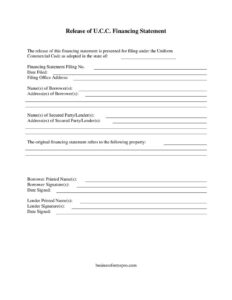
Release Of UCC Financing Statement
Download a free Release of UCC Financing Statement template to terminate a lender's security interest and clear collateral, available in PDF and DOCX.
PDF
DOCX
10 downloads
0
likes
Download Files
- DOCX
A Release of UCC Financing Statement is a document a secured party files to formally end a previously recorded lien on a borrower’s property under the Uniform Commercial Code. People most often use it once a loan is paid off, so the collateral is officially cleared of any claim. You can download this template free in PDF and DOCX formats, with no signup required.
What Is a Release of UCC Financing Statement?
A Release of UCC Financing Statement is a written instrument that cancels, or partially cancels, the public notice of a lender’s security interest in a borrower’s collateral. When a lender finances a purchase or extends credit secured by property, they typically file a UCC-1 financing statement with a state filing office to put the world on notice of their claim. Once the underlying obligation is satisfied, the secured party issues this release to remove that encumbrance. It identifies the original filing, the parties involved, and the property covered, and it confirms that the lender no longer asserts an interest in the collateral described.
When Do You Need a Release of UCC Financing Statement?
This document comes into play whenever a recorded UCC lien needs to be cleared or modified. Common situations include:
- Loan payoff: A business or individual has fully repaid a secured loan and wants the lien removed from the public record.
- Equipment financing completion: Machinery, vehicles, or inventory that secured the debt is now owned free and clear.
- Sale of a business: A buyer requires clean title to assets and wants any existing UCC filings released before closing.
- Refinancing: An old lender releases its interest so a new lender can take a first-priority position.
- Erroneous or expired filing: A financing statement was filed in error, against the wrong party, or covers property the lender no longer claims.
- Partial release: A lender frees a specific piece of collateral while keeping its interest in the rest.
What a Release of UCC Financing Statement Should Have
To be effective, the release must clearly tie back to the original filing it is intended to cancel. A complete release identifies the state whose UCC rules govern the filing, the original financing statement’s filing number and date, and the filing office where it was recorded. It must name both the borrower (debtor) and the secured party (lender), with current addresses, and describe the property or collateral the original statement covered. Finally, it needs printed names, dated signatures, and authority to act. Without an accurate reference to the original filing number, the filing office may be unable to match the release to the correct record, leaving the lien in place.
How to Fill Out a Release of UCC Financing Statement
- State of adoption: Enter the state under whose Uniform Commercial Code the financing statement was originally filed.
- Financing Statement Filing No.: Copy the exact filing or document number assigned when the original UCC-1 was recorded.
- Date Filed: Provide the date the original financing statement was filed.
- Filing Office Address: List the office (often the Secretary of State or a county recorder) where the original was recorded.
- Name(s) and Address(es) of Borrower(s): Enter the debtor’s legal name and current address exactly as on the original filing.
- Name(s) and Address(es) of Secured Party/Lender(s): Enter the lender’s legal name and address as the party releasing the interest.
- Property description: Describe the collateral the original financing statement referenced so the release matches it.
- Borrower printed name, signature, and date signed: Have the borrower complete this block where required.
- Lender printed name, signature, and date signed: The secured party signs and dates to authorize the release.
Filing the Release With the Right Office
A release generally has practical effect only once it is filed with the same office that recorded the original financing statement. Many states require releases to be submitted on the official UCC termination form (commonly the UCC-3) rather than a free-form document, so this template is most useful as a record of the transaction, a payoff acknowledgment, or a starting point you adapt to your state’s required form. Confirm whether your filing office accepts a typed release, requires its standardized form, or allows electronic submission. Keep proof of filing and the stamped confirmation for your records, since these documents demonstrate the lien was cleared.
Release Versus Termination Versus Amendment
It helps to understand related concepts. A termination statement fully ends the effectiveness of a financing statement. A partial release or amendment removes only certain collateral or updates information while leaving the rest of the filing intact. This document functions as a release of the secured party’s interest; depending on your jurisdiction, the same goal may be accomplished through a termination filing. Borrowers who have paid off a debt are often entitled by law to demand that the lender file a termination within a set period, and lenders who fail to do so can face penalties. Always check the specific rules in the governing state.
Common Mistakes to Avoid
- Wrong or missing filing number: An incorrect reference number means the office cannot match the release to the original lien.
- Mismatched names: Using a name that differs from the original filing can prevent the release from taking effect.
- Vague collateral description: Describe the property the way the original statement did, especially for a partial release.
- Filing with the wrong office: A release sent to the wrong jurisdiction or office leaves the public record unchanged.
- Skipping the official state form: Many states require a specific UCC termination form; relying on a generic document alone may be rejected.
- No proof of recording: Failing to keep the filed, stamped copy makes it hard to prove the lien was cleared later.
Frequently Asked Questions
What is a Release of UCC Financing Statement used for? It is used to cancel or remove a lender’s recorded security interest in a borrower’s collateral, usually after the secured debt has been paid in full. Filing it clears the public record so the borrower’s property is no longer shown as encumbered. This is important when selling assets, refinancing, or simply confirming a loan is closed.
Who signs the release, the borrower or the lender? The secured party (lender) is the one releasing the interest, so the lender’s signature is the operative one. This template also includes a borrower signature block, which can document mutual acknowledgment of the payoff. In most jurisdictions, the lender or its authorized representative must authorize the termination.
Do I need to file this with a government office? Yes, a release typically takes effect only when filed with the same office that recorded the original financing statement, such as the Secretary of State. Many states require their official UCC termination form. Always confirm your state’s filing rules and accepted formats before submitting.
Does a Release of UCC Financing Statement need to be notarized? Most UCC filings do not require notarization, but requirements vary by state and filing office. Some offices have specific formatting or signature rules. Check with the office where the original statement was filed before submitting.
Is this template legally binding? A properly completed and filed release can be effective, but its binding effect depends on following your state’s UCC procedures and using any required official form. This template is a general example to help you organize the necessary information. Confirm acceptance with your filing office.
How much does this template cost? It is completely free to download here in both PDF and DOCX formats, with no signup required. Note that the filing office may charge its own recording fee. Check the office’s fee schedule before you file.
This template is a general example provided for informational purposes only and is not legal, financial, or tax advice. UCC filing and release requirements vary by state and filing office. Consult a qualified attorney or your filing office for guidance on your specific situation.
Official resource: for the rules that apply to your situation, see the Consumer Financial Protection Bureau.
Related Forms
- Blank Cash Envelope
- Financial Worksheet
- Truth In Lending Statement
- Fixed Expenses Worksheet
- Payment Calculator per $100000
- Utilities Annual Use Tracker
Browse more in Money.