
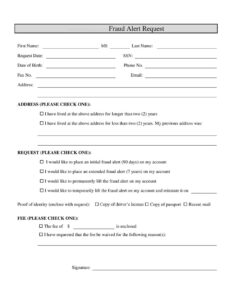
Fraud Alert Request
Use this free Fraud Alert Request form template to ask credit bureaus to flag your file against identity theft — free PDF and DOCX download.
PDF
DOCX
0
likes
Download Files
- DOCX
A Fraud Alert Request is a written notice you send to a credit reporting agency asking them to place an alert on your credit file so lenders take extra steps to verify your identity before opening new accounts. People most often use it after a wallet is lost, a data breach is announced, or suspicious activity appears on a credit report. This template is free to download in both PDF and DOCX, with no signup required.
What Is a Fraud Alert Request?
A Fraud Alert Request is a formal document submitted to a credit bureau or other reporting entity that asks them to attach a warning to your consumer file. Once an alert is in place, businesses are prompted to confirm your identity — often by calling a phone number you provide — before extending new credit in your name. The request is typically made by an individual consumer who suspects or has confirmed identity theft, or who simply wants an added layer of protection. The form documents who you are, how to reach you, the type of alert you want, and your authorizing signature, creating a clear paper trail of when and how you asked for protection.
When Do You Need a Fraud Alert Request?
This form fits a range of situations where you want creditors to slow down and verify before acting:
- Your wallet, purse, or mail containing personal documents was lost or stolen.
- You received a data breach notification from a company that held your Social Security number or financial details.
- You spotted accounts, inquiries, or charges on your credit report that you do not recognize.
- A debt collector contacts you about an account you never opened.
- You want a proactive precaution before traveling, moving, or after a phishing scam attempt.
- You are renewing an existing alert that is about to expire and want continued protection.
Types of Alerts
Alerts generally fall into a few categories: an initial fraud alert that lasts a set short period, an extended alert for confirmed identity theft victims who can supply documentation, and an active-duty alert for deployed service members. The “type of request” field on this form lets you specify which one you are seeking so the agency processes it correctly.
What a Fraud Alert Request Should Have
A complete and actionable request includes your full legal name, identifying details that match your credit file, and a way for the bureau to reach you. The most important elements are accurate identifying information (name, Social Security number, and date of birth), a current contact phone number that creditors can use to verify you, the specific type of alert you want, any required proof of identity, and your dated signature authorizing the request. Without matching identity details and a signature, the agency may be unable to locate your file or honor the request.
How to Fill Out a Fraud Alert Request
- Enter your first name, middle initial, and last name exactly as they appear on your official records.
- Write the request date — the day you are submitting the form.
- Provide your SSN (Social Security number) so the agency can match your credit file; double-check every digit.
- Enter your date of birth in the format requested.
- List your phone number, fax number, and email so the agency and creditors can reach you for verification.
- Fill in your current address and the time at address, which helps confirm your identity against your file.
- Select the type of request — for example, an initial, extended, or active-duty alert.
- Attach the required proof of identity, such as a copy of a government-issued ID, and note any applicable fee.
- Review everything, then date and add your signature to authorize the request.
Submitting Your Request and What Happens Next
After completing the form, send it to the credit reporting agency or entity using the delivery method they accept — mail, fax, or a secure upload portal. Keep a dated copy of the signed form and any proof of mailing for your records. Once the alert is placed, you should receive confirmation and, in many cases, a free copy of your credit report so you can review it for unfamiliar activity. Note that an alert with one bureau is often shared with the others, but you may wish to confirm coverage. If your request is part of recovering from identity theft, this signed form complements other steps such as filing reports and disputing fraudulent accounts. Calendar the expiration date of your alert so you can renew it if the threat persists.
Common Mistakes to Avoid
- Transposing or mistyping your SSN or date of birth, which prevents the agency from finding your file.
- Giving a phone number you rarely answer — creditors may use it to verify you, so list one you reliably reach.
- Leaving the type of request blank, which can delay processing or result in the wrong alert.
- Forgetting to attach the required proof of identity or to include a needed fee.
- Submitting the form unsigned or undated, making it unenforceable.
- Not keeping a copy or proof of submission for your own records.
Frequently Asked Questions
What is a Fraud Alert Request used for? It tells a credit reporting agency to flag your file so businesses verify your identity before opening new credit in your name. People use it after theft, a breach, or suspicious credit activity. The goal is to make it harder for someone to misuse your information.
How do I fill out the Fraud Alert Request form? Complete your full name, request date, SSN, and date of birth, then add your phone, fax, email, and address with time at that address. Choose the type of request, attach proof of identity, note any fee, and sign and date the form. Accuracy on identifying details is essential so the agency can locate your file.
Is a Fraud Alert Request legally binding? The form itself is a signed request you authorize, and consumer protection rules generally require agencies to honor valid fraud alert requests. The specific obligations and timeframes vary by jurisdiction and by the agency’s policies. Keep your signed copy as evidence of when and how you asked.
Do I need to notarize the form or provide proof of identity? Most fraud alert requests do not require notarization, but agencies commonly ask for proof of identity such as a copy of a government-issued ID. This template includes a proof-of-identity field so you can attach the right documentation. Always check the specific agency’s submission instructions.
How much does it cost to place a fraud alert? Placing an alert is often free, though some specialized services or longer-term protections may carry a fee, which is why the form includes a fee field. This template itself is completely free to download in PDF and DOCX. Confirm any charges directly with the agency before submitting.
How long does a fraud alert last? Duration depends on the type — initial alerts typically last a shorter set period, while extended and active-duty alerts last longer. When yours nears expiration, you can submit a new request to renew it. Mark the expiration date so your protection does not lapse unexpectedly.
This template is provided as a general example for informational purposes only and is not legal, financial, or tax advice. Fraud alert rules, fees, and processing requirements vary by jurisdiction and by agency — consult a qualified professional or contact the credit reporting agency directly for guidance specific to your situation.
Official resource: for the rules that apply to your situation, see the Consumer Financial Protection Bureau.
Related Forms
- Stop Payment On Check
- Cosigner Agreement
- Check Register Colorful
- Monthly Bill Organizer
- Theme Park Cash Envelope
- Pocket Tip Calculator
Browse more in Money.