
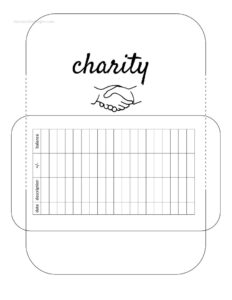
Charity Cash Envelope
Download a free Charity Cash Envelope template to record and track cash donations clearly and securely, available as a free PDF and DOCX download.
PDF
DOCX
0
likes
Download Files
- DOCX
A Charity Cash Envelope is a simple printed envelope used to collect, label, and record cash donations so every gift is accounted for from the moment it changes hands. People most often use it to gather offerings or contributions at events, services, and collection drives without losing track of who gave what. You can download this Charity Cash Envelope free in both PDF and DOCX, with no signup required.
What Is a Charity Cash Envelope?
A Charity Cash Envelope is a labeled paper envelope that a nonprofit, church, school, or community group provides to a donor so they can enclose a cash gift along with their details. It serves two purposes at once: it physically holds the money securely, and it captures the information the organization needs to record the donation, issue a receipt, and thank the giver. Treasurers and volunteers rely on it to reconcile collections at the end of an event, while donors use it to make sure their contribution is credited correctly. Because it travels with the cash, it creates a clear paper trail that links a specific amount to a specific person and date.
When Do You Need a Charity Cash Envelope?
The envelope is useful any time cash is collected and someone needs a record of it. Common situations include:
- Weekly worship services where congregants give offerings and want their gifts tracked for year-end statements.
- Fundraising events such as galas, bake sales, car washes, or charity dinners that generate loose cash.
- Door-to-door or workplace collection drives where volunteers gather contributions from many people.
- Memorial or tribute gifts given in honor or memory of someone, which need accurate attribution.
- Disaster relief or special appeals when a one-time campaign requires separating restricted funds.
- School and club fundraisers where students collect pledges and small cash donations from family and friends.
In each case, the envelope keeps the money organized and ensures the donor’s intent and identity are not lost in a pile of bills.
What a Charity Cash Envelope Should Have
A complete envelope should make it easy to identify the donor, the gift, and its purpose. The essentials are the organization’s name and logo, a space for the donor’s full name and contact details, the donation amount, the date, and a line for the fund or campaign the gift supports. Many envelopes also include a checkbox for whether a receipt is requested, a place to note cash versus check, and a small spot for the donor’s signature acknowledging the enclosed amount. A clear, uncluttered layout encourages people to fill it in completely, which saves the treasurer time during reconciliation.
How to Fill Out a Charity Cash Envelope
Filling out the envelope takes only a moment but should be done carefully so the record is accurate. Follow these steps:
- Confirm the organization details. Check that the printed charity name and campaign are correct before adding your gift.
- Write the date. Record the day you are giving so the donation is logged in the right period.
- Enter your name and contact information. Print your full name, address, email, or phone so the organization can send a receipt or thank-you.
- State the amount enclosed. Write the exact cash total, both in numbers and, if there is room, in words to prevent disputes.
- Note the fund or purpose. Indicate whether the gift is general, designated for a specific program, or made in honor of someone.
- Indicate receipt preference. Tick the box if you want a tax receipt or acknowledgment letter.
- Seal and hand off. Place the cash inside, seal the envelope, sign if a line is provided, and give it to a volunteer or place it in the collection container.
Counting and Reconciling the Cash
For the organization, the envelope is the start of a control process, not the end of it. Two volunteers should ideally open and count envelopes together, comparing the cash inside to the amount written on the front. Any discrepancy should be noted on the envelope and initialed by both counters before the funds are deposited. Keeping the envelopes after counting gives the treasurer a source document to back up the deposit slip and the donor records. This simple separation of duties protects both the volunteers and the charity, and it reassures donors that their gifts are handled responsibly.
Issuing Receipts and Thank-Yous
The contact and amount fields exist so the organization can follow up properly. If a donor requested a receipt, the recorded name, address, and amount let the bookkeeper generate an acknowledgment that the donor may need for their own records. Even when no receipt is requested, a brief thank-you note builds goodwill and encourages repeat giving. Whether a cash gift is tax-deductible, and what documentation a donor needs to claim it, depends on local rules and the organization’s tax status, so donors should keep their own notes and check the requirements that apply to them.
Common Mistakes to Avoid
- Leaving the amount blank — without a written figure, the counted cash cannot be verified against the donor’s intent.
- Skipping contact details — incomplete information makes it impossible to send a receipt or thank-you.
- Not sealing the envelope before handing it over, which risks loose bills being lost.
- Counting alone — a single person handling cash invites mistakes and undermines accountability.
- Discarding envelopes too soon — they are the backup for your deposit records and should be retained.
- Mixing designated and general gifts without noting the fund, which makes restricted donations hard to track.
Frequently Asked Questions
What is a Charity Cash Envelope used for? It is used to collect a cash donation while recording who gave it, how much, the date, and its purpose. This keeps gifts organized and gives the organization a clear record for receipts and reconciliation. It is especially helpful at events and services where many cash gifts are received at once.
How do I fill out a Charity Cash Envelope? Write the date, your name and contact information, and the exact cash amount enclosed on the front. Note the fund or purpose, tick the receipt box if you want one, then seal the envelope with the cash inside. Hand it to a volunteer or place it in the collection container.
Is a Charity Cash Envelope a legal document? It is not a contract, but it does serve as an internal record that supports the organization’s bookkeeping and deposit trail. Treating it as an official source document helps maintain accountability and transparency. It is good practice to retain envelopes after counting in case the records are ever reviewed.
Do cash donations need a receipt? Donors often request a receipt for their own records, and many organizations provide one as a courtesy or because it is required for their reporting. Whether a cash gift is tax-deductible depends on local rules and the charity’s status. Keep your own note of the gift and check the requirements that apply to you.
How should the organization count the cash? Two people should open and count envelopes together, comparing the cash to the amount written on each one. Any difference should be noted and initialed before the funds are deposited. This separation of duties protects both the volunteers and the donors.
How much does this template cost? The Charity Cash Envelope template is completely free to download from Business Forms Pro in both PDF and DOCX formats. There is no signup or payment required. You can customize the DOCX version with your own logo, fund names, and contact lines before printing.
This template is provided as a general example for informational purposes only and is not legal, financial, or tax advice. Rules for handling donations, issuing receipts, and tax deductibility vary by jurisdiction and by an organization’s status. Consult a qualified professional for guidance specific to your situation.
Official resource: for the rules that apply to your situation, see the Consumer Financial Protection Bureau.
Related Forms
- Insurance Coverage Record
- Appointment Of Collection Agent
- Consumer Equity Form
- Profit And Loss Statement
- Debt Worksheet
- Budget Revision Request
Browse more in Money.