
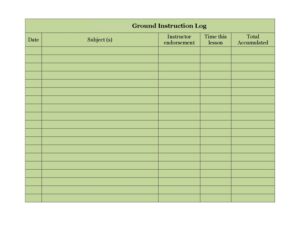
Ground Instruction Log
Track ground training hours with this free Ground Instruction Log template, recording date, subjects, endorsements, and accumulated time for free download.
PDF
DOCX
8 downloads
0
likes
Download Files
- DOCX
A Ground Instruction Log is a simple record that documents the date, subjects covered, instructor endorsement, and time spent during each ground training session in flight instruction. Pilots and student pilots most often use it to keep an organized, verifiable record of ground knowledge training toward a certificate or rating. You can download it free here in both PDF and DOCX formats with no signup required.
What Is a Ground Instruction Log?
A Ground Instruction Log is a written record maintained by a flight instructor and student to track classroom and one-on-one ground training. Unlike a flight logbook that records time aloft, this log captures the ground-based knowledge instruction — topics like aerodynamics, regulations, weather, navigation, and aircraft systems. It typically records the date of each lesson, the subjects discussed, the instructor’s endorsement or signature, the duration of that lesson, and a running total of accumulated ground time. Certified Flight Instructors (CFIs) and ground instructors use it to demonstrate that required training was delivered, while students rely on it to show readiness for written exams, checkrides, and certificate applications.
When Do You Need a Ground Instruction Log?
This log fits any structured ground training relationship between an instructor and a learner. Common situations include:
- Working toward a pilot certificate — recording ground lessons for a private, sport, recreational, instrument, or commercial program.
- Preparing for a knowledge (written) test — documenting the subjects covered so an instructor can endorse you to sit the exam.
- Pursuing an additional rating or endorsement — such as an instrument rating, complex or high-performance endorsement, or tailwheel training.
- Recurrent or proficiency training — capturing ground sessions during a flight review or refresher instruction.
- Tracking accumulated hours — keeping a clean running total that supports a certificate or rating application.
- Instructor recordkeeping — CFIs and ground instructors maintaining their own backup records of instruction given.
What a Ground Instruction Log Should Have
A complete and useful Ground Instruction Log captures enough detail to reconstruct exactly what was taught and when. The essential elements are the lesson date, a clear description of the subject or subjects covered in that session, the instructor’s endorsement or signature, the time spent on that specific lesson, and a cumulative total of all ground instruction to date. Together these fields create a chronological, signed trail showing the scope and depth of training. The instructor endorsement is what gives the entry credibility — it confirms that a qualified instructor actually delivered the listed instruction. A running accumulated total lets both parties see progress at a glance without re-adding every row.
How to Fill Out a Ground Instruction Log
- Date: Enter the calendar date of the ground lesson. Use a consistent format (for example MM/DD/YYYY) for every row so the log reads in clean chronological order.
- Subject(s): List the topics covered in that session — for example “weather theory and METAR/TAF interpretation,” “airspace and sectional charts,” or “performance and weight and balance.” Be specific enough that the entry is meaningful months later.
- Instructor Endorsement: Have the instructor sign or initial the entry. Where a formal endorsement is appropriate, include the instructor’s name, certificate number, and expiration date as your training program or regulations require.
- Time This Lesson: Record the duration of the session, usually in hours and tenths (for example 1.5). Log only the actual instruction time for that meeting.
- Total Accumulated: Add this lesson’s time to the previous running total and enter the new cumulative figure. This keeps a continuous tally of all ground instruction received.
Ground Instruction vs. Flight Log Entries
It is easy to confuse a Ground Instruction Log with the flight portion of a logbook, but they document different things. A flight log records time in the aircraft — dual instruction, solo, cross-country, night, and so on. A Ground Instruction Log records knowledge-based training that happens on the ground, whether in a classroom, a briefing room, or a debrief after a flight. Many pilots keep both because certificates and ratings often require demonstrated ground training in addition to flight hours. Keeping the two separate, with clear subjects and signatures on the ground side, makes it far easier to show an examiner or employer exactly what preparation took place.
Tips for Keeping a Clean Training Record
Fill in each entry at the end of the lesson while details are fresh, rather than reconstructing several sessions from memory later. Encourage your instructor to sign at the time of instruction so endorsements line up with the dates. Keep the log in a consistent place — a dedicated binder or a single digital file — and consider a backup copy. If you train with more than one instructor, make sure each session clearly identifies who provided the instruction. A well-maintained log not only satisfies recordkeeping needs but also doubles as a study roadmap showing which subjects you have already covered and which still need attention.
Common Mistakes to Avoid
- Vague subject entries: Writing only “ground school” instead of the specific topics makes the log far less useful for review or verification.
- Missing endorsements: An unsigned entry undermines the value of the record — capture the instructor’s signature for every session.
- Inconsistent time units: Mixing minutes and decimal hours leads to errors when totaling; pick one format and stick with it.
- Math errors in the running total: Re-check that each Total Accumulated equals the prior total plus the current lesson time.
- Delayed entries: Logging sessions days or weeks later invites forgotten subjects and incorrect dates.
- No backup: Relying on a single paper copy risks losing your entire training history if it is misplaced.
Frequently Asked Questions
What is a Ground Instruction Log used for? It is used to document each ground training session between an instructor and a student, including the date, subjects covered, time spent, and the instructor’s endorsement. It provides a verifiable record of knowledge instruction that supports certificate, rating, and exam preparation.
How do I fill out the Total Accumulated field? Add the Time This Lesson to the Total Accumulated figure from the previous entry, then write the new sum in the current row. This running tally lets you and your instructor see total ground instruction at a glance without re-adding every line.
Does a Ground Instruction Log need to be signed? The instructor endorsement field is meant to be signed or initialed by the instructor who delivered the lesson. A signature confirms the instruction actually took place and is what gives each entry its credibility for review.
Is this the same as my pilot logbook? No. A pilot logbook records flight time in the aircraft, while a Ground Instruction Log records knowledge-based ground training. Many pilots keep both because certificates and ratings often require documented ground instruction alongside flight hours.
Can I use this log toward a certificate or rating? It can serve as a supporting record of the ground training you received, organized by date, subject, and instructor endorsement. Always confirm the exact recordkeeping and endorsement requirements that apply to your specific certificate, rating, or training program.
How much does this template cost? Nothing — it is completely free to download here in both PDF and DOCX formats with no signup required. You can print it as is or edit the DOCX version to match the structure of your training program.
This Ground Instruction Log template is provided as a general example for informational purposes only and is not legal, regulatory, or aviation training advice. Recordkeeping and endorsement requirements vary by jurisdiction, certificate, and program — consult your flight instructor, training provider, or the appropriate aviation authority to confirm what applies to you.
Related Forms
- Pilot Record of Certificates and Ratings
- Pilot Logbook
- Flight Review Log
- Private Pilot Endorsements
- Flight Proficiency And Medical Certificate History
- Navigation Log
Browse more in Pilot.