
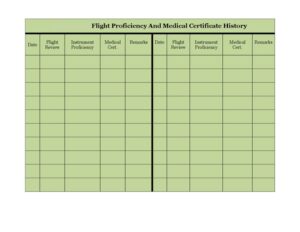
Flight Proficiency And Medical Certificate History
Track flight reviews, instrument proficiency checks, and medical certificates with this free Flight Proficiency and Medical Certificate History template — free download.
PDF
DOCX
0
likes
Download Files
- DOCX
A Flight Proficiency and Medical Certificate History form is a simple, pilot-maintained log that records flight reviews, instrument proficiency checks, and medical certificate dates in one place. Most pilots use it to keep currency requirements and medical expirations organized so they never lose track of a critical deadline. It is free to download in PDF and DOCX, with no signup required.
What Is a Flight Proficiency and Medical Certificate History?
A Flight Proficiency and Medical Certificate History is a personal record sheet that consolidates the recurring qualifications a pilot must maintain to keep flying legally and safely. Rather than digging through a logbook every time you need to confirm a flight review date or check when your medical lapses, this form gives you a single, scannable summary. It typically documents the date of each event, the type of review or check completed, the status of your medical certificate, and any relevant notes. Pilots, flight instructors, and chief pilots use it as a quick-reference companion to the official logbook and certificate records.
When Do You Need a Flight Proficiency and Medical Certificate History?
This form is useful any time you need to verify or demonstrate that your qualifications are current. Common situations include:
- Preparing for a flight review or instrument proficiency check and confirming your last completion date.
- Tracking when your medical certificate was issued and when it will expire so you can renew on time.
- Renting an aircraft from a flight school or club that asks to see proof of recent currency.
- Joining a flying club, insurance review, or transitioning to a new operator who wants a snapshot of your history.
- Planning instrument flying and confirming you remain within your proficiency window.
- Keeping an at-a-glance summary for an annual self-review of your training and medical status.
What the Form Should Include
A complete history sheet captures the recurring items that determine whether you remain legal to fly. The essential elements are a clear date for each entry, the specific type of event being recorded (flight review or instrument proficiency check), the medical certificate status, and a remarks column for context. Each row should stand on its own so anyone reading it — including you, months later — can immediately understand what happened, when, and whether action is needed. Keeping the entries chronological makes it easy to see your most recent activity at the bottom or top of the page and to spot any gaps in currency before they become a problem.
How to Fill Out a Flight Proficiency and Medical Certificate History
- Date: Enter the date of the event you are recording — the day a flight review was completed, an instrument proficiency check was passed, or a medical certificate was issued. Use a consistent format throughout the sheet.
- Flight Review: If the entry relates to a flight review, note that here. Record the date completed and, if helpful, the name of the instructor who endorsed it.
- Instrument Proficiency: For an instrument proficiency check or instrument currency activity, log it in this column. Note the date and the nature of the check completed.
- Medical Cert.: Record the class of medical certificate, the issue date, and the expiration date. This lets you see at a glance how much validity remains.
- Remarks: Add any clarifying notes — the aircraft type used, conditions of the check, the examiner or instructor, or a reminder of the next due date.
Update the sheet immediately after each event so the record stays accurate and reflects your true current status.
Why Pilots Keep a Consolidated History
Currency requirements come from different sources and renew on different cycles. A flight review, an instrument proficiency check, and a medical certificate each have their own validity period and their own consequences if allowed to lapse. Because these items rarely line up on the same date, it is easy to focus on one and overlook another. A single history sheet brings all of them into one view, helping you plan ahead rather than scramble at the last minute. It also serves as a useful talking point with your instructor or examiner, who can quickly see what you have completed recently and recommend the right next step in your training.
Keeping It Accurate and Backed Up
Treat this form as a supplement to — not a replacement for — your official logbook and the physical certificates themselves. The endorsements in your logbook and the medical certificate document remain the authoritative records. Keep a copy of this history sheet with your logbook, and consider scanning or photographing it so you have a digital backup. If you fly multiple aircraft categories or hold more than one rating, you may want a separate row or note for each so the requirements never blur together. Review the sheet at the start of every flying season and again before any major trip.
Common Mistakes to Avoid
- Recording the date you scheduled an event instead of the date it was actually completed.
- Leaving the medical certificate expiration off the sheet, which defeats the purpose of an early-warning record.
- Confusing a flight review with an instrument proficiency check — they are separate requirements with separate cycles.
- Forgetting to update the sheet right after a check, then misremembering details weeks later.
- Relying on this summary alone without keeping the underlying logbook endorsements and certificates.
- Using inconsistent date formats that make the timeline hard to read at a glance.
Frequently Asked Questions
What is a Flight Proficiency and Medical Certificate History form? It is a personal log that summarizes a pilot’s recurring qualifications — flight reviews, instrument proficiency checks, and medical certificate dates — in one place. It acts as a quick-reference companion to your official logbook and certificates. The goal is to make it easy to see your current status and plan upcoming renewals.
How do I fill it out? Add a new dated row each time you complete a flight review, pass an instrument proficiency check, or receive a new medical certificate. Fill in the relevant column, then use the Remarks field for details like the instructor, aircraft, or next due date. Keep entries in chronological order and update the sheet promptly after each event.
Does this form replace my logbook? No. Your logbook endorsements and the physical medical certificate remain the official records that prove currency. This history sheet is a convenient summary that helps you organize and monitor those items, not a substitute for them.
Is this form legally binding or official? The form itself is an informal tracking tool you maintain for your own convenience. The legal proof of your qualifications comes from your endorsed logbook and your issued medical certificate, not from this summary sheet.
How often should I update it? Update it immediately after any flight review, instrument proficiency check, or medical exam, and review the whole sheet at least once a season. Frequent updates keep the record accurate and help you catch approaching expirations early.
How much does the template cost? Nothing — it is completely free to download here in both PDF and DOCX formats with no signup required. You can print it for your flight bag or edit the DOCX version to suit your tracking style.
This template is a general example provided for informational purposes only and is not legal, medical, or aviation regulatory advice. Currency and certification requirements vary by jurisdiction and aircraft operation, and the official rules and your own logbook and certificates govern. Consult your flight instructor, a designated examiner, or the relevant aviation authority for guidance specific to your situation.
Related Forms
- Navigation Log
- Ground Instruction Log
- Flight Review Log
- Pilot Record of Certificates and Ratings
- Pilot Logbook
- Private Pilot Endorsements
Browse more in Pilot.