
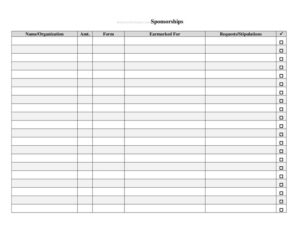
Sponsorships Tracker
Track political sponsorships, contributions, and donor commitments with our free Sponsorships Tracker template, available as a free PDF and DOCX download.
PDF
DOCX
4 downloads
0
likes
Download Files
- DOCX
A Sponsorships Tracker is a simple record-keeping document used to log, monitor, and reconcile every sponsorship, contribution, or in-kind commitment a campaign, committee, or political organization receives. Most people use it to keep a clear, running view of who pledged what, how much has actually arrived, and which commitments are still outstanding. It is free to download here in both PDF and DOCX formats, with no signup required.
What Is a Sponsorships Tracker?
A Sponsorships Tracker is a working ledger that brings every sponsor relationship into one organized view. Treasurers, campaign managers, event coordinators, and volunteer finance teams typically maintain it to document the name of each sponsor, the amount or value pledged, the date received, the sponsorship tier or benefit promised, and the current payment status. It is not a formal disclosure filing on its own, but rather the internal backbone that feeds accurate reporting. By recording details consistently as they happen, the tracker helps an organization stay transparent, avoid double-counting, and produce reliable totals whenever a board, donor, or compliance officer asks for them.
When Do You Need a Sponsorships Tracker?
The tracker becomes essential the moment money or pledges start flowing toward an event, campaign, or political committee. Common situations include:
- Fundraising galas and rallies: when multiple sponsors buy tables, banners, or branded placements at different price tiers.
- Campaign donor management: tracking recurring and one-time contributions across an election cycle.
- Political action committee operations: consolidating sponsorships from many sources for periodic reconciliation.
- In-kind contributions: recording donated goods, printing, venue space, or services that carry a fair-market value.
- Outstanding pledge follow-up: identifying sponsors who committed verbally but have not yet paid.
- Audit and reporting preparation: assembling clean totals before filing required disclosures or briefing leadership.
What a Sponsorships Tracker Should Have
A complete tracker captures enough detail to answer the three questions every finance lead asks: who, how much, and when. At minimum, each entry should include the sponsor’s name and contact information, the pledged amount or estimated value of an in-kind gift, the sponsorship level or category, the date the commitment was made, the date funds were received, the payment method, and the current status (pledged, partial, paid, or declined). A notes column is invaluable for capturing context — a promised second installment, a benefit still owed, or a sponsor who requested anonymity. Running subtotals and a grand total keep the big picture visible. Consistency across rows is what turns a list into a tool you can actually rely on.
How to Fill Out a Sponsorships Tracker
Because the template is a flexible grid, set it up once and update it as commitments come in. Work through it like this:
- Title and date the sheet: note the event or campaign name and the period the tracker covers so totals are never confused with another cycle.
- Enter the sponsor name: record the individual, business, or organization exactly as it should appear in any later report.
- Add contact details: capture a phone number or email so you can follow up on unpaid pledges.
- Log the sponsorship tier: indicate the level or package (for example, gold, silver, table, or banner).
- Record the pledged amount: enter the committed dollar figure or the fair-market value of an in-kind gift.
- Note the pledge date and received date: these two dates reveal how long money sits outstanding.
- Mark the payment method and status: check, card, transfer, or in-kind, plus pledged, partial, or paid.
- Use the notes field: document benefits owed, anonymity requests, or follow-up reminders.
- Update totals: recalculate subtotals after each batch of entries.
Tracking Cash Versus In-Kind Sponsorships
Not every sponsorship arrives as a check. Donated printing, catering, venue space, audio equipment, or volunteer professional services are in-kind contributions, and they still carry real value that often must be documented. Use your tracker to flag these clearly and assign a reasonable fair-market estimate so they are not mistaken for cash on hand. Keeping cash and in-kind entries visually distinct — whether by a status code or a separate column — prevents inflated cash totals and produces a more honest picture of what your event or campaign actually has to work with. When in doubt about how to value a donated item or service, ask the sponsor for an invoice or written estimate.
Reconciling and Reporting From Your Tracker
The tracker’s real payoff comes at reconciliation time. Periodically compare your logged “received” entries against actual bank deposits to catch missing or duplicate payments early. Sort by status to generate a clean follow-up list of outstanding pledges, and sort by sponsor to confirm aggregate giving from any single source. Many jurisdictions require political committees to report contributions above certain thresholds and to disclose contributor details; a well-maintained tracker makes assembling those figures fast and defensible. Keep the file updated in real time rather than rebuilding it from memory before a deadline — accuracy is far easier to maintain than to reconstruct.
Common Mistakes to Avoid
- Logging pledges as paid: a verbal commitment is not money in the bank — keep status fields honest.
- Skipping the received date: without it, you cannot tell which sponsors are overdue.
- Ignoring in-kind value: undocumented donated goods and services distort your totals.
- Inconsistent sponsor names: spelling the same donor three ways breaks your aggregate counts.
- Letting the file go stale: updating only before a deadline invites errors and missed entries.
- No backup copy: a single lost file can wipe out an entire cycle of records.
Frequently Asked Questions
What is a Sponsorships Tracker used for? It is an internal record used to log every sponsorship pledge and contribution a campaign, committee, or event receives. It tracks who committed, how much, when funds arrived, and what status each commitment is in. The goal is a clear, reconcilable view of all sponsorship activity.
How do I fill out the Sponsorships Tracker? Title and date the sheet, then add one row per sponsor with their name, contact info, sponsorship tier, pledged amount, pledge and received dates, payment method, status, and notes. Update each row as money arrives and recalculate your totals. Keeping entries consistent makes later reporting far easier.
Does a Sponsorships Tracker need to be notarized or witnessed? No. It is an internal management document, not a sworn legal instrument, so notarization and witnesses are not required. Its value comes from being accurate and kept up to date, not from any formal signing process.
Can I use this tracker for official campaign finance reporting? The tracker is designed to organize your data so that preparing required disclosures is faster and more accurate, but it is not itself an official filing. You will still need to submit the specific forms your jurisdiction requires. Always confirm thresholds and deadlines with your local election or finance authority.
How should I record in-kind sponsorships? Enter them as their own clearly marked rows with a fair-market value rather than a cash amount, and flag the status as in-kind. This keeps your cash totals accurate while still documenting the contribution’s worth. Ask the sponsor for an invoice or estimate when the value is unclear.
Is this Sponsorships Tracker template free to download? Yes. You can download it free in both PDF and DOCX formats with no signup required. The DOCX version is fully editable, so you can add columns, tiers, or formulas to match your event or committee’s needs.
This Sponsorships Tracker template is a general example provided for informational purposes only and does not constitute legal, financial, tax, or campaign-compliance advice. Reporting rules, contribution limits, and disclosure requirements vary by jurisdiction and change over time. Consult a qualified professional or your local election authority before relying on it for official purposes.
Related Forms
- Talking Points
- Campaign Volunteer Sign Up Sheet
- Candidates Comparison Chart
- Endorsements Tracker
- Candidate Favorability
- Exit Poll
Browse more in Political.