
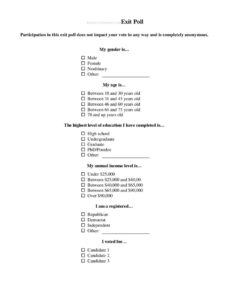
Exit Poll
Download a free Exit Poll template to survey voters as they leave polling places and capture clean, organized election-day data — free PDF & DOCX download.
PDF
DOCX
6 downloads
0
likes
Download Files
- DOCX
An exit poll is a short survey given to voters immediately after they cast their ballots, used to capture how people voted and why before official results are released. It is the most common tool campaigns, researchers, news outlets, and students use to forecast outcomes and analyze voter behavior. You can download this exit poll template free in both PDF and DOCX formats — no signup required.
What Is an Exit Poll?
An exit poll is a standardized questionnaire administered to a sample of voters as they leave their polling location on election day. It is typically used by media organizations, political researchers, academic institutions, civic groups, and student projects to estimate election results and understand the demographics and motivations behind voting choices. Unlike pre-election polls that measure intent, an exit poll records actual voting behavior moments after it happens, which makes the data uniquely valuable. A well-built exit poll form keeps each interview brief, captures voter selections and key demographic details, and standardizes responses so that data from many interviewers at many sites can be combined and analyzed accurately.
When Do You Need an Exit Poll?
Exit polls serve a wide range of organizations and projects. Common situations include:
- Election-night forecasting: News outlets and analysts use exit polls to project winners and explain margins before final counts are certified.
- Campaign analysis: Campaign teams gather data on which messages, issues, and candidate traits drove voters’ decisions.
- Academic and political science research: Universities study voting patterns across age, education, region, and other demographics.
- Student and classroom projects: Civics and statistics classes run mock or real exit polls to teach survey methodology and data analysis.
- Nonpartisan civic monitoring: Watchdog groups document turnout patterns and voter sentiment in a transparent, neutral way.
- Local and ballot-measure tracking: Community organizations gauge support for referendums, school bonds, or city offices.
What an Exit Poll Form Should Have
A complete exit poll form balances brevity with the information you actually need to analyze results. Strong exit poll forms include a header identifying the survey and polling location, the date and time of the interview, the interviewer’s name or ID, and a clear statement that participation is voluntary and anonymous. The core of the form is the candidate or ballot-question selection, followed by a small set of demographic questions such as age range, gender, and the issues that mattered most. Including a response code or numbering system makes it easier to enter data into a spreadsheet later. Finally, a brief thank-you note and an optional comments line round out a respectful, professional questionnaire.
How to Fill Out an Exit Poll
Whether you are the interviewer recording answers or the respondent completing it yourself, follow these steps:
- Record the survey header: Write the polling location name, precinct or site ID, and the election or contest being surveyed at the top of the form.
- Enter the date and time: Note the election date and the approximate time of the interview, which helps track turnout patterns across the day.
- Add interviewer details: Fill in the interviewer’s name or ID number so responses can be grouped and quality-checked.
- Confirm voluntary participation: Read or note the anonymity statement so the respondent understands their answers are confidential.
- Mark the candidate or ballot selection: Record which candidate, party, or ballot measure choice the voter selected.
- Capture key demographics: Mark the voter’s age range, gender, and any other category your project tracks.
- Note the deciding issues: Record the issue or factor that most influenced the vote.
- Add optional comments: Use the comments line for any volunteered remarks, then thank the respondent.
Keeping an Exit Poll Neutral and Accurate
The credibility of any exit poll depends on neutrality and consistent methodology. Interviewers should approach voters in a randomized, systematic way — for example, every fifth person leaving the polling place — rather than choosing who looks approachable, which introduces bias. Questions must be worded identically for every respondent and should never suggest a preferred answer. Maintain a respectful distance from the entrance to comply with local rules about electioneering and polling-place buffer zones, which vary widely. Recording refusals (people who decline) is also useful, because non-response patterns can skew results if certain groups consistently opt out.
How an Exit Poll Differs From a Pre-Election Poll
It helps to understand where the exit poll fits among survey types. A pre-election poll measures voter intention days or weeks before voting and asks how someone plans to vote. An exit poll, by contrast, records a completed action — how the person actually voted — moments after they leave the booth. Because it captures behavior rather than intent, an exit poll avoids the gap between what people say they will do and what they ultimately do. However, exit polls only reach in-person voters, so projects in areas with heavy mail-in or early voting should pair the exit poll with separate methods to avoid undercounting those ballots.
Common Mistakes to Avoid
- Leading or loaded questions: Wording that hints at a preferred answer distorts your data and undermines credibility.
- Selective sampling: Choosing who to interview based on appearance introduces bias; use a fixed interval instead.
- Skipping the anonymity statement: Voters are more candid when they trust the survey is confidential.
- Ignoring polling-place rules: Standing too close to the entrance can violate local buffer-zone laws.
- Overlong questionnaires: Long forms lower completion rates; keep it short enough to finish in under a minute.
- Inconsistent data entry: Failing to use response codes or numbering makes combining many forms error-prone.
Frequently Asked Questions
What is an exit poll used for? An exit poll is used to record how voters cast their ballots and why, immediately after they leave the polling place. The data helps forecast results, analyze voter demographics, and understand which issues influenced decisions before official counts are released.
How do I fill out this exit poll form? Start with the header — location, date, time, and interviewer ID — then read the anonymity statement and record the voter’s candidate or ballot selection, age range, gender, and the issue that mattered most. Keep responses brief and use the same wording for every respondent so the data stays comparable.
Is an exit poll anonymous? Yes, exit polls are designed to be anonymous and voluntary. The form should not record names or identifying details, and respondents should be told their answers are confidential, which encourages honest responses and protects their privacy.
Are exit polls accurate? Exit polls can be quite accurate when interviewers use random sampling, neutral wording, and a large enough sample. Accuracy drops when the sample is biased, when many voters refuse to answer, or when significant numbers of people vote by mail and are never reached by the in-person survey.
Do I need permission to conduct an exit poll? Rules vary by jurisdiction, and many areas require interviewers to stay a set distance from polling-place entrances. Check your local election authority’s regulations on buffer zones and electioneering before you begin to ensure your survey is conducted lawfully.
Is this exit poll template free to download? Yes. This exit poll template is completely free to download in both PDF and DOCX formats with no signup required, so you can customize it for your campaign, classroom, or research project right away.
This exit poll template is a general example provided for informational purposes only and does not constitute legal advice. Election laws, polling-place rules, and survey regulations vary by jurisdiction — consult your local election authority or a qualified professional before conducting any poll.
Related Forms
- Opponent Information Form
- Electorate Information
- Campaign Volunteer Sign Up Sheet
- Endorsements Tracker
- Candidate Favorability
- Contributor Mailing List
Browse more in Political.