
Rental Agreement
Download a free Rental Agreement template to collect tenant details, income, and references in minutes — free PDF and DOCX download, no signup required.
PDF
DOC
1 downloads
0
likes
Download Files
- DOC
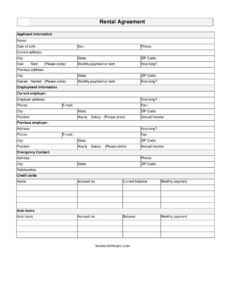
A Rental Agreement is a document landlords and property managers use to gather and record an applicant’s personal, employment, and financial details before approving a tenancy. The most common reason people use one is to screen prospective tenants consistently and keep a written record of who is applying for a unit. You can download this Rental Agreement free in both PDF and DOCX formats — no signup required.
What Is a Rental Agreement?
A Rental Agreement, in the context of this form, is a structured intake document that a landlord, leasing agent, or property management company gives to anyone seeking to rent a home, apartment, room, or commercial space. It collects the applicant’s identifying information, housing history, employment and income, emergency contact, and outstanding financial obligations such as credit cards and auto loans. The purpose is to help the property owner evaluate whether a candidate can reliably pay rent and to document the basis for an approval or denial. While some people use the term interchangeably with a lease, this particular form focuses on capturing applicant data rather than spelling out tenancy terms.
When Do You Need a Rental Agreement?
This form is useful any time you are evaluating someone for a rental property or want a clean, repeatable way to gather applicant details. Common situations include:
- A landlord renting out a single-family home or condo and needs to compare several interested applicants fairly.
- A property manager processing multiple applications for units in an apartment building.
- A homeowner renting a basement suite, spare room, or accessory dwelling unit and wants documented income and references.
- An individual subletting an apartment who needs to verify a replacement tenant’s stability.
- A small commercial landlord leasing office or retail space and assessing a business owner’s finances.
- A real estate agent collecting standardized information from prospects before forwarding files to an owner.
What a Rental Agreement Should Have
A complete Rental Agreement application captures enough information to make an informed decision while staying organized and easy to review. The essential elements include the applicant’s full identity and contact information, a clear housing history showing current and previous addresses, whether they owned or rented and for how long, and employment details that establish income. It should also record an emergency contact, and a financial snapshot covering credit card balances, monthly payments, and auto loan obligations. Strong forms keep these sections clearly labeled so the reviewer can quickly cross-check income against existing debt. Including space for the applicant’s signature and date adds accountability, since it confirms the information provided is accurate to the best of their knowledge.
How to Fill Out a Rental Agreement
- Under applicant information, enter your full name, date of birth, Social Security or identification number (the SSN field), and phone number.
- Provide your current address with city, state, and zip code, then indicate whether you own or rent, your monthly payment or rent, and how long you have lived there.
- List your previous address and mark whether it was owned or rented to show housing stability.
- Complete the employment information: current employer, employer address, and position.
- Enter pay details — your hourly rate or salary, plus total annual income.
- Add your previous employer if your current job is recent.
- Name an emergency contact and their relationship to you.
- Disclose finances: credit cards with account no., current balance, and monthly payment, followed by auto loans and their balance.
- Review every entry for accuracy, then sign and date the form before submitting it.
Tips for Landlords Reviewing the Form
Once an applicant returns the completed form, treat it as a starting point rather than a final verdict. Compare the stated annual income against the monthly rent they are applying for — many landlords look for income that comfortably exceeds the rent, and the disclosed credit card and auto loan payments help reveal how much of that income is already committed. Verify the current employer and position with a quick employment check, and contact the listed previous landlord at the previous address to confirm payment history. Always apply the same criteria to every applicant to keep your screening fair and consistent.
How This Differs From a Lease
It is worth distinguishing this application-style Rental Agreement from a lease. This form gathers information used to decide whether to rent to someone. A lease, by contrast, is the binding contract signed after approval that sets the rent amount, term, deposit, rules, and responsibilities of both parties. Many landlords use both: the application first to screen, then a separate lease to formalize the tenancy. Keeping the two documents distinct helps you stay organized and ensures sensitive applicant data is handled appropriately.
Common Mistakes to Avoid
- Leaving the SSN or income fields blank, which makes it impossible to verify ability to pay.
- Skipping the previous address and prior employer, hiding gaps in housing or work history.
- Listing an annual income that does not match the stated hourly rate or salary.
- Forgetting to disclose auto loans or credit card balances, which understates monthly obligations.
- Providing an emergency contact without a usable phone number or relationship.
- Submitting the form unsigned or undated, leaving its accuracy unverified.
Frequently Asked Questions
What is a Rental Agreement used for? It is used to collect and document a prospective tenant’s personal, housing, employment, and financial information so a landlord can decide whether to approve them for a unit. It creates a consistent record for every applicant and supports a fair screening process.
How do I fill out a Rental Agreement? Start with your name, date of birth, SSN, and phone, then complete your current and previous addresses, employment and income details, an emergency contact, and your credit card and auto loan information. Review each field for accuracy and sign and date the form before submitting it.
Is this Rental Agreement legally binding? This particular form is an application that documents information rather than a contract that creates a tenancy. The binding agreement is typically a separate signed lease, and the enforceability of any rental document depends on your local laws.
Do I need to provide my Social Security number? Many landlords request it to run a credit or background check, which is why the SSN field appears on the form. Whether you must provide it, and how it must be protected, varies by jurisdiction and the landlord’s screening policy.
How much does this Rental Agreement template cost? Nothing — you can download it completely free from Business Forms Pro in both PDF and DOCX formats. There is no signup or account required to use it.
Can I edit the template to fit my property? Yes. The DOCX version is fully editable, so you can add or remove fields, insert your business name, or adjust sections to match your screening needs before sharing it with applicants.
This Rental Agreement template is a general example provided for informational purposes only and is not legal, financial, or tax advice. Rental and tenant-screening requirements vary by jurisdiction, including rules on collecting and storing applicant information. Consult a qualified attorney or professional to ensure your form and process comply with applicable laws.
Official resource: for the rules that apply to your situation, see HUD.
Related Forms
- Complaint Letter Against Tenant
- Reasonable Accommodation Request Deaf
- Real Estate Listing Tracker
- Inspection Checklist
- Property Appraisal Form
- Intent To Vacate Apartment
Browse more in Rental and Real Estate.