
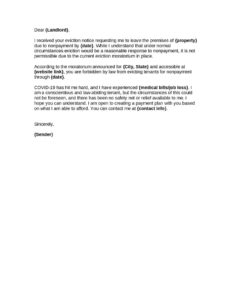
Covid Eviction Moratorium Tenant
Download a free COVID Eviction Moratorium Tenant form template in PDF and DOCX to notify your landlord of protected status, with no signup required.
DOCX
0
likes
Download Files
- DOCX
A COVID Eviction Moratorium Tenant form is a written declaration a renter gives a landlord to assert protection from eviction tied to pandemic-related financial hardship. The single most common reason people use it is to formally notify a landlord—on the record and in writing—that the tenant qualifies under an applicable moratorium or hardship-relief program. This template is free to download in PDF and DOCX, with no signup required.
What Is a COVID Eviction Moratorium Tenant Form?
A COVID Eviction Moratorium Tenant form is a tenant-issued document used to communicate that a renter is unable to pay full rent due to circumstances connected to the COVID-19 pandemic, such as lost income, reduced hours, or medical expenses. It typically references the specific federal, state, or local protection the tenant is relying on and documents the tenant’s intent to remain in the home while seeking assistance. The form is used by residential tenants and shared with landlords or property managers. Although pandemic-era moratoriums have largely expired in many jurisdictions, the document remains useful as a hardship-notice template, a record of communication, and a starting point where local emergency protections still apply.
When Do You Need a COVID Eviction Moratorium Tenant Form?
This form fits a range of situations where a tenant needs to put hardship and protection claims in writing:
- You received an eviction notice and want to assert that an active moratorium or hardship protection applies to your situation.
- You have fallen behind on rent due to job loss, reduced income, or pandemic-related medical costs and need to notify your landlord formally.
- You are applying for emergency rental assistance and want documented proof you communicated your hardship to the landlord.
- Your jurisdiction still maintains a local emergency-protection ordinance and requires tenants to submit a declaration to qualify.
- You want a dated written record of your circumstances in case of a future dispute or court proceeding.
- Your landlord requested a hardship statement before agreeing to a payment plan or forbearance arrangement.
What This Form Should Include
A complete tenant declaration should clearly identify everyone involved and the basis for the claim. Essential elements include the tenant’s full legal name and the rental property address; the landlord or property manager’s name and contact details; the date of the declaration; a description of the COVID-related hardship; a statement of the protection or program the tenant is relying on; the amount of rent owed or affected, if known; and the tenant’s signature affirming the statements are true. Including a clear request—such as a forbearance period, payment plan, or pause on eviction proceedings—helps the landlord understand what action the tenant is seeking and creates a usable record.
How to Fill Out a COVID Eviction Moratorium Tenant Form
- Enter the date you are completing and sending the declaration at the top of the form.
- Fill in your full legal name as the tenant, exactly as it appears on your lease.
- Add the complete rental property address, including unit number, city, state, and ZIP code.
- Enter the landlord or property manager’s name and their mailing address, email, or phone number.
- Reference the lease or rental agreement date if the form asks for it, to tie the declaration to your tenancy.
- Describe your COVID-related hardship in plain terms—lost employment, reduced income, increased medical or childcare costs.
- State the protection, moratorium, or assistance program you are relying on, if one applies in your area.
- Note the rent amount affected and any balance owed, and describe the relief you are requesting.
- Sign and date the form, keep a copy for your records, and deliver it to the landlord using a trackable method.
How to Deliver and Keep Records
How you deliver this declaration matters as much as what it says. Send it using a method that produces proof of delivery—certified mail with a return receipt, email with a read confirmation, or hand delivery with a signed acknowledgment. Keep a copy of the signed form along with the delivery confirmation, any eviction notices you received, pay stubs or termination letters that document your hardship, and records of rental-assistance applications. Organizing these materials in one place protects you if the matter reaches a court or mediation. If you are working with a legal aid organization or tenant advocate, provide them copies of everything so your communication trail is complete and consistent.
How This Differs From an Eviction Defense or Court Filing
A tenant declaration is a notice and communication tool, not a court pleading. It tells your landlord your circumstances and what protection you believe applies, but it does not by itself stop a court case or substitute for an answer filed in an eviction lawsuit. If your landlord files for eviction, you generally must respond through the court within a deadline using the correct local forms. Treat this declaration as one supporting document within a broader strategy that may include rental-assistance applications, negotiation, and—if needed—formal legal help.
Common Mistakes to Avoid
- Leaving the hardship description vague—be specific about what changed and when.
- Failing to date and sign the form, which weakens its value as a record.
- Assuming the declaration alone stops an eviction; it does not replace a required court response.
- Sending it without proof of delivery, leaving no evidence the landlord received it.
- Citing a protection that has expired in your jurisdiction without confirming it still applies.
- Forgetting to keep a copy and supporting documents for your own files.
Frequently Asked Questions
What is a COVID Eviction Moratorium Tenant form used for? It is a written declaration a renter sends a landlord to assert pandemic-related financial hardship and any eviction protection that may apply. It documents your circumstances, states the relief you are requesting, and creates a dated record of communication. It is commonly used alongside rental-assistance applications.
Are COVID eviction moratoriums still in effect? Most broad federal and state moratoriums have expired, though some local emergency protections and assistance programs may still exist in certain areas. Because rules vary widely by jurisdiction and change over time, you should confirm what currently applies where you live. This template can still serve as a hardship-notice and record-keeping document regardless.
Does this form need to be notarized or witnessed? A tenant declaration generally does not require notarization or witnesses to be sent to a landlord. Some programs or courts may have their own signing or certification requirements, so check the instructions for any specific protection you are claiming. When in doubt, signing and dating it yourself and keeping proof of delivery is usually sufficient.
Will sending this form stop my eviction? Not on its own. The declaration notifies your landlord of your hardship and any protection you rely on, but it does not substitute for responding to an eviction lawsuit in court within the required deadline. Treat it as one step in a broader plan that may include legal aid and assistance programs.
How much does this template cost? It is completely free to download here in both PDF and DOCX formats, with no signup or payment required. You can edit the DOCX version to match your situation or print the PDF and fill it in by hand. You may reuse it as your circumstances change.
What should I do after sending the form? Keep a copy with your delivery confirmation, apply for any rental-assistance programs you qualify for, and document all further communication with your landlord. If you receive an eviction filing, respond promptly through the court and consider contacting a local legal aid organization or tenant advocate.
This template is a general example provided for informational purposes only and is not legal, financial, or tax advice. Eviction rules, tenant protections, and pandemic-related programs vary by jurisdiction and change over time. Consult a qualified attorney or local legal aid organization about your specific situation before relying on this document.
Official resource: for the rules that apply to your situation, see HUD.
Related Forms
- Lease Extension Rejection
- Complaint Letter Against Landlord
- Inspection Checklist
- Rent Increase
- Lawn Care Form
- Apartment Hunting Checklist
Browse more in Rental and Real Estate.