
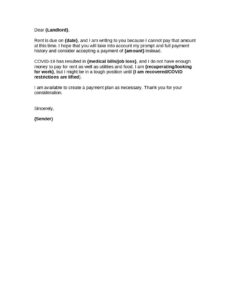
Covid Tenant Relief Request
Use a free Covid Tenant Relief Request template to formally ask your landlord for rent relief during hardship — free download in PDF and DOCX.
DOCX
0
likes
Download Files
- DOCX
A Covid Tenant Relief Request is a written letter a renter sends to a landlord or property manager asking for rent relief — such as a deferral, reduction, or payment plan — because a pandemic-related hardship has affected their ability to pay on time. People most often use it when a job loss, reduced hours, or illness has made the usual rent unaffordable and they want to put the request in writing rather than rely on a phone call. It’s free to download here in both PDF and DOCX formats, with no signup required.
What Is a Covid Tenant Relief Request?
A Covid Tenant Relief Request is a formal communication from a tenant to a landlord that documents a financial hardship tied to the pandemic and proposes a specific solution for the rent owed. It is typically issued by the renter (or their authorized representative) and addressed to the landlord, management company, or leasing office. The letter records what happened, how it affected the tenant’s income, what relief is being requested, and the time period involved. While it does not by itself change the lease, it creates a clear paper trail, opens a good-faith negotiation, and may be required to qualify for certain rental assistance programs or temporary protections that depend on a documented request.
When Do You Need a Covid Tenant Relief Request?
This letter is useful any time a renter needs to formally raise a hardship and ask for flexibility on rent. Common situations include:
- You lost your job, were furloughed, or had your hours cut and cannot pay the full rent this month.
- You or a household member became seriously ill and faced unexpected medical costs or lost income while recovering.
- You need to request a temporary rent reduction or to defer part of the rent until your income recovers.
- You want to propose a structured payment plan to catch up on missed or partial payments.
- A rental assistance program or local protection requires written proof that you notified your landlord of hardship.
- You prefer a documented record of the conversation in case of a future dispute over late fees or arrears.
What a Covid Tenant Relief Request Should Have
A clear, persuasive relief request is specific and respectful. To be complete and useful, the letter should include the tenant’s full name and the rental property address, the landlord or property manager’s name, and the date. It should state the lease details — monthly rent amount and the period affected — followed by a plain description of the hardship and its cause. The heart of the letter is the specific relief requested: a reduced amount, a deferral, forgiveness of late fees, or a proposed payment plan with dates and amounts. Supporting details — such as references to documentation you can provide — strengthen the case. Finally, it should close with the tenant’s contact information and signature so the landlord can respond promptly.
How to Fill Out a Covid Tenant Relief Request
- Add the date at the top, then the landlord’s or property management company’s name and address.
- Enter your full name and the complete rental property address, including unit number, so there is no confusion about which tenancy this concerns.
- State your current monthly rent and reference your lease or rental agreement and its start date.
- Describe the hardship in two or three honest sentences: what changed (job loss, reduced hours, illness), roughly when it began, and how it reduced your household income.
- Specify the relief you are requesting — for example, a rent reduction for a set number of months, deferral of a portion until a future date, waiver of late fees, or a written payment plan.
- If proposing a payment plan, list the amounts and dates you can realistically meet.
- Note any documentation you can provide, such as a termination notice, pay stubs, or proof of benefits.
- Add your phone number and email, then sign and date the letter. Keep a copy for your records.
Tips for a Stronger Request
Landlords respond better to letters that are concrete and solution-oriented. Lead with the specific relief you want rather than a long story, and propose a plan you can actually keep — offering to pay something, even a partial amount, signals good faith. Be honest about the timeline; if you expect your income to recover, say when. Keep your tone professional and cooperative, since you and your landlord both benefit from a workable arrangement. Send the letter in a way you can prove, such as email with a read receipt or certified mail, and follow up politely if you don’t hear back within a reasonable window. If you reach an agreement, ask to have it confirmed in writing.
How This Differs From a Lease Amendment
A relief request is the opening move — it asks for a change but does not, on its own, modify your obligations. If your landlord agrees, the new terms should be captured in a written agreement or lease addendum signed by both parties. Until that happens, your original lease typically remains in effect, including any rent and late-fee terms. Treat the request as the start of a negotiation rather than the final word, and don’t assume relief is granted simply because you asked. Keeping your request, any reply, and the final signed agreement together gives you a complete record if questions arise later.
Common Mistakes to Avoid
- Being vague about the relief you want — always name a specific amount, date, or plan.
- Stopping rent payments entirely before any agreement is reached, which can put you in breach of the lease.
- Leaving out the property address or unit number, which slows the landlord’s response.
- Promising a payment plan you can’t realistically keep, then defaulting on it.
- Sending the request by a method you can’t document, leaving no proof it was received.
- Assuming the request is automatically approved and failing to get the final terms in writing.
Frequently Asked Questions
What is a Covid Tenant Relief Request? It is a written letter from a renter to a landlord that documents a pandemic-related hardship and asks for specific rent relief, such as a reduction, deferral, or payment plan. It creates a clear record and opens a good-faith conversation about the rent owed.
How do I fill out a Covid Tenant Relief Request? Add the date, the landlord’s details, your name and rental address, and your monthly rent. Then briefly describe your hardship, state the exact relief you want, list any supporting documents, and sign with your contact information.
Does this letter need to be notarized or witnessed? No, a relief request is generally a simple business letter and does not require notarization or witnesses. What matters most is that it is clear, signed, dated, and sent in a way you can prove the landlord received it.
Is a relief request legally binding? The request itself is not binding — it is a proposal. Any relief only becomes enforceable once your landlord agrees and the new terms are captured in a signed written agreement or lease addendum, so always confirm the outcome in writing.
Will sending this stop late fees or eviction? Not automatically. Whether late fees, deferrals, or protections apply depends on your lease, your landlord’s response, and local rules, which vary by jurisdiction. Sending a documented request can help, but it does not change your obligations until an agreement is reached.
How much does this template cost? Nothing — this Covid Tenant Relief Request template is completely free to download in PDF and DOCX formats with no signup required. You can edit it to fit your situation and reuse it whenever you need to communicate with your landlord.
This template is a general example provided for informational purposes only and is not legal, financial, or tax advice. Rental laws, relief programs, and tenant protections vary by jurisdiction and change over time. Consult a qualified attorney, housing counselor, or local tenant resource for guidance specific to your situation.
Official resource: for the rules that apply to your situation, see HUD.
Related Forms
- Apartment Hunting Checklist
- Property Appraisal Form
- Landlord Lease Renewal Letter
- Intent To Vacate Apartment
- Complaint Letter Against Landlord
- Rental Lease Extension Request
Browse more in Rental and Real Estate.