
Bill of Sale Vehicle Parts
Download a free Vehicle Parts Bill of Sale template in PDF and DOCX to document the as-is sale of auto parts between buyer and seller — free download.
PDF
DOCX
5 downloads
0
likes
Download Files
- DOCX
A Vehicle Parts Bill of Sale is a written record that transfers ownership of one or more motor vehicle parts from a seller to a buyer, most often used to prove a private sale of used auto components like engines, transmissions, or body panels. It is free to download here in both PDF and DOCX formats, with no signup required.
What Is a Vehicle Parts Bill of Sale?
A Vehicle Parts Bill of Sale is a simple legal document that records the sale and transfer of motor vehicle parts between two private individuals or businesses. It is typically issued by the seller and signed by both parties to confirm that the seller is the legal owner of the items, that the parts are free of liens or encumbrances, and that they are sold “as is” with no warranties. Unlike a full vehicle title transfer, this form covers individual components rather than a complete automobile. It provides a paper trail that protects the buyer against future ownership disputes and gives the seller proof that responsibility for the parts passed at the time of sale.
When Do You Need a Vehicle Parts Bill of Sale?
This form is useful any time auto parts change hands and both sides want a clear record. Common situations include:
- Selling a used engine, transmission, or differential pulled from a donor vehicle.
- Buying body panels, doors, bumpers, or fenders from a private seller or salvage operation.
- Transferring high-value components such as catalytic converters, ECUs, or alloy wheels where proof of legitimate ownership matters.
- Selling parts removed from a damaged or totaled vehicle when liquidating an estate or project car.
- Documenting a wholesale sale of multiple parts between repair shops or recyclers.
- Creating a receipt when selling rare or collectible parts that may need provenance later.
What a Vehicle Parts Bill of Sale Should Have
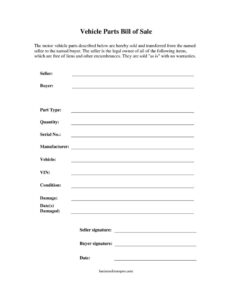
A complete parts bill of sale identifies the people involved, describes the items precisely, and confirms the terms of the transfer. The key elements are the full legal names of the seller and buyer, a clear description of each part including type, quantity, and any serial or manufacturer numbers, and details about the source vehicle such as make, model, and VIN. It should state the condition of the parts and note any damage and when it occurred. Finally, it needs an “as is” statement, a declaration that the items are free of liens, and dated signatures from both parties. Including all of these makes the document credible and useful if questions arise later.
How to Fill Out a Vehicle Parts Bill of Sale
- Seller: Enter the full legal name and contact details of the person or business selling the parts.
- Buyer: Enter the full legal name and contact details of the person or business purchasing the parts.
- Part Type: Describe each item clearly — for example “V6 engine block,” “front bumper assembly,” or “4-speed transmission.”
- Quantity: Note how many of each part are being sold.
- Serial No.: Record any serial or part numbers stamped on the component to make it identifiable.
- Manufacturer: List the brand or OEM that produced the part.
- Vehicle: Identify the source vehicle by year, make, and model.
- VIN: Enter the vehicle identification number of the donor vehicle when known.
- Condition: Describe the working state — new, used, rebuilt, salvage, or for parts only.
- Damage / Date(s) Damaged: Note any defects, cracks, or wear and when the damage occurred.
- Signatures and Date: Both the seller and buyer sign and date the form to finalize the transfer.
Types of Parts You Might Sell With This Form
The same template works across a wide range of components, but the level of detail you record should match the value and traceability of the part. Mechanical components like engines, transmissions, and rear ends usually carry stamped serial numbers, so be thorough in the Serial No. and Manufacturer fields. Body and exterior parts such as doors, hoods, and bumpers often lack serial numbers, so a detailed Part Type description and condition note matter more. Electronic modules and computers may require matching to a specific VIN to function, which is why the Vehicle and VIN fields are valuable. Wheels, tires, and trim pieces are typically sold by quantity, making the Quantity field the most important detail. Tailor the description to the item so the document leaves no ambiguity about exactly what was sold.
Why the “As Is” and Lien Language Matters
This template states that the parts are sold “as is” with no warranties and that the seller is the legal owner free of liens. The “as is” clause tells the buyer that they accept the parts in their current condition, which protects the seller from later claims that a component failed or was worn out. The lien declaration confirms the seller has the right to sell and that no lender or third party can claim the items. For higher-value parts such as engines or catalytic converters, this language combined with serial numbers helps demonstrate the parts were obtained legitimately. Keep a signed copy for your records, because it serves as both a receipt and proof of the transaction terms.
Common Mistakes to Avoid
- Leaving the Serial No. or Manufacturer blank when the part has identifiable markings — this weakens proof of ownership.
- Writing vague part descriptions like “engine parts” instead of naming each specific component.
- Forgetting to record the source vehicle’s VIN, which can matter for parts that must match a specific car.
- Skipping the Damage and Date(s) Damaged fields, leaving the condition open to dispute later.
- Failing to have both parties sign and date the form, which makes it far less useful as evidence.
- Not giving each party a signed copy of the completed bill of sale.
Frequently Asked Questions
What is a Vehicle Parts Bill of Sale used for? It is used to document the private sale and transfer of motor vehicle parts from a seller to a buyer. It records what was sold, the condition, and the agreed terms, serving as a receipt and proof of ownership transfer for both parties.
Does a Vehicle Parts Bill of Sale need to be notarized? In most cases a parts bill of sale does not require notarization to be valid between the buyer and seller. However, for high-value components some buyers prefer notarized signatures for extra assurance, and requirements vary by location, so check your local rules.
Is this bill of sale legally binding? Once both the seller and buyer sign and date the form, it generally creates a binding record of the transaction and its terms. The “as is” and no-liens language helps define each party’s responsibilities, though enforceability ultimately depends on local law.
What does “sold as is” mean on this form? It means the buyer accepts the parts in their current condition with no guarantees about performance or future reliability. This limits the seller’s responsibility after the sale, so buyers should inspect parts carefully before signing.
How much does this template cost? The Vehicle Parts Bill of Sale template is completely free to download from Business Forms Pro in both PDF and DOCX formats. There is no signup required, and you can fill it out by hand or edit it digitally.
Do I need the source vehicle’s VIN to sell parts? A VIN is not always required, but including it strengthens the record and is especially important for parts that must be matched to a specific vehicle, such as electronic control modules. Filling in the Vehicle and VIN fields makes the document more credible and traceable.
This template is provided as a general example for informational purposes only and is not legal, financial, or tax advice. Requirements for documenting the sale of vehicle parts vary by jurisdiction. Consult a qualified professional to ensure your specific transaction complies with applicable laws.
Official resource: for the rules that apply to your situation, see your state DMV.
Related Forms
- Recreational Vehicle Bill Of Sale
- Farm Animal Bill Of Sale
- Bike Bill of Sale
- Dock Receipt
- Antique Bill of Sale
- Salvage Bill Of Sale
Browse more in Bills of Sale.