
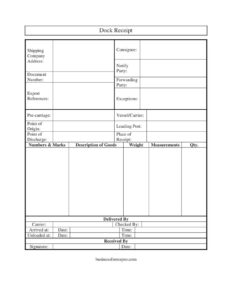
Dock Receipt
Download a free Dock Receipt template to document cargo handed over for ocean export, available as a free PDF and DOCX download with editable fields.
PDF
DOCX
20 downloads
0
likes
Download Files
- DOCX
A Dock Receipt is a document used in ocean freight shipping to confirm that cargo has been physically received at the pier, dock, or terminal and is ready to be loaded aboard a vessel for export. People most often use it to create a paper trail proving the carrier or terminal took custody of the goods before the bill of lading is issued. You can download this Dock Receipt template free as a print-ready PDF or an editable DOCX, with no signup required.
What Is a Dock Receipt?
A Dock Receipt is an interim transport document issued when goods arrive at an ocean terminal or warehouse ahead of loading. It is typically prepared by the shipper or freight forwarder and signed by the receiving carrier, terminal operator, or warehouse agent. The document records exactly what was delivered, in what condition, when, and by whom — bridging the gap between inland delivery and the issuance of an ocean bill of lading. While it is not a title document like a bill of lading, the Dock Receipt provides crucial evidence of receipt and condition. It captures shipment marks, quantities, weights, and any visible exceptions noted at the dock, helping resolve disputes about damage or shortages later in the supply chain.
When Do You Need a Dock Receipt?
This form comes into play whenever export cargo changes hands at a port facility. Common situations include:
- Delivering containerized or break-bulk freight to an ocean terminal before vessel loading.
- Handing cargo to a carrier or terminal operator who will hold it until a sailing date.
- Documenting condition at receipt so any damage caused before loading can be identified.
- Supporting a freight forwarder’s file ahead of preparing the ocean bill of lading.
- Providing proof of delivery to a warehouse or consolidation point for less-than-container-load (LCL) shipments.
- Reconciling quantities, weights, and measurements between the shipper’s packing list and what physically arrived at the dock.
In short, anytime export goods are received at a pier or warehouse and you need an official acknowledgment of that handover, a Dock Receipt is the right tool.
What a Dock Receipt Should Have
A complete Dock Receipt ties the physical cargo to a paper record. Key elements include the parties involved (shipper, consignee, notify party, and forwarding agent), the routing details (place of receipt, loading port, point of discharge, and point of origin), and a precise cargo description with quantity, weight, measurements, and numbers and marks. It should also identify the carrier or vessel, the document number for reference, the date and time of arrival, the person who delivered and the person who received the goods, and a signature confirming acceptance. Critically, it must include an exceptions field where damage, shortages, or irregularities are noted at the moment of receipt — this is what gives the document its evidentiary value.
How to Fill Out a Dock Receipt
- Enter the Document Number so the receipt can be cross-referenced with the booking and bill of lading.
- Fill in the Shipping Company Address and identify the Carrier and Vessel/Carrier handling the shipment.
- Record the Consignee, Notify Party, and Forwarding Party exactly as they appear on the booking.
- Complete the routing: Point of Origin, Place of Receipt, Pre-carriage, Loading Port, and Point of Discharge.
- Note Arrived at, Unloaded at, the Date, and the Time the cargo reached the dock.
- Describe the freight in Description of Goods, then enter Numbers & Marks, Qty., Weight, and Measurements.
- Add any Export References tied to the shipment or commercial documents.
- List any damage or discrepancies in the Exceptions field — leave blank only if the cargo is clean.
- Capture the chain of custody: Delivered By, Received By, and Checked By.
- Have the receiving party add a Signature to confirm acceptance.
Dock Receipt vs. Bill of Lading
It’s easy to confuse a Dock Receipt with an ocean bill of lading, but they serve different roles. The Dock Receipt is an internal, interim acknowledgment that goods reached the terminal — it is not a document of title and cannot be used to claim or transfer ownership of the cargo. The bill of lading, issued after loading, functions as a contract of carriage, a receipt for the goods, and often a negotiable title document. The information on the Dock Receipt — marks, quantities, weights, and exceptions — typically feeds directly into the bill of lading, which is why accuracy at the dock stage matters so much.
Tips for Accurate Documentation
Match the cargo details against your packing list and commercial invoice before signing. Record weights and measurements in consistent units, and confirm that numbers and marks on the document match the physical labels on the cargo. If you spot crushed cartons, broken seals, or short counts, write them clearly in the exceptions field rather than waving them through — an unrecorded problem becomes much harder to claim against later. Keep a copy for the shipper, the forwarder, and the carrier so everyone shares the same record of what was received.
Common Mistakes to Avoid
- Leaving the Exceptions field blank when damage was visible, which weakens any later claim.
- Mismatching the consignee or notify party with the booking, causing release problems at destination.
- Recording weights or measurements in the wrong units or estimating instead of verifying.
- Omitting the Document Number, making it hard to tie the receipt to the bill of lading.
- Forgetting the Signature or the name of who received and checked the goods.
- Failing to note the exact date and time of arrival, which can matter for storage charges and cutoff deadlines.
Frequently Asked Questions
What is a Dock Receipt used for? It documents that export cargo has been received at a pier, terminal, or warehouse and is ready for loading aboard a vessel. It records the cargo’s description, quantity, condition, and the parties involved, serving as evidence of custody before the ocean bill of lading is issued.
Who fills out and signs the Dock Receipt? The shipper or freight forwarder usually prepares the form with cargo and routing details, while the carrier, terminal operator, or warehouse agent who receives the goods signs to acknowledge custody. The fields for delivered by, received by, and checked by establish a clear chain of handling.
Is a Dock Receipt the same as a bill of lading? No. A Dock Receipt is an interim acknowledgment that goods arrived at the dock and is not a title document. The bill of lading, issued after loading, is the contract of carriage and often a negotiable document of title, though it draws its details from the Dock Receipt.
Why is the exceptions field important? The exceptions field is where you note any visible damage, shortages, or irregularities at the moment of receipt. Recording these promptly protects your ability to file a claim later, since cargo accepted without noted exceptions is presumed to have been received in good order.
Is a Dock Receipt legally binding? It is an evidentiary document that records receipt and condition rather than a binding contract on its own. Its information and signature can carry significant weight in disputes over damage or shortage, so it should be completed carefully and honestly.
How much does this Dock Receipt template cost? Nothing — you can download it here completely free as a PDF or editable DOCX with no signup or account required. Fill it on a computer or print it for handwritten use at the dock.
This Dock Receipt template is provided as a general example for informational purposes only and is not legal, financial, or shipping compliance advice. Documentation requirements and trade regulations vary by carrier, port, and jurisdiction — consult a qualified freight forwarder, customs broker, or legal professional for guidance on your specific shipment.
Official resource: for the rules that apply to your situation, see your state DMV.
Related Forms
- Musical Instrument Bill of Sale
- Bill of Sale With Lien
- Trailer Bill Of Sale
- Firewood Bill Of Sale
- Farm Animal Bill Of Sale
- Golf Cart Bill Of Sale
Browse more in Bills of Sale.