
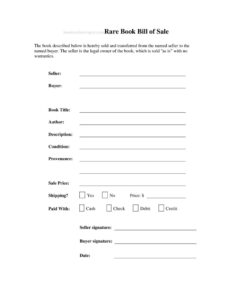
Rare Book Bill Of Sale
Download a free Rare Book Bill of Sale template in PDF and DOCX to document the sale, condition, and provenance of a collectible book.
PDF
DOCX
0
likes
Download Files
- DOCX
A Rare Book Bill of Sale is a written record that documents the transfer of ownership of a collectible, antiquarian, or first-edition book from a seller to a buyer. People most often use it to create proof of purchase, confirm the agreed price, and record the book’s condition and provenance at the moment of sale. You can download this Rare Book Bill of Sale template free in PDF and DOCX, with no signup required.
What Is a Rare Book Bill of Sale?
A Rare Book Bill of Sale is a short legal document that records the sale of a rare or valuable book and confirms that ownership has passed from the seller to the buyer. It is typically issued by the seller — whether a private collector, an estate, an antiquarian dealer, or an auction participant — and given to the buyer once payment is complete. The form documents the identity of both parties, a detailed description of the book, the purchase price, and the date of the transaction. Because rare books can be worth substantial sums and are vulnerable to disputes over authenticity and condition, this document serves as both a receipt and a permanent reference for the item’s history.
When Do You Need a Rare Book Bill of Sale?
This document is useful any time a collectible book changes hands and both parties want a clear written record. Common situations include:
- Selling a first edition, signed copy, or antiquarian volume to a private collector.
- Buying a rare book at a fair, estate sale, or online marketplace and wanting documented proof of purchase.
- Settling or distributing an estate that includes a valuable book collection.
- Transferring a book to a dealer for resale or consignment-related sale.
- Establishing provenance to support a future appraisal, insurance claim, or resale.
- Donating or gifting a book where a record of value and condition is needed for tax or insurance purposes.
Types of Rare Book Transactions
Not every rare book sale looks the same, and the bill of sale should reflect the nature of the deal. A private collector-to-collector sale often emphasizes provenance and signature authenticity. A dealer sale may include warranties about edition and condition. An estate sale typically sells the book “as is” with limited representations. A cash sale at a book fair may be brief but still benefits from a written description. Identifying the type of transaction helps you decide how much detail to include and whether to add condition disclaimers or authenticity statements.
What a Rare Book Bill of Sale Should Have
A complete bill of sale for a rare book includes the elements that identify the item and the deal precisely:
- Full names and contact details of the seller and buyer.
- The date of the sale.
- A detailed description of the book: title, author, publisher, edition, printing, and year.
- Distinguishing features such as signatures, inscriptions, bindings, dust jacket, or illustrations.
- A condition statement noting any flaws, repairs, or restoration.
- The purchase price and method of payment.
- Any provenance or chain-of-ownership information.
- An “as is” clause or authenticity representation, as agreed.
- Signatures of both parties.
How to Fill Out a Rare Book Bill of Sale
- Enter the date of the transaction at the top of the form.
- Identify the seller by full legal name and address, and add a phone number or email.
- Identify the buyer with the same complete contact information.
- Describe the book in detail: record the title, author, publisher, edition number, printing, and publication year exactly as they appear.
- Note unique features such as author signatures, inscriptions, bookplates, the presence or absence of a dust jacket, and binding type.
- Document the condition honestly, listing foxing, tears, missing pages, spine wear, repairs, or restoration.
- State the purchase price in numbers and words, and record how payment was made (cash, check, card, or transfer).
- Add provenance details if known, including prior owners or supporting documentation.
- Include any clauses such as an “as is” sale or an authenticity warranty.
- Sign and date: both seller and buyer sign, and each keeps a copy.
Provenance, Authenticity, and Condition
For rare books, the written description often matters as much as the price. Provenance — the documented history of who owned the book — can significantly affect value and credibility, so record any auction catalogs, prior bills of sale, or letters of authenticity that accompany the item. When a book is signed or inscribed, note exactly what the inscription says and to whom, since this detail is central to authenticity. Condition should be described using consistent, honest language; many collectors use standard grades such as fine, very good, good, and fair. Because this bill of sale becomes part of the book’s documented history, an accurate, specific description protects both parties and supports future appraisal or resale.
Common Mistakes to Avoid
- Writing a vague description like “old book” instead of recording edition, printing, and year.
- Overstating condition or omitting known flaws, which can lead to disputes later.
- Forgetting to specify whether the sale is “as is” or carries an authenticity warranty.
- Leaving out provenance documents that establish the chain of ownership.
- Failing to record the payment method and confirm that payment was received in full.
- Not having both parties sign and keep their own copy of the completed form.
Frequently Asked Questions
What is a Rare Book Bill of Sale used for? It is used to document the sale of a collectible or antiquarian book and to confirm that ownership has transferred from the seller to the buyer. It serves as a receipt, a record of condition, and a reference for provenance. Both parties keep a copy for their records.
Does a Rare Book Bill of Sale need to be notarized? Notarization is generally not required for a book sale, but some buyers and sellers choose to notarize high-value transactions to add an extra layer of verification. Requirements vary by jurisdiction, so check your local rules if a notary is important to you. At minimum, both parties should sign and date the document.
Is this document legally binding? When signed by both the buyer and seller, a bill of sale generally serves as binding evidence of the transaction and the terms agreed upon. Its enforceability depends on accurate information and applicable local law. Keeping a complete, honest record strengthens its value in any dispute.
How do I describe the book’s condition? Be specific and honest, noting features such as the dust jacket, binding, foxing, tears, repairs, or missing pages. Many collectors use standard grades like fine, very good, good, and fair to communicate condition consistently. Including photographs alongside the description is a helpful addition.
What should I do about authenticity? Record any signatures, inscriptions, or supporting documents, and state clearly whether the sale includes an authenticity warranty or is sold “as is.” For high-value items, an independent appraisal or expert authentication before the sale is wise. Attach any certificates to the bill of sale.
How much does this template cost? This Rare Book Bill of Sale template is completely free to download from Business Forms Pro in both PDF and DOCX formats, with no signup required. You can fill it out digitally or print and complete it by hand. Edit it freely to match the specifics of your transaction.
This template is a general example provided for informational purposes only and is not legal, financial, or tax advice. Requirements for documenting the sale of valuable goods vary by jurisdiction, and authenticity or appraisal matters can be complex. Consult a qualified professional before relying on this document for a significant transaction.
Official resource: for the rules that apply to your situation, see your state DMV.
Related Forms
- Mobile Home Bill Of Sale
- Bill of Sale Vehicle Parts
- Dock Receipt
- Farm Animal Bill Of Sale
- As-Is Bill Of Sale
- Recreational Vehicle Bill Of Sale
Browse more in Bills of Sale.