
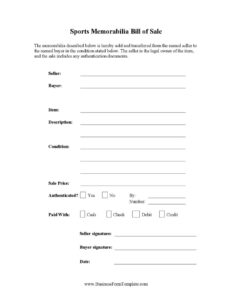
Sports Memorabilia Bill Of Sale
Download a free Sports Memorabilia Bill of Sale template in PDF or DOCX to document the sale of signed jerseys, cards, and collectibles with confidence.
PDF
1 downloads
0
likes
Download Files
A Sports Memorabilia Bill of Sale is a written record that documents the sale and transfer of a sports collectible — such as a signed jersey, autographed ball, trading card, or game-used equipment — from a seller to a buyer. People most often use it to create a paper trail of ownership and authenticity when buying or selling high-value items in a private deal. You can download this form free in PDF or DOCX format, with no signup required.
What Is a Sports Memorabilia Bill of Sale?
A Sports Memorabilia Bill of Sale is a simple sales document that confirms a specific collectible changed hands for an agreed price on a specific date. It is typically created by the seller and signed by both parties at the time of the transaction. The form identifies the item being sold, describes its condition and any authentication details, and records the payment amount and method. Unlike a generic receipt, it ties the buyer, seller, and item together in one signed record. For collectors, this document supports provenance — the chain of ownership that often affects a piece’s market value and credibility down the road.
When Do You Need a Sports Memorabilia Bill of Sale?
This form is useful any time a collectible moves from one owner to another outside of a major auction house. Common situations include:
- Selling a signed jersey, helmet, or ball to a private buyer you met online or at a card show.
- Buying a graded trading card and wanting written proof of the price and seller identity.
- Transferring game-used equipment between collectors who want a clear provenance record.
- Gifting or passing memorabilia to a family member and documenting it for insurance or estate purposes.
- Trading or consigning a piece and needing a record before it leaves your possession.
- Reselling an item later, where the original bill of sale helps demonstrate authenticity and history.
Types of Memorabilia This Form Covers
The same form works across a wide range of collectibles: autographed photos and jerseys, single trading cards or sealed packs, game-worn uniforms, championship rings, ticket stubs, signed bats and balls, bobbleheads, and limited-edition prints. Whatever the item, the goal is the same — describe it precisely enough that there is no confusion about what was sold.
What a Sports Memorabilia Bill of Sale Should Have
A complete bill of sale leaves no room for ambiguity. It should clearly include the full names and contact information for both the buyer and the seller, the date of sale, and a detailed description of the item. That description should cover the player or team, the type of item, any serial or grading numbers, and the condition. The form should also state the sale price, the payment method, and whether the item is sold “as-is.” Finally, it needs space for any authentication or certificate of authenticity (COA) references, plus signatures from both parties confirming the transaction took place.
How to Fill Out a Sports Memorabilia Bill of Sale
- Date: Enter the date the sale takes place at the top of the form.
- Seller information: Write the seller’s full legal name, mailing address, and phone or email.
- Buyer information: Add the buyer’s full name and the same contact details.
- Item description: Describe the memorabilia in detail — player or team name, item type (jersey, card, ball), the year, brand, and any unique markings or serial numbers.
- Authentication details: Note any COA, holographic sticker, or grading company and certification number, and attach copies if available.
- Condition: Record the item’s condition honestly (mint, near-mint, used, with flaws).
- Sale price: State the agreed total and the payment method (cash, transfer, check).
- As-is clause: Confirm whether the item is sold with no warranty.
- Signatures: Both buyer and seller sign and date. Each party keeps a copy.
Authentication and Provenance Notes
For sports memorabilia, the value of a bill of sale comes largely from how well it supports authenticity. Whenever possible, reference any certificate of authenticity by its issuing company and certificate number, and describe the form of authentication (a tamper-evident hologram, a letter of authenticity, or third-party grading). Photographs of the item — including close-ups of signatures, tags, and any serial numbers — can be attached to the bill of sale to strengthen the record. Keep the original COA and the bill of sale together in a safe place. Over time, this combined paper trail becomes part of the item’s provenance and can make a meaningful difference if you sell or insure the piece later.
Bill of Sale vs. Receipt vs. COA
These three documents are related but not interchangeable. A simple receipt confirms payment but rarely identifies both parties or the item in detail. A certificate of authenticity vouches for the genuineness of a signature or item but does not record the sale itself. A bill of sale ties everything together: it names the buyer and seller, describes the item, states the price, and is signed by both. For serious collectibles, having all three creates the strongest record of ownership and authenticity.
Common Mistakes to Avoid
- Vague item descriptions — “signed ball” instead of the player, year, and authentication number.
- Forgetting to record COA or grading details, which weakens the provenance later.
- Leaving off one party’s signature or contact information.
- Not specifying whether the sale is “as-is” versus guaranteed authentic.
- Overstating condition or signature quality, which can lead to disputes.
- Failing to keep a copy — both buyer and seller should retain a signed version.
Frequently Asked Questions
What is a Sports Memorabilia Bill of Sale? It is a signed document that records the sale of a collectible item from a seller to a buyer, including the item description, price, and authentication details. It serves as proof of the transaction and supports the item’s chain of ownership.
How do I fill out a Sports Memorabilia Bill of Sale? Enter the date, the buyer’s and seller’s names and contact details, and a detailed description of the item, including any COA or grading numbers. Then record the price and payment method, and have both parties sign and date the form.
Does a Sports Memorabilia Bill of Sale need to be notarized? Notarization is generally not required for memorabilia sales, but it can add an extra layer of credibility for high-value items. Requirements vary by location, so check your local rules if you want the document notarized or witnessed.
Is this bill of sale legally binding? Once both parties sign, a bill of sale generally functions as a binding record of the transaction and the agreed terms. To be enforceable, the details should be accurate and complete, and both parties should keep a signed copy.
Does the form prove the item is authentic? A bill of sale documents who sold the item and on what terms, but it is not itself a guarantee of authenticity. Pair it with a certificate of authenticity, grading, or expert verification for the strongest proof.
How much does this template cost? This Sports Memorabilia Bill of Sale template is completely free to download here in PDF or DOCX format, with no signup or account required. You can fill it out by hand or edit the document on your computer.
This template is a general example provided for informational purposes only and is not legal, financial, or tax advice. Authentication standards and sale requirements vary by jurisdiction and by item — consult a qualified professional or reputable authentication service for guidance on your specific situation.
Official resource: for the rules that apply to your situation, see your state DMV.
Related Forms
- Conditional Bill Of Sale
- Recreational Vehicle Bill Of Sale
- Dry Cleaning Ticket
- As-Is Bill Of Sale
- Bill of Sale Vehicle Parts
- Bill of Sale for Parts Only
Browse more in Bills of Sale.