
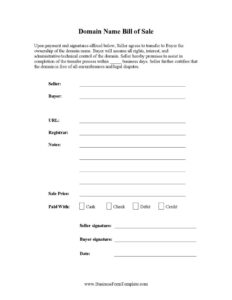
Domain Name Bill Of Sale
Download a free Domain Name Bill of Sale template in PDF or DOCX to document the transfer of a website domain between seller and buyer with no signup.
PDF
0
likes
Download Files
A Domain Name Bill of Sale is a written record that documents the sale and transfer of an internet domain name from a seller to a buyer. People most often use it to create proof of ownership change when buying or selling a valuable web address, and it’s free to download here in both PDF and DOCX formats with no signup required.
What Is a Domain Name Bill of Sale?
A Domain Name Bill of Sale is a legal document that confirms a domain name has changed hands for an agreed price. It identifies the seller (often called the transferor) and the buyer (the transferee), names the exact domain being sold, states the purchase amount, and records the date the transaction closed. Unlike a standard purchase agreement that may set out future obligations, a bill of sale is primarily evidence that the transfer actually occurred. It is used by individuals, freelancers, startups, and businesses who buy and sell domains as digital assets, and it serves as a paper trail for both parties’ records, tax purposes, and any registrar transfer process.
When Do You Need a Domain Name Bill of Sale?
Because domains are intangible but often valuable, having clear documentation prevents disputes later. Common situations include:
- Selling a premium or aged domain you registered years ago to another party for a lump sum.
- Buying a domain through a private deal or marketplace and wanting written proof of the purchase.
- Transferring a domain as part of selling an entire website, brand, or online business.
- Acquiring a competitor’s or complementary domain to protect a brand or redirect traffic.
- Documenting the handover of a domain between business partners, family members, or related companies.
- Including the domain transfer in due diligence records during a larger acquisition or merger.
What a Domain Name Bill of Sale Should Have
A complete bill of sale leaves no room for confusion about what was sold and to whom. The essential elements include the full legal names and contact details of both the seller and buyer, the exact domain name being transferred (spelled precisely, including the extension such as .com or .net), the agreed purchase price and how it was paid, and the closing or effective date. It should also state that the seller is the lawful owner with the right to sell, confirm that the domain is being transferred free of liens or competing claims, and include signature lines for both parties. Many versions add the registrar name and any warranties or “as-is” language to clarify the condition of the asset.
How to Fill Out a Domain Name Bill of Sale
- Enter the date of the sale at the top so the document has a clear effective date.
- Fill in the seller’s full name and address, and the buyer’s full name and address, matching official identification or business records.
- Write the exact domain name being sold, including the extension. Double-check spelling and hyphens — a single typo can void the description.
- List the registrar where the domain is currently held, if the template provides space for it.
- State the purchase price in numbers and words, and note the payment method (wire, escrow service, check, or cryptocurrency).
- Include any warranties or representations, such as the seller confirming clear ownership and the buyer accepting the domain in its current condition.
- Add any additional terms, like who pays transfer fees or a deadline for completing the registrar push.
- Have both the seller and buyer sign and date. Each party should keep a copy for their records.
Completing the Registrar Transfer
Signing the bill of sale documents the deal, but it does not automatically move the domain between accounts. The actual transfer happens at the registrar level — usually through an authorization (EPP) code, an account-to-account “push,” or an inter-registrar transfer. Best practice is to use a reputable escrow service for higher-value domains so that payment is only released once the buyer confirms control of the domain. The bill of sale, paired with the escrow receipt and registrar confirmation, forms a complete record of a clean transaction. Make sure the domain is unlocked and out of any 60-day transfer hold before initiating the move, and update the WHOIS contact details promptly after the handover.
Bill of Sale vs. Purchase Agreement
A domain purchase agreement and a domain bill of sale serve related but distinct roles. The agreement is typically negotiated first and sets out conditions, timelines, contingencies, and remedies if something goes wrong. The bill of sale is the closing document — it confirms the sale was completed and ownership passed. For small private deals, a single bill of sale often covers everything. For larger or more complex transactions, parties may use both: an agreement to define the terms and a bill of sale to memorialize the final transfer.
Common Mistakes to Avoid
- Misspelling the domain or omitting the extension, which makes the document ambiguous about exactly what was sold.
- Releasing payment before the buyer actually controls the domain in their own registrar account.
- Leaving out who pays transfer or escrow fees, leading to last-minute disputes.
- Failing to confirm the seller is the true registrant — verify against current WHOIS or registrar records.
- Forgetting to note any trademarks tied to the domain that could create future legal exposure.
- Skipping signatures or dates, which weakens the document as proof of the transaction.
Frequently Asked Questions
What is a Domain Name Bill of Sale? It is a written document that records the sale and transfer of a domain name from a seller to a buyer. It identifies both parties, names the domain, states the price, and serves as proof that ownership changed hands.
How do I fill out a Domain Name Bill of Sale? Enter the date, the names and addresses of the seller and buyer, the exact domain name with its extension, the purchase price and payment method, and any warranties or extra terms. Both parties then sign and keep copies for their records.
Does a Domain Name Bill of Sale need to be notarized? Notarization is generally not required for a domain bill of sale, but it can add an extra layer of verification for high-value sales. Requirements vary by jurisdiction, so check your local rules and consider notarizing if either party wants stronger proof.
Is a Domain Name Bill of Sale legally binding? When it is signed by both parties and reflects a genuine agreement supported by payment, it is generally considered binding evidence of the transaction. The actual ownership change, however, is finalized through the registrar transfer process.
Does signing the bill of sale transfer the domain automatically? No. The document records the deal, but the domain must still be moved between accounts using an authorization code, an account push, or an inter-registrar transfer. Always confirm the buyer has control before considering the sale complete.
How much does this Domain Name Bill of Sale template cost? It is completely free to download from Business Forms Pro in both PDF and DOCX formats, with no signup or account required. You can edit the DOCX version to fit your specific transaction.
This Domain Name Bill of Sale template is a general example provided for informational purposes only and is not legal, financial, or tax advice. Domain transfer rules and contract requirements vary by jurisdiction and registrar — consult a qualified professional before completing a significant transaction.
Official resource: for the rules that apply to your situation, see your state DMV.
Related Forms
- Farm Animal Bill Of Sale
- ATV Bill Of Sale
- Rare Book Bill Of Sale
- Recreational Vehicle Bill Of Sale
- Horse Bill Of Sale
- Snowmobile Bill Of Sale
Browse more in Bills of Sale.