
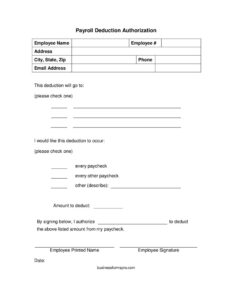
Payroll Deduction Authorization
Download a free Payroll Deduction Authorization form template in PDF and DOCX to document an employee's written consent for payroll deductions.
PDF
DOCX
8 downloads
0
likes
Download Files
- DOCX
A Payroll Deduction Authorization is a short written form an employee signs to give their employer permission to withhold a specific amount or percentage from their paycheck for a defined purpose. It is most commonly used to set up voluntary deductions such as benefit premiums, retirement contributions, loan repayments, or charitable giving. You can download this form free in PDF and DOCX with no signup required.
What Is a Payroll Deduction Authorization?
A Payroll Deduction Authorization is a document that records an employee’s voluntary, written consent for an employer to deduct money from their wages. It typically identifies the employee, the type of deduction, the amount or rate, how often it occurs, and when it starts and stops. Employers use it to comply with wage-and-hour rules that often require written authorization before withholding anything beyond legally mandated taxes and garnishments. Payroll and HR departments keep the signed form on file as proof that the deduction was authorized. By documenting the agreement clearly, both the employer and employee avoid confusion about why a paycheck was reduced and by how much.
When Do You Need a Payroll Deduction Authorization?
Anytime an employer wants to take money out of an employee’s pay for a voluntary or agreed-upon reason, written authorization protects both parties. Common situations include:
- Benefit enrollment — withholding premiums for health, dental, vision, or supplemental insurance plans.
- Retirement contributions — deducting elected amounts for a 401(k), 403(b), or similar savings plan.
- Repaying an advance or loan — recovering a payroll advance, signing bonus, or employee loan in scheduled installments.
- Equipment or uniform costs — covering the cost of tools, uniforms, or a company device where local law permits.
- Charitable or union contributions — sending recurring donations or union dues from each paycheck.
- Correcting an overpayment — recovering wages paid in error through an agreed repayment schedule.
Types of Payroll Deductions
It helps to distinguish the deductions this form covers from those it does not. Mandatory deductions — federal, state, and local income tax, Social Security, Medicare, and court-ordered garnishments — generally do not require employee consent because the law compels them. Voluntary deductions are the ones this authorization addresses: benefits, savings plans, loan repayments, and similar items the employee chooses or agrees to. Some deductions, such as recovering an overpayment or charging for equipment, sit in a gray area where written consent is strongly advised or legally required depending on the jurisdiction. This form gives you a clean record for any of those voluntary or agreed-upon withholdings.
What a Payroll Deduction Authorization Should Have
A complete authorization leaves no ambiguity about what is being withheld and why. Strong versions include:
- The employee’s full name and identifying details such as employee ID or department.
- The employer or company name.
- A clear description of the deduction’s purpose.
- The exact amount per pay period or a stated percentage of wages.
- The frequency and the total number of deductions, if there is a cap.
- The start date and, where applicable, an end date.
- A statement that the employee authorizes the deduction voluntarily.
- The employee’s signature and date, plus an employer or HR acknowledgment line.
How to Fill Out a Payroll Deduction Authorization
Work through the form one section at a time so the final document is accurate and easy for payroll to process:
- Enter employee information. Write the employee’s full legal name, employee ID number, job title, and department so payroll can match the form to the correct record.
- Identify the employer. Add the company or organization name and, if requested, the location or pay group.
- Describe the deduction. State exactly what the money is for — for example, “health insurance premium” or “repayment of payroll advance.”
- Specify the amount. Enter the dollar amount per pay period or the percentage of gross wages to withhold.
- Set the frequency and duration. Note whether it recurs each pay period, the start date, and an end date or total number of deductions if it is finite.
- Add any cap or total. For loans or advances, record the total amount being repaid so deductions stop automatically when satisfied.
- Review the authorization statement. Confirm the language stating the deduction is voluntary and that the employee understands it.
- Sign and date. The employee signs and dates, and an HR or payroll representative acknowledges receipt.
Recordkeeping and Changes
Once signed, the form should be stored with the employee’s payroll records and treated as confidential. Many employers retain authorizations for several years after the deduction ends, both for audit purposes and to resolve any dispute about prior paychecks. If the employee wants to change the amount or stop the deduction, the cleanest approach is to complete a new authorization or a written revocation rather than relying on a verbal request. Keep the original on file even after a deduction stops, so you can show when and why the withholding began. For finite deductions like loan repayments, confirm the total stops once the balance is cleared so the employee is never over-deducted.
Common Mistakes to Avoid
- Leaving the amount vague — “as needed” or “varies” invites disputes; state a specific figure or percentage.
- Skipping the start date — without it, payroll may begin deducting in the wrong cycle.
- Forgetting an end date or cap — finite deductions can run too long and over-withhold.
- Not getting a signature — an unsigned form is not valid authorization.
- Withholding below minimum wage — many jurisdictions prohibit deductions that drop pay under the legal minimum.
- Losing the form — keep the signed original on file for the entire required retention period.
Frequently Asked Questions
What is a Payroll Deduction Authorization used for? It documents an employee’s written consent for an employer to withhold a specific amount from their wages for a voluntary purpose. Common uses include benefit premiums, retirement contributions, loan repayments, and charitable giving. The signed form serves as proof the deduction was authorized.
Is a Payroll Deduction Authorization legally required? For most voluntary deductions, written authorization is either required or strongly recommended under wage-and-hour laws. Mandatory deductions like taxes and court-ordered garnishments do not need consent. Because rules vary by state and country, check your local wage payment laws to confirm what must be authorized in writing.
How do I fill out the form? Enter the employee and employer details, describe the deduction’s purpose, state the exact amount or percentage, and set the frequency, start date, and any end date or total cap. The employee then signs and dates the form, and HR or payroll acknowledges it. Keep the completed form with the employee’s payroll records.
Can an employee cancel a payroll deduction? Most voluntary deductions can be stopped or changed by submitting a written revocation or a new authorization. Some deductions tied to a contract, such as a loan repayment agreement, may have terms about when they can stop. Always document any change in writing rather than relying on a verbal request.
Does this form need to be notarized? Notarization is generally not required for a payroll deduction authorization. An employee signature and an employer acknowledgment are usually sufficient. Follow your company’s internal policy and any applicable local rules for how authorizations should be recorded.
Is this template really free to download? Yes. You can download this Payroll Deduction Authorization template free in both PDF and DOCX formats with no signup required. Edit it to match your organization’s pay periods, deduction types, and recordkeeping needs.
This template is a general example provided for informational purposes only and is not legal, financial, or tax advice. Payroll deduction rules vary by jurisdiction and may limit what can be withheld and under what conditions. Consult a qualified payroll, HR, or legal professional before relying on this form.
Related Forms
- Day Off Request Form
- Additional Work Authorization Form
- Bank Account Closure Authorization
- Request For Divorce Records
- Company Request Rejection
- Service Call Book
Browse more in Request and Authorization.