
Shareholder Ballot
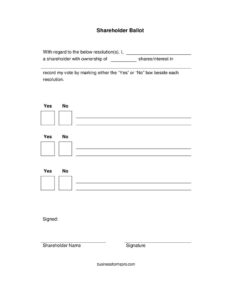
Download a free Shareholder Ballot template to record yes or no votes on corporate resolutions — clear, printable, and ready in PDF and DOCX format.
PDF
DOCX
0
likes
Download Files
- DOCX
A Shareholder Ballot is a written voting document that lets a shareholder formally cast a yes or no vote on a corporate matter put before them, such as a resolution, election, or proposed amendment. People most often use one to gather and record clear, documented votes at or before an annual or special meeting. You can download this Shareholder Ballot free in both PDF and DOCX formats, with no signup required.
What Is a Shareholder Ballot?
A Shareholder Ballot is a form issued by a corporation — typically through its secretary or board — that gives each eligible shareholder a structured way to vote on a specific item of business. Rather than relying on a verbal show of hands, the ballot captures each shareholder’s decision in writing, usually as a simple yes or no, alongside their signature. It documents who voted, how they voted, and confirms their participation in the corporate decision. This written record helps the company tally results accurately, demonstrate that proper voting procedures were followed, and resolve any later disputes about whether a resolution was actually approved by the required number of shares.
When Do You Need a Shareholder Ballot?
Corporations use ballots whenever a decision must be put to the shareholders and recorded formally. Common situations include:
- Annual meetings where shareholders approve the election of directors, ratify auditors, or accept financial statements.
- Special meetings called to vote on a single significant matter, such as a merger, sale of assets, or dissolution.
- Amending governing documents, including changes to the articles of incorporation or corporate bylaws.
- Approving major transactions that require shareholder consent under the company’s bylaws or applicable law.
- Written consent votes conducted outside a meeting, where each shareholder returns a completed ballot by a deadline.
- Contested decisions where management wants a clear, signed paper trail showing exactly how each share was voted.
What a Shareholder Ballot Should Have
A complete and usable Shareholder Ballot should clearly state the matter being voted on so there is no ambiguity about what a yes or no means. It needs distinct yes and no options that the shareholder can mark plainly, a space for the shareholder’s printed name, and at least one signature line to authenticate the vote. Many ballots also include the name of the corporation, the date of the meeting or voting deadline, the number of shares the holder is entitled to vote, and a reference to the specific resolution number. Including these details makes tallying straightforward and gives the result a defensible, well-documented foundation.
How to Fill Out a Shareholder Ballot
This template keeps things simple, so completing it correctly takes only a moment. Follow these steps:
- Read the resolution. Before marking anything, confirm the exact matter or proposal the ballot covers so your vote reflects your true intention.
- Mark your choice. Select the yes field to vote in favor of the resolution, or the no field to vote against it. Mark only one to keep your ballot valid.
- Confirm a single selection. Make sure you have not checked both boxes, as a ballot showing two conflicting choices may be set aside as spoiled.
- Sign the ballot. Use the Signed line to add your signature, authenticating that the vote is genuinely yours. If two signature lines are provided, a co-owner of the shares or a second authorized signer can also sign.
- Add identifying details. If the corporation requests it, print your name and note the number of shares you are voting alongside your signature.
- Return the ballot to the corporate secretary or designated officer by the stated deadline or hand it in at the meeting.
Yes, No, and Why the Choice Matters
The heart of this ballot is the binary yes/no decision. A yes vote signals approval of the resolution exactly as presented, while a no vote registers opposition. Because the count is what ultimately determines whether a measure passes, clarity is essential. If a shareholder wishes to abstain, the company should provide separate instructions, since abstentions are treated differently from a no vote under many bylaws. Always vote on the resolution as written — if you disagree with only part of it, the proper course is usually to vote no and raise amendments through the meeting’s normal procedures rather than altering the ballot itself.
Counting and Recording the Vote
After ballots are collected, the corporate secretary or an appointed inspector of elections tallies the yes and no responses, often weighting each ballot by the number of shares the holder controls rather than counting one vote per person. The threshold needed for approval — a simple majority, a supermajority, or another standard — is set by the corporation’s bylaws and the governing statute. Completed ballots are typically retained with the meeting minutes as part of the corporate record. Keeping the signed originals matters because they serve as evidence that the required approval was obtained should the decision ever be questioned by shareholders, auditors, or a regulator.
Common Mistakes to Avoid
- Marking both yes and no, which makes the ballot ambiguous and likely invalid.
- Forgetting to sign — an unsigned ballot generally cannot be authenticated or counted.
- Missing the deadline for ballots submitted by written consent or mail-in voting.
- Voting on the wrong resolution because the ballot was not matched to the correct numbered item.
- Not recording share counts when votes are weighted by shareholding, leading to inaccurate tallies.
- Discarding completed ballots instead of filing them with the official minutes and records.
Frequently Asked Questions
What is a Shareholder Ballot used for? It is used to record a shareholder’s formal vote — yes or no — on a corporate matter such as electing directors, approving a merger, or amending the bylaws. The signed ballot becomes part of the corporate record and supports an accurate tally of the result.
How do I fill out the yes and no fields? Read the resolution carefully, then mark the yes field to support it or the no field to oppose it, choosing only one. After marking your choice, sign on the line provided so the vote can be authenticated and counted.
Does a Shareholder Ballot need to be notarized or witnessed? Most ballots do not require notarization; the shareholder’s signature is generally sufficient. However, some corporations or specific transactions may call for witnessing or additional verification, so check your bylaws and any instructions provided with the ballot.
Is a Shareholder Ballot legally binding? A properly completed and signed ballot reflects a binding vote when it follows the corporation’s bylaws and applicable law, and when the required approval threshold is met. The underlying resolution takes effect once the votes are validly tallied and recorded.
Can I change my vote after submitting the ballot? Whether a vote can be changed depends on the corporation’s procedures and timing — some allow revocation before the polls close or before a written-consent deadline. Contact the corporate secretary promptly if you need to revise a submitted ballot.
How much does this Shareholder Ballot template cost? It is completely free to download from Business Forms Pro in both PDF and DOCX formats, with no signup required. You can customize the resolution wording and fields to match your meeting before printing or distributing it.
This Shareholder Ballot template is a general example provided for informational purposes only and is not legal, financial, or tax advice. Corporate voting requirements and approval thresholds vary by jurisdiction and by a company’s governing documents — consult a qualified attorney or corporate professional before relying on this form.
Related Forms
- Appointment of Proxy
- Request For Birth Certificate
- Drug and Alcohol Testing Company
- Specialty Item Form
- Request To Terminate Unauthorized Service
- Parental Image Use Permission Form
Browse more in Request and Authorization.