
FOIA Request
Download a free FOIA request letter template to request federal records, ask for fee waivers, and submit your Freedom of Information Act request fast.
DOCX
3 downloads
0
likes
Download Files
- DOCX
A FOIA request is a written letter that asks a federal agency to release records under the Freedom of Information Act. People most often use it to obtain government documents, reports, or data that are not already published, and you can download this template free in PDF and DOCX with no signup required.
What Is a FOIA Request?
A FOIA request is a formal letter submitted to a U.S. federal agency invoking the Freedom of Information Act, the law that gives any person the right to access records held by federal executive branch agencies. The letter identifies the requester, describes the specific records being sought, and addresses how fees should be handled. It is issued by an individual, journalist, researcher, business, or organization, and directed to the agency that holds the records — often to a designated FOIA officer or the head of the agency. The purpose is to create a clear, dated paper trail that triggers the agency’s legal obligation to search for, review, and produce responsive documents (or explain why they are being withheld).
When Do You Need a FOIA Request?
You need a FOIA request whenever you want federal records that have not been proactively published. Common situations include:
- Journalism and reporting: A reporter seeks internal memos, contracts, or correspondence for a story in the public interest.
- Academic research: A scholar or graduate student requests datasets, studies, or historical files from a federal department.
- Personal records: An individual asks for their own immigration file, military records, or other documents an agency holds about them.
- Business and legal due diligence: A company requests inspection reports, regulatory filings, or enforcement records relevant to its industry.
- Government accountability: A nonprofit or watchdog group requests spending records, meeting minutes, or policy documents.
- Verifying public claims: A citizen wants the underlying data behind an agency statement, grant, or program.
Note that FOIA applies to federal agencies. State and local records are governed by separate public-records or sunshine laws, so a different letter and process may apply for those.
What a FOIA Request Should Have
A complete and effective FOIA request letter contains several core elements. It should clearly state that the request is being made under the Freedom of Information Act so there is no ambiguity about your legal basis. It must identify you and provide reliable contact information so the agency can respond and follow up. The heart of the letter is a precise description of the records you want — specific enough that an employee who is unfamiliar with the subject could locate them. Finally, the letter should address fees: whether you are requesting a waiver, the category you fall into, and the maximum amount you are willing to pay if a waiver is denied.
How to Fill Out a FOIA Request
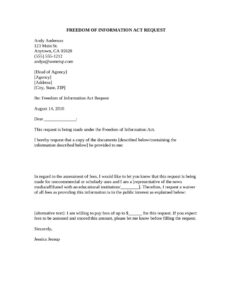
- Add your contact block: Replace the sample name and details (Andy Anderson, 123 Main St., Anytown, CA, phone, email) with your own full name, mailing address, phone number, and email.
- Address the agency: Fill in the [Head of Agency], [Agency], [Address], and [City, State, ZIP] fields with the correct recipient — ideally the agency’s designated FOIA officer.
- Date the letter: Enter the current date so the agency’s response deadline can be tracked.
- Open the salutation: Complete the “Dear ______” line with the FOIA officer’s name or title.
- Describe the records: In the request paragraph, choose “described below” or “containing the information described below” and write a detailed description of the documents, including dates, subjects, and any reference numbers.
- State your fee category: Indicate whether you are a representative of the news media, affiliated with an educational institution, or another category, and explain the public-interest basis for a fee waiver.
- Set a fee limit (if applicable): Use the alternative text to state the maximum dollar amount you will pay and ask to be notified before fees exceed it.
- Sign off: Replace the sample signature line with your own name.
Fees, Waivers, and Response Times
Agencies may charge for the time spent searching for and copying records, but the rules differ by requester category. Members of the news media, educational and noncommercial scientific institutions often pay only duplication costs, while commercial requesters may pay search, review, and duplication fees. You can ask for a full fee waiver by showing that releasing the information is in the public interest and is not primarily for your commercial benefit — this template includes language to make that argument. Setting a dollar cap protects you from surprise charges and obligates the agency to contact you first. Federal agencies generally must respond within a set number of business days, though complex requests can take longer; keep a copy of your dated letter so you can follow up.
Tips for a Stronger Request
Be specific without being so narrow that you exclude relevant material. Reference time periods, named programs, document types, and any tracking numbers you already know. If you are unsure which office holds the records, check the agency’s FOIA reference guide before sending. Keeping the letter polite, concise, and clearly organized helps the FOIA staff process it faster.
Common Mistakes to Avoid
- Vague descriptions: Asking for “all documents about a topic” can lead to delays or denials — describe records as precisely as possible.
- Sending to the wrong agency: FOIA applies to federal agencies only; confirm the right one holds your records.
- Forgetting contact details: Leaving out a phone number or email slows down any clarification the agency needs.
- Ignoring fees: Failing to state a fee cap or waiver request can result in unexpected charges.
- Not keeping a copy: Without a dated copy, it is harder to track deadlines or appeal a denial.
- Overstating your category: Claiming a media or educational status that does not apply can complicate the fee determination.
Frequently Asked Questions
What is a FOIA request used for? It is used to obtain copies of records held by federal agencies that have not already been published. Journalists, researchers, businesses, and individuals use it to access documents, data, and correspondence in the public interest or for personal reasons.
How do I fill out a FOIA request letter? Insert your contact information, address it to the correct agency or FOIA officer, date it, and write a clear, specific description of the records you want. Then state your fee category, request a waiver if appropriate, set a fee limit, and sign the letter.
Does a FOIA request need to be notarized? No, a standard FOIA request does not require notarization or witnesses. However, if you are requesting records about yourself, some agencies may ask for proof of identity or a signed certification before releasing personal information.
Is there a fee to file a FOIA request? There is no filing fee, but agencies may charge for search, review, or duplication depending on your requester category. You can request a fee waiver in the letter and set a maximum amount you are willing to pay.
How long does an agency have to respond? Federal agencies generally must respond within a set number of business days under the law, though complex requests or large volumes of records can extend that timeline. Keeping a dated copy of your letter helps you track the deadline and follow up.
Is this FOIA request template free to download? Yes, this FOIA request template is completely free to download in PDF and DOCX formats with no signup required. You can edit it to match your records request and the specific agency you are contacting.
This template is a general example provided for informational purposes only and is not legal advice. Freedom of Information Act procedures, fee rules, and response times can vary by agency and may change over time, so consult the relevant agency’s FOIA guidance or a qualified professional for your specific situation.
Related Forms
- Work Order
- Request To Terminate Unauthorized Service
- Day Off Request Form
- Request to be Removed From Mailing List
- Revocation of Power of Attorney
- Repair Under Warranty Request
Browse more in Request and Authorization.