
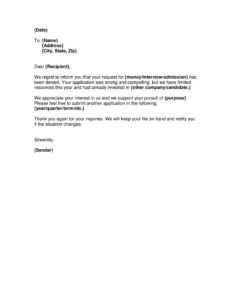
Company Request Rejection
Download a free Company Request Rejection letter template to decline applications, funding, or interview requests professionally — free PDF and DOCX download.
PDF
DOCX
0
likes
Download Files
- DOCX
A Company Request Rejection letter is a formal message a business sends to notify an applicant, candidate, or requester that their request — whether for funding, an interview, admission, or another opportunity — has been declined. It is most often used when an organization must turn down a strong applicant due to limited resources or prior commitments while keeping the relationship cordial. You can download this template free in both PDF and DOCX formats, with no signup required.
What Is a Company Request Rejection?
A Company Request Rejection is a professionally worded letter issued by a company, hiring manager, grant committee, or admissions office to communicate a negative decision. It documents that a specific request — for money, an interview, admission, or similar — has been reviewed and denied. The purpose is twofold: to deliver the decision clearly and to preserve goodwill by acknowledging the applicant’s effort and leaving the door open for future opportunities. Because rejections can feel personal, a well-structured letter softens the message, explains the situation in general terms, and offers an encouraging next step. It also creates a written record that the request was formally addressed, which helps with consistency and fairness across many applicants.
When Do You Need a Company Request Rejection?
This letter fits many situations where a business must politely say no to an external party. Common scenarios include:
- Job applications and interviews — informing a candidate that they will not advance to the interview stage or were not selected after consideration.
- Funding and grant requests — declining a request for money, sponsorship, donation, or investment due to budget limits.
- Admissions decisions — notifying an applicant that they were not admitted to a program, cohort, or membership.
- Proposal and partnership pitches — turning down a vendor, contractor, or business partnership offer.
- Scholarship or grant cycles — letting an applicant know the awards have been allocated this term.
- Internship or fellowship slots — declining when openings are filled but the candidate is encouraged to reapply.
What a Company Request Rejection Should Have
An effective rejection letter is brief, respectful, and clear. To be complete it should include the date, the recipient’s name and mailing address, and a courteous salutation. The body should state the decision plainly, identify exactly what was requested, and offer a general, non-defensive reason such as limited resources or prior commitments. Strong letters also recognize the applicant’s effort, express continued support for their goals, and — where appropriate — invite a future application and explain when. Finally, the letter needs a polite closing and the sender’s name. Avoid detailed criticism, legally risky specifics, or promises you cannot keep. The tone should leave the recipient feeling fairly treated even though the answer is no.
How to Fill Out a Company Request Rejection
- Date: Enter the date you are sending the letter so the decision is properly timestamped.
- To / Name: Type the full name of the person or organization receiving the rejection.
- Address and City, State, Zip: Add the recipient’s mailing address for a formal, mailed letter or for your records.
- Dear {Recipient}: Use the recipient’s name in the salutation to personalize the message.
- Request type ({money/interview/admission}): Specify exactly what was requested — funding, an interview, admission, or another opportunity — so there is no confusion.
- Reason ({other company/candidate}): Note the general reason, such as limited resources or a prior commitment to another candidate or company, kept tactful and brief.
- Purpose ({purpose}): Acknowledge the applicant’s goal and express support for their pursuit of it.
- Future timing ({year/quarter/term/etc.}): Indicate when they may reapply if you welcome a future submission.
- Sender: Sign with the name and, if helpful, the title of the person issuing the decision.
How to Deliver the Rejection Professionally
How you send the letter matters as much as what it says. For formal funding or admissions decisions, a mailed letter on company letterhead conveys seriousness and creates a paper trail. For routine hiring decisions, email is faster and widely accepted. Send the letter promptly once the decision is final — leaving applicants waiting damages your reputation. Keep the message consistent across all rejected applicants in the same cycle so no one can claim unequal treatment. If your decision involved many applicants, store a copy of each sent letter with the corresponding application file. The template’s line about keeping the applicant’s file on hand is useful only if you genuinely intend to do so; otherwise remove it to avoid implying a commitment you will not honor.
How It Differs From a General Decline
A Company Request Rejection is more structured than a quick verbal or email no. It documents the specific request, gives a measured reason, and intentionally preserves the relationship by inviting future contact. Unlike an internal memo, it is addressed directly to the requester and written to be read by them. It also differs from an acceptance or offer letter, which advances a relationship, and from a termination or cancellation notice, which ends an existing arrangement. The rejection simply closes one request while leaving the broader connection intact and professional.
Common Mistakes to Avoid
- Giving too much detail — over-explaining the decision can invite arguments or appear inconsistent; keep the reason general.
- Sounding cold or robotic — failing to acknowledge the applicant’s effort makes a no feel harsher than necessary.
- Leaving placeholders unfilled — sending a letter with {Name} or {purpose} still in brackets looks careless and impersonal.
- Making false promises — saying you will keep a file or reconsider when you will not erodes trust.
- Delaying the decision — applicants planning their next steps deserve a timely answer.
- Inconsistent treatment — using different reasons or tones for similar applicants can create the appearance of unfairness.
Frequently Asked Questions
What is a Company Request Rejection letter? It is a formal letter a business sends to inform someone that their request — for funding, an interview, admission, or a similar opportunity — has been declined. It states the decision clearly while remaining courteous and, where appropriate, invites a future application.
How do I fill out this template? Add the date, the recipient’s name and address, and a personalized greeting, then specify what was requested, give a brief and tactful reason, acknowledge the applicant’s purpose, note when they may reapply, and sign with the sender’s name. Replace every bracketed field before sending.
Do I have to give a reason for the rejection? A short, general reason such as limited resources or prior commitments is courteous and helps the recipient understand the outcome. You are usually not required to provide detailed feedback, and keeping the reason brief reduces the risk of disputes.
Is a rejection letter legally binding? A rejection letter is a notification of a decision, not a contract, so it does not create binding obligations the way an offer or agreement would. Still, you should keep statements accurate and consistent, since careless wording could be cited in a dispute.
Should the letter be mailed or emailed? Either works depending on context — formal funding or admissions decisions are often mailed on letterhead, while routine hiring rejections are commonly sent by email. Choose the channel your recipients expect and keep a copy for your records.
How much does this template cost? Nothing — this Company Request Rejection template is completely free to download in PDF and DOCX formats with no signup required. You can edit it freely to match your organization’s voice and the specific request being declined.
This template is provided as a general example for informational purposes only and does not constitute legal, employment, or business advice. Communication and record-keeping requirements vary by jurisdiction and industry; consult a qualified professional before relying on this document for important decisions.
Related Forms
- Appointment of Proxy
- Damage Claim
- Garage Repair Order
- FOIA Request Appeal
- FOIA Request
- Revocation of Power of Attorney
Browse more in Request and Authorization.