
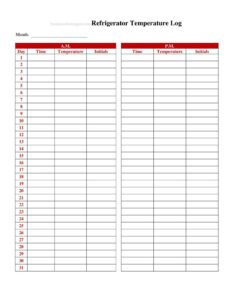
Refrigerator Temperature Log
Track and document cold-storage temperatures with our free Refrigerator Temperature Log template, available as a free download in PDF and DOCX.
PDF
DOCX
5 downloads
0
likes
Download Files
- DOCX
A Refrigerator Temperature Log is a simple record used by restaurants and food businesses to document the internal temperature of cold-storage units at regular intervals throughout the day. The most common reason people use it is to prove food-safety compliance during health inspections and to catch a failing cooler before stock spoils. You can download this template free in PDF and DOCX, with no signup required.
What Is a Refrigerator Temperature Log?
A Refrigerator Temperature Log is a monitoring sheet on which staff write down the measured temperature of a refrigerator, walk-in cooler, or refrigerated display case at scheduled times. It documents who checked the unit, when, what the reading was, and whether any corrective action was taken. Kitchen managers, line cooks, shift leads, and food-safety coordinators all use it as part of a Hazard Analysis and Critical Control Points (HACCP) routine. The log creates a paper trail showing that perishable foods were kept within a safe cold-holding range, which protects customers, reduces waste, and gives health inspectors the evidence they expect to see during a routine visit.
When Do You Need a Refrigerator Temperature Log?
Almost any operation that stores cold food benefits from a written temperature record. Common situations include:
- Daily restaurant operations — recording cooler and walk-in temperatures at opening, mid-shift, and closing to confirm cold-holding compliance.
- Health inspections — providing inspectors with a documented history that proves your cold storage stays within a safe range.
- HACCP and food-safety programs — meeting a monitoring requirement for a critical control point in your written plan.
- Grocery and convenience stores — tracking refrigerated display cases, dairy coolers, and deli units across multiple zones.
- Catering and commissary kitchens — verifying that prepped foods stayed cold during overnight holding and transport staging.
- Schools, hospitals, and care facilities — documenting that institutional kitchens meet cold-storage standards for vulnerable populations.
What a Refrigerator Temperature Log Should Have
A complete and usable log captures enough detail to be meaningful months later. Key elements include the name or number of each refrigeration unit being monitored, the date, the time of each reading, the measured temperature, the acceptable target range, the initials of the person who took the reading, and a column for corrective action. Many logs also note the day of the week, the location or department, and a verification signature from a manager who reviews the sheet. Including the target range directly on the form lets staff instantly tell whether a reading is in or out of spec, so problems are caught and addressed in the moment rather than discovered later.
How to Fill Out a Refrigerator Temperature Log
Because the readings change throughout the day, fill the log out consistently at each scheduled check:
- Identify the unit. Write the name or number of the refrigerator, walk-in, or display case at the top so the record clearly ties to a single piece of equipment.
- Enter the date. Record the calendar date for the day’s set of readings, and start a fresh sheet daily or weekly as your routine dictates.
- Note the target range. Write the acceptable cold-holding temperature your operation follows so every reading can be judged against it.
- Record the time. Log the clock time of each check — for example opening, mid-shift, and closing.
- Write the temperature. Read the unit’s thermometer or use a calibrated probe and enter the measured value.
- Add your initials. The staff member who took the reading initials the row to establish accountability.
- Document corrective action. If a reading is out of range, describe what was done — adjusted the thermostat, moved product, or called for repair.
- Have a manager verify. A supervisor reviews and signs the completed sheet, then files it for your retention period.
Calibrating Thermometers and Reading Accurately
A log is only as reliable as the thermometer behind it. Many operations calibrate probe thermometers regularly using an ice-water or boiling-water check so readings stay accurate. When recording, place the probe in the warmest practical spot or read the unit’s built-in display, and avoid checking immediately after a door has been open for a long time, since that can give a falsely high number. If you use a digital data-logging device, the written sheet still serves as a manual backup and a record of human verification. Note on the log if a reading was taken during restocking or a defrost cycle, because context explains a brief spike and prevents an inspector from misreading a normal fluctuation as a violation.
What to Do When a Reading Is Out of Range
An out-of-range reading is the moment the log proves its value. Record the actual temperature, then take and document corrective action right away. Common responses include lowering the thermostat, redistributing crowded product to improve airflow, checking that the door seal closes fully, and moving at-risk food to a backup unit. If the temperature does not recover, evaluate whether the food has been in the danger zone long enough to require discarding it, and call for equipment service. Writing down what you did — and the follow-up reading after the fix — closes the loop and shows you actively manage food safety rather than simply observing problems.
Common Mistakes to Avoid
- Backfilling the log. Filling in a whole day’s readings at once defeats the purpose and is obvious to inspectors.
- Skipping the corrective-action column. Recording an out-of-range temperature without noting what you did leaves a gap that raises questions.
- Using an uncalibrated thermometer. Inaccurate readings make the entire log unreliable.
- Leaving units unlabeled. Logs that don’t identify which cooler was checked are hard to use in multi-unit kitchens.
- No initials or verification. Without staff initials and a manager review, there’s no accountability behind the numbers.
- Discarding old logs too soon. Keep completed sheets for your required retention period in case of an inspection or incident review.
Frequently Asked Questions
What is a Refrigerator Temperature Log used for? It is used to document that cold-storage units stay within a safe temperature range over time. Restaurants and food businesses rely on it to demonstrate food-safety compliance to health inspectors and to detect a failing cooler before food spoils.
How often should I record temperatures? Most operations check at least at opening, mid-shift, and closing, though your HACCP plan or local health code may specify a different frequency. The key is consistency — record at the same scheduled times each day so the record is complete and credible.
What temperature should a refrigerator be kept at? Cold-holding requirements vary by jurisdiction and by the type of food, so follow the standard set by your local health authority or food-safety plan. Write that target range on the log so every reading can be judged against it instantly.
Is this Refrigerator Temperature Log legally required? Whether written logs are mandatory depends on your local health code and whether you operate under a formal HACCP plan. Even where not strictly required, keeping a log is widely considered best practice and is often expected during inspections.
How much does this template cost? It is completely free to download here in both PDF and DOCX formats, with no signup required. You can print the PDF for posting near each unit or edit the DOCX to add your own unit names and target ranges.
Can I customize the log for multiple units? Yes. The DOCX version lets you add rows or columns for each refrigerator, walk-in, or display case so a single sheet can cover several units or zones in your kitchen.
This template is a general example provided for informational purposes only and does not constitute legal, regulatory, or food-safety advice. Food-storage requirements and recordkeeping rules vary by jurisdiction and operation — consult your local health authority or a qualified food-safety professional to confirm what applies to you.
Related Forms
- Wine List
- Smoking Section Sign
- Shift Request Form
- Knife Sharpening Log
- Coffee Menu
- Shift Preferences Log
Browse more in Restaurant.