
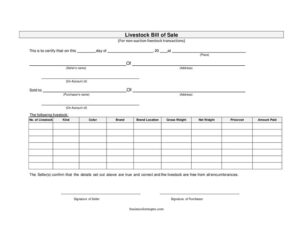
Livestock Bill Of Sale
Download a free Livestock Bill of Sale template to document private cattle and livestock sales — available in PDF and DOCX with no signup, free download.
PDF
DOCX
4 downloads
0
likes
Download Files
- DOCX
A Livestock Bill of Sale is a written record that proves ownership of animals has legally transferred from a seller to a buyer in a private, non-auction transaction. People most commonly use it to document the sale of cattle, horses, hogs, sheep, or goats so both parties have proof of the deal, the price, and the animal’s identifying marks. You can download this template free in PDF and DOCX, with no signup required.
What Is a Livestock Bill of Sale?
A Livestock Bill of Sale is a certificate signed by the seller (and acknowledged by the purchaser) confirming that specific animals were sold on a given date, at a stated location, for an agreed price. It is typically used for direct farm-to-farm or private-party sales that do not go through a licensed auction barn. The document records who sold the livestock, who bought them, how many animals changed hands, their kind and physical description, any brands and brand locations, weights, the price per hundredweight, and the total amount paid. It also includes the seller’s confirmation that the animals are free from liens and other encumbrances, protecting the buyer from hidden claims.
When Do You Need a Livestock Bill of Sale?
Any time animals move from one owner to another outside of a formal auction, a written record protects both sides. Common situations include:
- Selling cattle, hogs, or sheep directly from your ranch to a neighbor or another producer.
- Buying a horse or a small group of goats from a private seller and needing proof of purchase.
- Transporting livestock across county or state lines, where inspection officers or brand officials may ask for proof of ownership.
- Documenting a sale priced by weight, so both parties agree on gross weight, net weight, and price per hundredweight (cwt).
- Settling an estate, dissolving a partnership, or dividing herd assets and needing a clear paper trail.
- Establishing a cost basis for tax records or supporting a future insurance or financing claim.
What a Livestock Bill of Sale Should Have
To be useful and complete, the form needs enough detail to identify the exact animals and the exact terms. Strong bills of sale include the transaction date and location, the full names and addresses of both seller and buyer, and a precise description of the livestock — number of head, kind, color, and any brands together with their location on the animal. Sales priced by weight should show the gross weight, net weight, price per cwt, and the total amount paid. Finally, the seller’s certification that the animals are free from all encumbrances, followed by signatures of both seller and purchaser, makes the document binding and verifiable.
How to Fill Out a Livestock Bill of Sale
- Enter the date by filling in the day, month, and year the sale takes place.
- Record the location where the transaction occurs — typically the ranch, farm, or sale point.
- Write the seller’s name and address exactly as they appear on official identification.
- Write the purchaser’s name and address the same way.
- Fill in the number of livestock being sold (head count).
- State the kind of animal — for example cattle, horses, hogs, sheep, or goats.
- Describe the color and note any brand and its brand location on the animal.
- For weight-based sales, enter the gross weight, the net weight, and the price per cwt.
- Record the total amount paid.
- Have the seller sign to certify the details are true and the livestock are free of encumbrances, then have the purchaser sign to acknowledge the sale.
Understanding Weights and Price per Hundredweight
Many livestock sales are priced by weight rather than by the head, which is why this form includes fields for gross weight, net weight, and price per cwt. Gross weight is the animal’s full weight at weigh-in; net weight may account for a customary “shrink” allowance that compensates for water and feed lost in transport, or it may simply reflect the figure both parties agree to use. Price per cwt means price per hundred pounds — so animals weighing a combined 1,200 pounds sold at $180/cwt would total $2,160. Always confirm whether you are weighing live, agree on any shrink percentage in advance, and double-check that the math behind the amount paid matches the weight and price you recorded.
Brands, Inspection, and Recordkeeping
Brands are a key part of livestock identification, and the brand and brand-location fields help prove the animals are the same ones described in the sale. In many cattle states, a brand inspection or a brand-clearance certificate is required before livestock can be moved or sold, and some jurisdictions also require health papers or a veterinary inspection certificate. The Livestock Bill of Sale does not replace those documents — it works alongside them. Keep a signed copy for your own files and give the original to the buyer, who may need it to register a brand transfer, prove ownership at a future sale, or satisfy a transport checkpoint. Requirements differ widely, so check your state or provincial rules before moving animals.
Common Mistakes to Avoid
- Leaving the brand or brand-location fields blank when the animals are branded — this weakens the proof of identity.
- Recording an inaccurate head count or mixing up kinds of livestock in a single combined entry.
- Forgetting to confirm the animals are free from encumbrances when an existing lien actually exists.
- Skipping the weight and price-per-cwt details on a weight-based sale, leaving the total unverifiable.
- Using abbreviated names or P.O. boxes instead of full legal names and complete addresses.
- Failing to have both parties sign, or not keeping a copy for each side once the sale is complete.
Frequently Asked Questions
What is a Livestock Bill of Sale used for? It documents the private sale and transfer of ownership of animals such as cattle, horses, hogs, sheep, or goats. It records the date, the parties, the animals’ description, the price, and the seller’s confirmation that the livestock are free from liens, giving both sides proof of the transaction.
Is a Livestock Bill of Sale legally binding? Once both the seller and purchaser sign, it generally serves as evidence of a completed sale and the terms agreed upon. To be enforceable it should be accurate, complete, and signed voluntarily. Specific requirements vary by jurisdiction, so check your local rules.
Does this form need to be notarized or witnessed? Notarization is not always required for a livestock sale, but having the document notarized or witnessed can add credibility and may be requested for high-value animals or interstate moves. Check your state or provincial requirements before assuming it is unnecessary.
How do I describe the livestock correctly? Use the number of head, kind, color, and any brand along with its location on the animal. For weight-priced sales, also record gross weight, net weight, and price per cwt. The more precise the description, the easier it is to prove which animals were sold.
Do I still need a brand inspection or health certificate? Often, yes. A bill of sale does not replace a brand-inspection clearance, transport permit, or veterinary health certificate where those are required. This form works alongside such documents, so confirm what your jurisdiction mandates before moving animals.
How much does this template cost? Nothing — it is completely free to download here in both PDF and DOCX formats, with no signup required. You can fill it out by hand after printing the PDF or edit the DOCX version on your computer before printing and signing.
This template is a general example provided for informational purposes only and is not legal, financial, or tax advice. Livestock sale, brand, inspection, and transport requirements vary by jurisdiction. Consult a qualified professional or your local livestock authority to ensure your transaction complies with applicable laws.
Need to work out sales tax? Use our free Sales Tax Calculator to add or remove sales tax from any amount in seconds.
Official resource: for the rules that apply to your situation, see the U.S. Small Business Administration.
Related Forms
- Daily Sales Log
- Price Quotes List
- Gift Certificate Log
- New Benefits Announcement
- Credit Application
- Order Authorization Form
Browse more in Sales.