
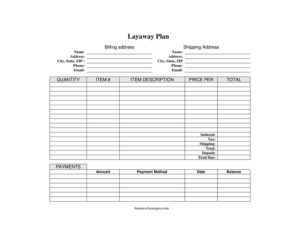
Layaway Plan Record
Track customer layaway purchases, deposits, and payments with our free Layaway Plan Record template — easy PDF and DOCX free download.
PDF
DOCX
2 downloads
0
likes
Download Files
- DOCX
A Layaway Plan Record is a simple document a retailer uses to track a customer’s reserved merchandise, deposit, and installment payments until the balance is paid in full. The most common reason people use it is to keep a clear, written account of what a customer owes and what they’ve already paid on a layaway purchase. You can download this Layaway Plan Record for free in both PDF and DOCX formats — no signup required.
What Is a Layaway Plan Record?
A Layaway Plan Record is a sales form that documents an agreement in which a customer reserves one or more items by placing a deposit, then pays off the remaining balance over time before taking possession of the goods. It’s typically issued by a retailer, boutique, jeweler, furniture store, or any small business that offers layaway. The form captures the buyer’s contact details, an itemized list of merchandise, the full price breakdown, and a running log of payments. By recording each transaction, the layaway record protects both the seller and the buyer, prevents disputes over the outstanding balance, and gives the customer a transparent picture of how much is left to pay.
When Do You Need a Layaway Plan Record?
Any business that lets customers pay for items in stages benefits from documenting the arrangement. Common situations include:
- Holiday or seasonal shopping — a customer reserves gifts in advance and pays them off over several weeks before pickup.
- High-ticket purchases — furniture, electronics, appliances, or jewelry that a buyer prefers to pay for gradually instead of using credit.
- Small retail and boutique sales — clothing, shoes, or accessories held aside while the shopper completes payments.
- Special-order merchandise — items secured with a deposit so the store knows the sale is committed.
- Repeat or trusted customers — a flexible payment option offered as a courtesy, with a clear paper trail.
- Multi-item orders — when a buyer wants several products bundled into one payment schedule with a single balance.
What a Layaway Plan Record Should Have
A complete layaway record leaves no room for confusion about who, what, and how much. The essentials are the customer’s full contact and address details, both billing and shipping addresses if they differ, and a clear itemized list of the reserved merchandise. It should show the financial breakdown — subtotal, tax, shipping, and a grand total — along with the deposit amount that started the plan. Just as important is a payment log that records each amount, date, and payment method, plus the remaining balance after every transaction. Keeping the running balance current is what makes the form genuinely useful day to day.
How to Fill Out a Layaway Plan Record
- Enter the customer’s name, address, city, state, and zip at the top, along with phone and email for follow-up.
- Record the billing address and, if items will be delivered, the shipping address separately.
- List each reserved item with its quantity, item #, item description, and price per unit, then calculate the line total.
- Add the line totals to get the subtotal, then apply tax and any shipping charge to reach the grand total.
- Note the deposit the customer paid to open the plan.
- In the payments section, log each installment’s amount, payment method (cash, card, etc.), and date.
- After every payment, update the balance so both parties always know what remains.
- When the balance reaches zero, mark the plan complete and release the merchandise.
Setting Clear Layaway Terms
A record is only as good as the terms behind it. Before the first deposit, agree on the payment schedule — for example, equal installments every two weeks or a fixed monthly amount — and write the expected dates into the payment log. Decide in advance what happens if a payment is missed or the plan is canceled: many stores keep a small service or restocking fee, while others refund deposits in full. Whatever your policy, state it plainly so the customer understands it from the start. Spelling out the pickup or shipping arrangement once the balance is paid also prevents last-minute confusion.
Layaway vs. Credit and Financing
It helps to remember how layaway differs from buying on credit. With a layaway plan, the store holds the merchandise and the customer receives it only after paying in full — no interest, no credit check, and no debt. With financing or a credit card, the buyer takes the item immediately and pays the lender over time, often with interest. Because layaway carries no borrowing cost, the Layaway Plan Record simply tracks payments toward a fixed total rather than calculating finance charges. This makes the form straightforward, but accuracy in the running balance is essential since it is the customer’s only proof of what they’ve paid.
Common Mistakes to Avoid
- Forgetting to update the balance after each payment, leaving the record out of sync with reality.
- Skipping the payment method or date, which makes it hard to reconcile cash and card receipts later.
- Omitting tax and shipping from the total, so the final amount the customer owes is understated.
- Vague item descriptions — without an item # and clear description, the wrong product can be released.
- Not stating cancellation terms, leading to disputes if the customer backs out.
- Failing to give the customer a copy, leaving them no record of their own payments.
Frequently Asked Questions
What is a Layaway Plan Record used for? It documents a layaway purchase, tracking the items a customer has reserved, the deposit they paid, and each installment until the balance is cleared. It keeps both the buyer and seller on the same page about what is owed. The form serves as a receipt and a running ledger in one.
Is a Layaway Plan Record legally binding? The form itself is a record of the transaction and the agreed terms, and a signed, mutually accepted layaway arrangement can carry contractual weight. To strengthen it, include your cancellation and refund policy and have both parties acknowledge the terms. Because rules vary by state, check your local consumer-protection requirements.
How do I calculate the remaining balance? Start with the grand total (subtotal plus tax and shipping), subtract the deposit, then subtract each payment as it is made. The figure left over is the current balance, which you should update on the form every time the customer pays.
Does layaway charge interest? No. Unlike credit or financing, layaway involves no borrowing, so there is no interest. The customer simply pays toward a fixed total, though some stores charge a small service or cancellation fee, which you should disclose up front.
Can I track multiple items on one form? Yes. The itemized section lets you list several products with their own quantity, item #, description, and price per unit. The form rolls them into a single subtotal and total so the customer pays off one combined balance.
How much does this template cost? It’s completely free. You can download the Layaway Plan Record in PDF or DOCX with no signup, fill it in by hand or on your computer, and reuse it for every layaway customer you serve.
This Layaway Plan Record template is a general example provided for informational purposes only and is not legal, financial, or tax advice. Retail and consumer-protection requirements vary by jurisdiction — consult a qualified professional to ensure your layaway practices comply with applicable laws.
Need to work out sales tax? Use our free Sales Tax Calculator to add or remove sales tax from any amount in seconds.
Official resource: for the rules that apply to your situation, see the U.S. Small Business Administration.
Related Forms
- Ebay Auction Worksheet
- Shipment Procedure
- Commission Summary
- Credit Application
- Daily Sales Log
- Sales Projection
Browse more in Sales.