
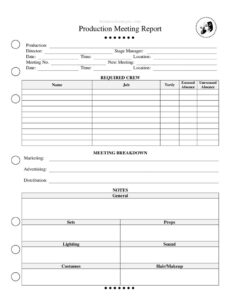
Production Meeting Notes
Keep your show on track with our free Production Meeting Notes template, capturing decisions, action items and deadlines — free download in PDF and DOCX.
PDF
DOCX
7 downloads
0
likes
Download Files
- DOCX
A Production Meeting Notes form is a structured record of what was discussed, decided, and assigned during a theater production meeting. Most theater teams use it to keep designers, stage management, and crew aligned between rehearsals and to track who owns each task. It’s free to download here in both PDF and DOCX, with no signup required.
What Is a Production Meeting Notes Form?
A Production Meeting Notes form is the written summary that the stage manager or production assistant keeps during a regular production meeting. In theater, these meetings bring together the director, designers (set, lighting, sound, costumes, props), the production manager, and stage management to coordinate the many moving parts of a show. The form documents attendance, agenda items, decisions made, open questions, and action items with owners and due dates. It becomes the official record everyone refers to afterward, so nothing discussed gets lost. Distributed to the full team after each meeting, it keeps departments accountable and ensures the production moves forward on schedule and within budget.
When Do You Need a Production Meeting Notes Form?
- Weekly production meetings during the pre-production and rehearsal period, where each department reports progress.
- Design and concept meetings when the creative team finalizes the look, sound, and feel of the show.
- Budget and build check-ins to track scenic construction, costume purchases, and equipment rentals against the production budget.
- Tech week coordination, when cue sheets, scene changes, and timing decisions need to be logged quickly and shared overnight.
- Resolving cross-department conflicts, such as a set piece blocking a lighting position, so the agreed solution is recorded.
- Handoff between staff, giving a substitute stage manager or new crew member a clear history of decisions.
What a Production Meeting Notes Form Should Have
A complete set of meeting notes captures more than just a list of topics. It should clearly identify the production, the date, and who was present, then organize the discussion so action items stand out from general updates. The strongest notes pair every decision with a responsible person and a deadline, distinguish open questions from settled matters, and reference the relevant department. Including the date and location of the next meeting helps the team plan ahead. Consistent formatting from week to week makes it easy to scan back through the record and trace how a decision evolved over the rehearsal process.
How to Fill Out a Production Meeting Notes Form
- Production title and meeting date: Write the name of the show, the date, time, and location (or video link) at the top so the notes can be filed correctly.
- Attendees and absentees: List everyone present by name and role — director, set, lighting, sound, costume, and props designers, production manager, and stage management — and note who was absent.
- Agenda items: Record each topic in the order discussed, grouping by department where it helps clarity.
- Discussion and decisions: Summarize the key points and clearly mark what was decided versus what remains open.
- Action items: For each task, write the action, the person responsible, and the due date.
- Outstanding questions: Capture anything that needs follow-up or an answer from someone not in the room.
- Next meeting: Note the date, time, and place of the following production meeting, then circulate the notes promptly.
Tips for Useful Theater Production Notes
Take notes in real time rather than reconstructing them from memory afterward — accuracy fades fast once tech week energy takes over. Use a consistent shorthand for departments (LX for lighting, SD for sound, props, costumes) so reports stay scannable. Bold or flag action items so department heads can find their tasks at a glance. Send the notes within a few hours of the meeting while details are fresh and so anyone who was absent can catch up before the next rehearsal. Keep all notes in one shared folder, named by date, so the full production history is searchable. Finally, open each meeting by reviewing the previous notes’ action items to confirm what’s done and what’s slipping.
How These Notes Differ From a Rehearsal Report
Production meeting notes and rehearsal reports serve related but distinct purposes. A rehearsal report is generated after each rehearsal and focuses on what happened in the room that day — staging changes, prop needs, scheduling, and notes to specific departments. Production meeting notes, by contrast, summarize a planning meeting where the team discusses the broader trajectory of the show, makes design and budget decisions, and assigns longer-term tasks. Many stage managers keep both: the rehearsal report handles the daily detail, while the meeting notes track the strategic decisions that shape the production. Using a dedicated meeting notes form keeps those two streams of information from getting tangled.
Common Mistakes to Avoid
- Recording discussion without decisions — capture what was actually agreed, not just that a topic was raised.
- Action items with no owner or deadline, which leave tasks floating and unaccountable.
- Forgetting to list attendees, so it’s unclear later who agreed to what or who missed key information.
- Sending notes too late, after the team has already moved on or forgotten the context.
- Mixing rehearsal notes and meeting notes in one document, making both harder to use.
- Inconsistent formatting week to week, which slows down anyone trying to track a decision’s history.
Frequently Asked Questions
What are production meeting notes used for? They document what a theater production team discussed and decided during a meeting, including action items, owners, and deadlines. The notes are circulated afterward so every department knows its responsibilities and the production stays coordinated and on schedule.
Who is responsible for taking production meeting notes? Usually the stage manager or a production assistant takes the notes, since stage management acts as the communication hub for the show. In smaller productions, the production manager or director may take them. The key is that one consistent person owns the record each meeting.
How detailed should production meeting notes be? Detailed enough that someone who missed the meeting can understand every decision and follow up on their tasks, but concise enough to scan quickly. Focus on decisions, action items, owners, and deadlines rather than transcribing every word of conversation.
How quickly should I send out the notes? Ideally within a few hours of the meeting, and certainly before the next rehearsal or work call. Prompt distribution means department heads can act on their tasks immediately and any errors can be corrected while memories are fresh.
Can I edit this template for my production? Yes. The DOCX version is fully editable, so you can add department-specific sections, your theater’s logo, or extra columns for budget tracking. Adapt the headings to match how your team actually runs its meetings.
Is this template really free? Yes, the Production Meeting Notes template is completely free to download in both PDF and DOCX formats with no signup required. You can reuse it for every meeting throughout your production and share it with your whole team.
This template is a general example provided for informational purposes only and does not constitute legal, financial, or professional advice. Production practices and organizational requirements vary between theaters and companies — adapt the form to your own workflow and consult your production manager or a qualified professional as needed.
Related Forms
Browse more in Theater.