
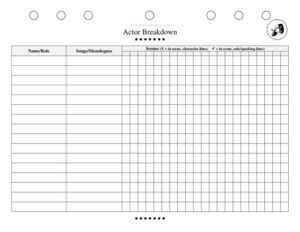
Actor Breakdown
Download a free Actor Breakdown template in PDF and DOCX to organize cast roles, character notes, and scenes for your theater production with no signup.
PDF
DOCX
5 downloads
0
likes
Download Files
- DOCX
An Actor Breakdown is a casting and production document that lists every character in a play or musical alongside the key information needed to cast, schedule, and track each performer. People most often use it during the casting process to translate a script into a clear, organized roster of roles. You can download this Actor Breakdown template for free in both PDF and DOCX formats, with no signup required.
What Is an Actor Breakdown?
An Actor Breakdown is a structured summary of all the roles in a theatrical production, prepared by a director, casting director, or stage manager. It documents each character’s name, description, age range, vocal or physical requirements, and the scenes or songs in which they appear. The breakdown serves as a single reference point that turns a full script into actionable casting information. Production teams use it to post audition notices, organize callbacks, plan rehearsal schedules, and ensure that every speaking and non-speaking part is accounted for. Whether you are staging a community theater play, a school musical, or a professional production, the Actor Breakdown keeps everyone aligned on who is needed and what each role demands.
When Do You Need an Actor Breakdown?
The Actor Breakdown is most valuable in the early planning and casting stages, but it stays useful throughout the run. Common situations include:
- Preparing audition notices — pulling character descriptions and requirements directly into casting calls and breakdown service postings.
- Running auditions and callbacks — giving panelists a consistent reference so they can match performers to specific roles.
- Scheduling rehearsals — knowing which actors appear in which scenes so you only call the people you actually need.
- Planning double-casting or understudies — identifying smaller roles that one performer could combine and which leads need cover.
- Budgeting and contracting — counting how many performers a production requires before committing to a cast size.
- Communicating with designers — sharing age ranges, character counts, and quick-change needs with costume and wig teams.
Types of Roles to Capture
A thorough breakdown distinguishes between leading roles, supporting roles, featured ensemble, and chorus or background performers. It may also flag specialty parts that require dancing, singing in a particular range, dialects, stage combat, or playing an instrument. Separating roles this way helps you prioritize casting decisions and spot where a single actor can cover multiple smaller parts.
What an Actor Breakdown Should Have
A complete Actor Breakdown gives readers everything they need to picture and cast each role without re-reading the entire script. Essential elements include the production title, the character name, a short character description, the age range, gender or playing-age guidance, and any vocal range for musicals. It should also note the scenes or songs each character appears in, special skills required, the relative size of the part, and any doubling possibilities. Adding columns for the cast member’s name and contact details turns the document into a working casting grid you can update as roles are filled.
How to Fill Out an Actor Breakdown
Because this is a flexible template, build it out row by row directly from your script:
- Enter the production details — add the play or musical title, author, and the name of the person preparing the breakdown at the top.
- List each character — create one row per role, starting with leads and working down to ensemble and non-speaking parts.
- Write a brief description — summarize personality, relationships, and function in two or three phrases per character.
- Note age and playing range — record the written age and the realistic range a performer could play.
- Add vocal or physical requirements — for musicals, list the vocal range; for plays, note dialects, dance, or combat skills.
- Map scenes and songs — mark where each character appears so you can plan rehearsals and track stage time.
- Flag doubling and understudies — indicate which roles can be combined and which need cover.
- Leave a casting column — keep a blank field to fill in the actor’s name and contact once cast.
Tips for Building a Useful Breakdown
Keep descriptions vivid but concise so collaborators can scan the document quickly. Use consistent labels for role size — for example, lead, supporting, featured, ensemble — so everyone interprets them the same way. If your production involves quick changes or shared tracks, note those next to the relevant characters; this saves your costume and stage management teams from surprises later. Consider color-coding or numbering scenes so the breakdown links cleanly to your rehearsal schedule. Finally, treat the document as living: update it as you cut or merge roles, finalize casting, and confirm understudy assignments.
How It Differs From a Cast List and a Scene Breakdown
An Actor Breakdown is sometimes confused with a final cast list or a scene-by-scene breakdown, but each serves a distinct purpose. A cast list simply names who plays each role after casting is complete. A scene breakdown focuses on which characters are present in each scene, often for blocking and tech planning. The Actor Breakdown sits earlier and broader: it describes the roles themselves so you can find the right performers in the first place, and it naturally feeds into both the cast list and the scene breakdown once casting is set.
Common Mistakes to Avoid
- Forgetting non-speaking roles — extras, dancers, and background characters still need to be cast and scheduled.
- Vague age ranges — writing only the scripted age instead of a realistic playing range limits your casting pool.
- Omitting special skills — failing to flag singing, dialects, or stage combat leads to mismatched casting.
- Inconsistent role labels — mixing terms for part size confuses collaborators and audition panelists.
- Letting it go stale — not updating the breakdown after cuts or recasting causes scheduling errors.
- Skipping doubling notes — overlooking which roles one actor can combine inflates your cast count and budget.
Frequently Asked Questions
What is an Actor Breakdown used for? It is used to organize every character in a production into a clear, scannable reference for casting, auditions, and scheduling. Casting teams use it to post audition notices and match performers to roles. As casting finalizes, it becomes a working grid showing who plays each part.
Who creates the Actor Breakdown? Typically the director, casting director, or stage manager prepares it after reading the full script. In smaller community or school productions, one person may handle all of these roles. The document is then shared with audition panelists, designers, and production staff.
What information should each character row include? At minimum, include the character name, a short description, an age or playing range, and the scenes the character appears in. For musicals, add vocal range, and for any production, note special skills like dance or dialects. A blank casting column lets you fill in the performer’s name once decided.
How is an Actor Breakdown different from a cast list? A cast list names who plays each role after casting is complete, while an Actor Breakdown describes the roles themselves to help you cast them. The breakdown is created earlier and includes far more detail about each character. Once casting finishes, the breakdown’s casting column effectively becomes your cast list.
Can I use this template for both plays and musicals? Yes. The template is flexible enough for straight plays, musicals, and revues. For musicals, simply use the columns to add vocal ranges and song appearances alongside the standard character details.
Is this Actor Breakdown template free to download? Yes, you can download it completely free in both PDF and DOCX formats, with no signup or payment required. The DOCX version is fully editable so you can add rows, rename columns, and tailor it to your specific production.
This Actor Breakdown template is provided as a general example for informational purposes only and does not constitute legal, contractual, or professional advice. Casting practices, union rules, and contractual requirements vary by production, organization, and jurisdiction — consult the appropriate professional or governing body for guidance specific to your circumstances.
Related Forms
- Sound Inventory Sheet
- Scene Breakdown
- Line Notes Breakdown
- Character Breakdown
- Props Scene List
- Costume Measurement Form
Browse more in Theater.