
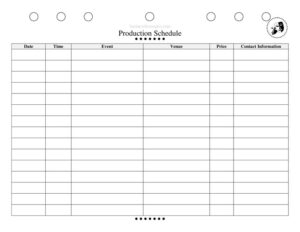
Production Schedule
Download a free Production Schedule template for theater rehearsals, tech, and performances in PDF and DOCX to keep your show on track and on time.
PDF
DOCX
4 downloads
0
likes
Download Files
- DOCX
A Production Schedule is a master timeline that maps every rehearsal, technical milestone, build deadline, and performance for a theatrical production. Stage managers and producers use it most often to keep an entire company — cast, crew, designers, and front of house — working in sync toward opening night. You can download this Production Schedule template free in both PDF and DOCX formats, with no signup required.
What Is a Production Schedule?
A Production Schedule is the central planning document for a theater production, usually issued and maintained by the stage manager or production manager. It documents what happens, when, where, and who is involved across the full life of a show — from the first read-through and table work through blocking rehearsals, technical and dress rehearsals, previews, and the run of performances. The schedule pulls together calls for actors, scenic and costume build deadlines, lighting and sound load-in, and strike. By giving everyone a single shared reference, it prevents double-booking, missed deadlines, and confusion, and it keeps the production moving toward an on-time, fully prepared opening.
When Do You Need a Production Schedule?
Almost every staged production benefits from a written schedule, but it becomes essential in these common situations:
- Planning a full rehearsal period — laying out weeks of rehearsals so cast and crew know their calls well in advance.
- Coordinating a technical week — sequencing load-in, focus, cue-to-cue, tech rehearsals, and dress rehearsals where timing is tight.
- Managing scenic and costume builds — setting deadlines for set construction, painting, fittings, and prop completion.
- Running a community or school theater program — keeping volunteers, students, and part-time participants aligned around clear dates.
- Producing a festival or repertory season — juggling multiple shows sharing the same stage, crew, and resources.
- Touring a production — tracking travel, get-in, performance, and get-out times across multiple venues.
What a Production Schedule Should Have
A complete Production Schedule gives every member of the company the information they need without ambiguity. At minimum it should include the production title and venue, the date and day of the week for each activity, the start and end times, the type of activity (rehearsal, tech, fitting, performance), the location or space being used, and the personnel called for that session. Many schedules also note the scenes or pages being worked, key deadlines for departments, meal breaks, and a contact for the stage management team. Clear formatting matters as much as content: a schedule that is easy to scan reduces missed calls and last-minute scrambling.
How to Fill Out a Production Schedule
Because this template is flexible, build it out step by step so it reflects your specific show:
- Add the production details — enter the show title, producing organization, and primary venue at the top so the document is unmistakable.
- Set the date range — list the first rehearsal date through opening or the close of the run.
- Create dated rows — for each working day, record the date and day of the week.
- Enter call and end times — specify when each session begins and ends, including any planned breaks.
- Label the activity type — note whether it is a read-through, blocking rehearsal, run, tech, dress, fitting, or performance.
- Assign the location — identify the rehearsal room, shop, or stage being used.
- List who is called — name the actors, crew, or departments required, and the scenes or material covered.
- Mark key deadlines — flag build completion, costume parade, and load-in milestones.
- Distribute and date the version — note the revision date and circulate to the whole company.
Types of Schedules Within a Production
A single show often relies on several layered schedules that all feed into the master Production Schedule. The rehearsal schedule breaks down day-by-day calls for actors and which scenes are worked. The build or shop schedule tracks scenic construction, painting, and prop deadlines. The tech schedule details the hour-by-hour plan for load-in, focus, level setting, cue-to-cue, and dress rehearsals. A performance schedule lists show dates, half-hour calls, and any talkbacks or special events. Keeping these aligned under one master document ensures that, for example, a set is finished before tech begins and costumes are ready before the first dress rehearsal.
Tips for Keeping the Schedule Accurate
A Production Schedule is only useful if people trust it. Always include a revision date or version number so the company knows they are reading the current copy, and clearly mark superseded versions as outdated. Coordinate with designers and shop heads before publishing deadlines so the dates are realistic, not aspirational. Build in buffer time around tech week, where overruns are most common, and confirm room and stage availability before committing to a date. When changes happen — and they will — communicate them promptly and reissue rather than relying on word of mouth.
Common Mistakes to Avoid
- Omitting end times — listing only call times leaves cast and crew unsure when sessions wrap, which complicates personal scheduling and union rest rules.
- Forgetting to version the document — circulating multiple undated copies creates confusion about which schedule is current.
- Overpacking tech week — underestimating how long load-in and cue-to-cue take leads to exhausted crews and rushed dress rehearsals.
- Leaving out break times — skipping meal and rest breaks can violate agreements and burns out the company.
- Failing to confirm spaces — assuming a rehearsal room or stage is free without checking causes last-minute relocations.
- Not naming who is called — vague entries waste people’s time when actors show up for scenes they aren’t in.
Frequently Asked Questions
What is a Production Schedule used for? It is the master timeline that organizes every rehearsal, build deadline, technical milestone, and performance for a theatrical production. It keeps the cast, crew, and design teams coordinated so the show is fully prepared by opening night. Stage managers rely on it as the single source of truth for who is needed when and where.
Who creates the Production Schedule? Typically the stage manager or production manager builds and maintains it, often in collaboration with the director, designers, and shop heads. They gather everyone’s needs and deadlines, then publish a unified schedule. As the production evolves, the stage management team issues updated versions.
How is a Production Schedule different from a rehearsal schedule? A rehearsal schedule focuses narrowly on which scenes are worked and which actors are called each day. The Production Schedule is broader, encompassing builds, technical rehearsals, performances, and department deadlines across the whole production. The rehearsal schedule is essentially one component of the larger document.
How often should the schedule be updated? Update it whenever a date, time, location, or call changes, and always mark the revision with a date or version number. During tech week, changes can happen daily, so reissue promptly. Reliable versioning prevents people from working off outdated information.
Does a Production Schedule need to be signed or notarized? No — a Production Schedule is an internal planning and communication tool, not a legal contract, so it does not require signatures or notarization. It simply needs to be clear, current, and distributed to everyone involved. Any binding agreements, such as performer contracts, are handled in separate documents.
Is this Production Schedule template really free? Yes. You can download this Production Schedule template free in both PDF and DOCX formats with no signup required. Customize it with your show’s dates, venues, and calls, and reuse it for every production you manage.
This Production Schedule template is provided as a general example for informational purposes only and does not constitute legal, financial, or professional advice. Scheduling requirements, union rules, and venue policies vary by organization and jurisdiction — consult the appropriate professional or governing agreement for guidance specific to your production.
Related Forms
- Box Office Count
- Spike Matrix
- Instrument Schedule
- Audition Checklist
- Props Preset By Act
- Theater Wallet Cards
Browse more in Theater.