
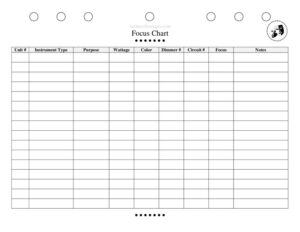
Focus Chart
Download a free Focus Chart template for theater lighting in PDF and DOCX to record fixture focus, beam positions, and channel notes for every cue.
PDF
DOCX
7 downloads
0
likes
Download Files
- DOCX
A Focus Chart is the document a lighting team uses to record exactly how each fixture in a theatrical rig is aimed, shaped, and adjusted during the focus session. Its most common use is to preserve the precise focus of every light so the design can be reproduced, refocused, or troubleshot during a run, on tour, or in a remount. You can download this Focus Chart free in both PDF and DOCX, with no signup required.
What Is a Focus Chart?
A Focus Chart is a working reference sheet created and maintained by the lighting department — typically the master electrician, assistant lighting designer, or programmer — during the focus call. It documents where each instrument points, how its beam is sized and framed, what color or accessories it carries, and any special notes the designer gives in the moment. Because focus is one of the most labor-intensive and detail-heavy parts of a production, the chart turns fleeting verbal instructions into a permanent, sharable record. If a fixture drifts, a lamp blows, or the rig is rebuilt in a new venue, the Focus Chart lets the crew restore the look quickly and accurately.
When Do You Need a Focus Chart?
Lighting teams reach for a Focus Chart whenever the exact aim and shape of each fixture matters and must be repeatable. Common situations include:
- During the focus call, to capture the designer’s instructions for every unit as they walk the rig instrument by instrument.
- Before a touring production loads out, so the rig can be refocused identically in each new venue with different sightlines and trim heights.
- When a lamp burns out or a fixture is bumped, allowing an electrician to restore the correct beam without calling the designer back in.
- For long-running shows, where understudy crews and swing electricians need a clear, written reference to maintain the design night after night.
- During a remount or revival, to recreate a previous production’s looks from the original documentation.
- For educational and community theaters, where teaching the focus process and handing off paperwork between volunteer crews is essential.
What a Focus Chart Should Have
A complete Focus Chart ties paperwork back to the physical rig and the lighting plot. It should identify each instrument clearly, describe how it was focused, and leave room for the designer’s notes. Useful elements include the production and venue name, the date of the focus session, the channel and dimmer or address, the instrument type and unit number, its position on the plot, the purpose or system the unit belongs to, the focus point on stage, beam size and shaping (shutters, barn doors, iris, or zoom), color and gobo information, and a notes column for special instructions. Page numbers and a position-by-position layout keep the document organized when the rig contains dozens or hundreds of units.
How to Fill Out a Focus Chart
Work through the chart systematically, ideally one hanging position at a time so nothing is skipped:
- Header information: Enter the production title, theater or venue, lighting designer, and the date of the focus session at the top so the sheet is unambiguous later.
- Position and unit number: Identify each fixture’s hanging position (for example, 1st Electric, Box Boom SL) and its unit number on that position, matching the lighting plot.
- Channel, dimmer, and address: Record the control channel, dimmer or circuit, and DMX address so the unit can be located in the console and patch.
- Instrument type and accessories: Note the fixture type, wattage or lamp, and any accessories such as barn doors, top hats, or an iris.
- Focus point: Describe where the unit is aimed on stage — a stage area, a number on a focus tape, or a person’s mark.
- Beam shaping: Record beam size, edge (hard or soft), shutter or framing cuts, and zoom or spread.
- Color and gobo: Enter the gel color number and any gobo or template.
- Notes: Capture the designer’s specific instructions, then page-number each sheet.
Focus Chart vs. the Lighting Plot and Channel Hookup
It helps to understand how the Focus Chart fits alongside the other core lighting documents. The lighting plot is a scaled drawing showing where each fixture hangs; the channel hookup and instrument schedule list how everything is patched and addressed. The Focus Chart is the only document that records what happens after the rig is hung and patched — the actual physical aim and shaping decided live in the room. Plot and hookup tell you what a fixture is and where it lives; the Focus Chart tells you what it does. Keeping all three current and cross-referenced means any member of the team can move from paperwork to the real rig and back without guesswork.
Tips for Accurate Focus Documentation
Good focus paperwork is written for the person who was not in the room. Use consistent abbreviations and define them once, so a soft-edged beam, a half-cut shutter, or a tight iris reads the same on every line. Note focus points relative to fixed stage references — set pieces, taped marks, or proscenium lines — rather than vague descriptions that change with the scenery. Photograph difficult or signature looks and reference the photo number in the notes column. Finally, update the chart immediately whenever a fixture is refocused during tech, because an out-of-date Focus Chart is worse than none at all.
Common Mistakes to Avoid
- Leaving the notes column blank — the designer’s verbal instructions are exactly what a later crew cannot reconstruct without documentation.
- Recording channel without position or unit number, which makes it impossible to find the physical fixture in the rig.
- Using inconsistent shorthand that one person understands but the next electrician cannot decode.
- Skipping the date and venue header, so multiple versions of the chart become indistinguishable.
- Forgetting to update the chart after refocusing during tech or previews.
- Describing focus points vaguely instead of tying them to fixed, repeatable stage references.
Frequently Asked Questions
What is a Focus Chart used for? A Focus Chart records exactly how each lighting fixture is aimed and shaped during the focus call. It lets a crew reproduce, restore, or troubleshoot the lighting design later without needing the designer present for every adjustment.
Who fills out the Focus Chart? Typically the assistant lighting designer, master electrician, or a dedicated paperwork person writes it during the focus session while the designer calls out instructions. On smaller productions, the lighting designer may keep it personally.
How is a Focus Chart different from a channel hookup? A channel hookup lists how fixtures are patched, addressed, and assigned to control channels, while a Focus Chart documents the physical aim, beam shaping, and notes from the focus call. They complement each other and are usually maintained together.
Do I need special software to use this template? No. This Focus Chart downloads as a PDF you can print and fill in by hand at the tech table, or as a DOCX you can edit, expand with more rows, and customize for your production’s positions.
How detailed should each entry be? Detailed enough that someone who was not in the room could refocus the unit correctly. Include the focus point, beam size and edge, any shutter or framing cuts, color, and the designer’s specific notes for that fixture.
Is this Focus Chart template free? Yes. You can download it free in both PDF and DOCX formats with no signup or payment required, and adapt it to fit any venue, rig size, or production workflow.
This Focus Chart template is provided as a general example for informational purposes only and does not constitute professional, technical, or safety advice. Theatrical rigging, electrical, and venue requirements vary widely — always follow your venue’s policies and consult a qualified technician or production professional for your specific situation.
Related Forms
- Run Sheet
- Production Meeting Notes
- Rehearsal Sign-In Sheet
- Blank Schedule Ongoing
- Bio Form
- Rehearsal Schedule Month
Browse more in Theater.