
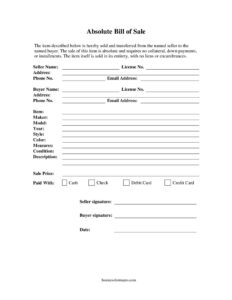
Absolute Bill Of Sale
Download a free Absolute Bill of Sale template in PDF and DOCX to document an outright, paid-in-full sale of personal property with no liens.
PDF
DOCX
21 downloads
0
likes
Download Files
- DOCX
An Absolute Bill of Sale is a written record that transfers ownership of an item outright from a seller to a buyer in a single, completed transaction. People most often use it to prove that an item was sold in full, with no loans, liens, or remaining payments attached. You can download this Absolute Bill of Sale free in both PDF and DOCX formats, with no signup required.
What Is an Absolute Bill of Sale?
An Absolute Bill of Sale is a document that confirms the complete and unconditional transfer of an item from the named seller to the named buyer. The word “absolute” means the sale requires no collateral, no down payments, and no installments — the item changes hands entirely once payment is made. It also confirms that the item is sold free of liens or encumbrances, meaning no third party has a financial claim against it. Either party can issue or request the document, though the seller usually prepares it. It serves as proof of purchase, evidence of ownership transfer, and a written record of the agreed price and item details for both buyer and seller.
When Do You Need an Absolute Bill of Sale?
This form fits any situation where an item is sold completely and paid for in full. Common scenarios include:
- Selling a used vehicle, trailer, or motorcycle outright for cash or card with nothing financed.
- Privately selling furniture, appliances, electronics, or musical instruments between individuals.
- Transferring equipment, tools, or machinery during a small-business sale or downsizing.
- Selling collectibles, jewelry, firearms, or artwork where buyer and seller both want a clear paper trail.
- Documenting a gift or family transfer that involves a nominal payment, so ownership is unambiguous.
- Providing a buyer with proof of ownership needed to register, insure, or resell the item later.
What an Absolute Bill of Sale Should Have
A complete Absolute Bill of Sale clearly identifies both parties, describes the item in enough detail to distinguish it from any other, states the price and how it was paid, and confirms the sale is final and lien-free. It should include the date of sale, full contact information for the seller and buyer, and signatures from both. The more precisely the item is described — by maker, model, year, color, and condition — the more useful the document becomes if a question about ownership ever arises. A well-completed form leaves no room for dispute about what was sold, for how much, and to whom.
How to Fill Out an Absolute Bill of Sale
- Enter the Date of the transaction at the top of the form.
- Fill in the Seller Name and the Buyer Name exactly as they appear on each person’s identification.
- Record the seller’s contact details: Address, Phone No., and Email Address.
- Describe the Item being sold, including its general Description and any specifics such as Maker, Model, Style, and Year.
- Add identifying physical details: Color, Condition, Measures (dimensions or size), and a License No. if the item is a vehicle or registered equipment.
- Enter the agreed Sale Price.
- Indicate how the buyer paid under Paid With — checking Cash, Check, Credit Card, or Debit Card.
- Have both parties sign: the Seller signature and the Buyer signature confirm the transfer is complete.
What “Absolute” Means for the Transaction
The defining feature of this form is that the sale is final and unconditional. Unlike a conditional bill of sale — where the seller may retain an interest in the item until installment payments are completed — an absolute bill of sale records a transfer that is fully done at signing. There are no future payments, no security interest, and no right for the seller to reclaim the item. The form also affirms that the item carries no liens or encumbrances, which reassures the buyer that no lender, creditor, or other party can later claim the property. For the seller, the document provides evidence that the item left their ownership on a specific date for a stated price.
Keeping Copies and Next Steps
After both parties sign, each should keep a copy of the completed form. The buyer may need it to register a vehicle, transfer a title, update insurance, or prove ownership if reselling the item later. The seller should retain a copy as evidence that responsibility for the item — including any liability — transferred on the date of sale. Storing a scanned digital copy alongside the paper version is a sensible habit. If the item is a titled vehicle, remember that the bill of sale typically supplements, rather than replaces, the official title transfer required by your local motor vehicle agency.
Common Mistakes to Avoid
- Leaving the item description vague — always include maker, model, year, and any serial or license number so the item can’t be confused with another.
- Forgetting to record how the buyer paid, which leaves the payment method and proof of payment unclear.
- Failing to date the document, making it hard to establish exactly when ownership and liability transferred.
- Missing one of the signatures — both the seller and buyer must sign for the transfer to be valid.
- Listing a sale price that doesn’t match what was actually exchanged, which can cause tax or registration problems.
- Not giving each party a copy, leaving one side without proof of the transaction.
Frequently Asked Questions
What is an Absolute Bill of Sale? It is a written document confirming that an item has been sold and transferred completely from a seller to a buyer in one finished transaction. “Absolute” means the sale is final, with no installments, collateral, or liens. It records the parties, the item, the price, and how payment was made.
How is it different from a conditional bill of sale? An absolute bill of sale transfers full ownership immediately at signing because the item is paid for in full. A conditional bill of sale, by contrast, lets the seller keep a security interest until the buyer finishes paying. If your sale involves payments over time, a conditional form is the better fit.
Does an Absolute Bill of Sale need to be notarized? Notarization is not always required, but some jurisdictions or item types — such as vehicles — may call for it or for witnesses. Notarizing the document adds an extra layer of proof that both parties signed willingly. Check your local rules before assuming it is or isn’t necessary.
Is an Absolute Bill of Sale legally binding? Once both the seller and buyer sign and the payment is exchanged, the document generally serves as binding evidence of the transaction. To be enforceable it should accurately reflect the agreed price, the item, and the parties involved. Keeping it complete and signed strengthens its legal value.
How much does this template cost? Nothing — you can download the Absolute Bill of Sale free from Business Forms Pro in both PDF and DOCX formats. There is no signup or account required. You can fill it in by hand after printing or edit the DOCX version on your computer.
Can I use it for selling a vehicle? Yes. The form includes fields for License No., Maker, Model, Year, Color, and Condition, which suit vehicle sales well. Keep in mind that for titled vehicles, the bill of sale usually accompanies an official title transfer handled by your local motor vehicle agency.
This template is provided as a general example for informational purposes only and is not legal, financial, or tax advice. Requirements for bills of sale and ownership transfers vary by jurisdiction. Consult a qualified professional to confirm what applies to your specific transaction.
Official resource: for the rules that apply to your situation, see your state DMV.
Related Forms
- Mobile Home Bill Of Sale
- Dock Receipt
- Dry Cleaning Ticket
- Receipt for Company Property
- Boat Bill of Sale
- Salvage Bill Of Sale
Browse more in Bills of Sale.