
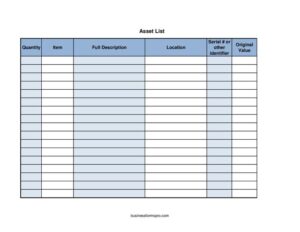
Asset List
Track and document everything your business owns with this free Asset List template, available as a free download in PDF and DOCX formats.
PDF
XLSX
15 downloads
0
likes
Download Files
- XLSX
An Asset List is a simple inventory document that records the items your business or household owns, along with key details like description, location, serial number, and value. People most often use it to keep an organized record for insurance, accounting, audits, or estate planning. You can download this Asset List template for free in both PDF and DOCX formats — no signup required.
What Is an Asset List?
An Asset List is a written or digital record that catalogs the tangible items owned by an individual, family, business, or organization. It documents each asset’s quantity, description, physical location, identifying number, and value so that owners always know what they have and what it is worth. Bookkeepers, office managers, business owners, and individuals use it to support insurance claims, depreciation tracking, financial statements, and general accountability. Unlike a quick shopping list, an Asset List is meant to be a living reference that grows and changes as items are bought, sold, moved, or retired. It brings clarity to ownership and value in one easy-to-scan place.
When Do You Need an Asset List?
An Asset List proves valuable in a surprising number of situations, especially when proof of ownership or value matters. Common reasons people create one include:
- Insurance documentation — recording valuables and equipment so you can substantiate a claim after theft, fire, or flood.
- Business accounting — tracking fixed assets like computers, machinery, and furniture for depreciation and tax purposes.
- Office or warehouse inventory — knowing what equipment exists, where it sits, and how to identify it by serial number.
- Estate planning and probate — listing personal property so heirs and executors can account for and distribute belongings.
- Moving or relocating — confirming that every item leaves one site and arrives at the next.
- Loan or financing applications — demonstrating the assets a borrower owns when collateral or net worth must be shown.
Types of Assets You Might Track
The same template works for many categories of property. A small business might log office electronics, tools, vehicles, and furniture. A homeowner might track jewelry, appliances, art, and electronics. A nonprofit might inventory donated equipment and program supplies. Some users keep separate lists by department or location, while others maintain a single master list and use the location field to organize entries. Because the form is flexible, you decide what counts as an asset worth recording — typically anything with meaningful value, a serial number, or a reason to prove ownership later.
What an Asset List Should Have
A complete Asset List leaves no doubt about what each item is and what it is worth. The essential elements include a clear item name, a full description that distinguishes similar objects, the quantity on hand, the location where the item lives, a serial number or other unique identifier, and both the original and current value. Together these fields let you identify any single item, prove you own it, and estimate its worth at a glance. Adding a header with your name or company and the date the list was prepared makes it easy to keep versions organized over time.
How to Fill Out an Asset List
Work through the form one row at a time so each item is fully documented. Using the actual fields in this template:
- Quantity — enter how many of the item you have. Group identical items (for example, “10” identical office chairs) or list valuable items individually when each has a unique serial number.
- Item — write a short, recognizable name such as “Laptop,” “Forklift,” or “Diamond Ring.”
- Full description — add the make, model, color, size, material, or any detail that separates this item from a similar one. The more specific, the easier it is to verify later.
- Location — note where the asset is kept, such as “Main Office, Room 2,” “Warehouse Bay B,” or “Home Safe.”
- Serial number or other identifier — record the manufacturer serial number, VIN, model number, asset tag, or any unique code. Write “N/A” if none exists.
- Original value — enter the purchase price or estimated cost when the item was acquired.
- Current value (if known) — note today’s estimated worth, accounting for wear, depreciation, or appreciation. Leave it blank if you are unsure.
Repeat for each asset, then save and date the completed list.
Keeping Your Asset List Accurate
An Asset List is only as useful as it is current. Set a routine — monthly, quarterly, or annually — to review entries, add new purchases, and remove items you have sold, donated, or disposed of. When you record a new asset, capture its serial number and value right away while the receipt is handy. For high-value items, consider attaching or storing photos alongside the list as extra proof for insurers. Keep a backup copy in a separate location, such as a cloud drive or an off-site folder, so your records survive the very disasters they are meant to document.
Asset List vs. a General Inventory Sheet
People sometimes confuse an Asset List with a stock or supply inventory, but they serve different goals. A general inventory typically tracks consumable or sellable goods that turn over quickly — products on shelves, raw materials, or supplies. An Asset List focuses on longer-lived property you own and keep, such as equipment, fixtures, and valuables, with an emphasis on identification and value rather than reorder points. If you need both, keep them as separate documents so each stays focused and easy to read.
Common Mistakes to Avoid
- Vague descriptions — writing only “laptop” instead of the brand and model makes proof of ownership harder.
- Skipping serial numbers — these identifiers are often what insurers and police need to match recovered items.
- Forgetting to update — an outdated list can understate or overstate what you actually own.
- Guessing values blindly — base figures on receipts or reasonable estimates rather than round guesses.
- Storing the only copy on-site — a list lost in the same fire as the assets offers no protection.
- Leaving location blank — without it, large lists become hard to verify during an audit or move.
Frequently Asked Questions
What is an Asset List used for? An Asset List is used to document the items you or your business own, including their description, location, identifier, and value. It supports insurance claims, accounting and depreciation, audits, estate planning, and proof of ownership. Having one organized record saves time and stress when you need to verify what you have.
How do I fill out an Asset List? Go row by row, entering the quantity, item name, a full description, the location, the serial number or other identifier, the original value, and the current value if you know it. Be as specific as possible so each entry clearly identifies one item. Save and date the list, then update it whenever assets change.
Does an Asset List need to be notarized? No, an Asset List generally does not need to be notarized for everyday tracking, insurance, or internal accounting use. In specific legal contexts, such as probate or court proceedings, additional verification may be requested. When in doubt, check the requirements of the party requesting the list.
What is the difference between original value and current value? Original value is what the item cost when you acquired it, while current value is its estimated worth today after depreciation or appreciation. Recording both gives a fuller financial picture for insurance and accounting. You can leave current value blank if you are not sure.
Is this Asset List template really free? Yes, this Asset List template is completely free to download from Business Forms Pro in both PDF and DOCX formats. There is no signup, subscription, or hidden cost. You can edit the DOCX version to add rows or columns that fit your needs.
How often should I update my Asset List? Review your Asset List on a regular schedule — many people choose quarterly or annually — and update it immediately whenever you buy, sell, move, or dispose of an item. Frequent updates keep the record accurate for insurance and tax purposes. Keeping a dated backup copy ensures you always have a current version available.
This Asset List template is a general example provided for informational purposes only and does not constitute legal, financial, tax, or insurance advice. Requirements and best practices vary by jurisdiction and situation. Consult a qualified professional for guidance specific to your circumstances.
Related Forms
- Trip Vehicle Inspection Checklist
- Monthly Multiple Project Timetable
- Salad Bar Items Inventory Spreadsheet
- Inventory Comparison Spreadsheet
- Interruptions Log
- Side Hustle Expenses Log
Browse more in Log and Inventory.