
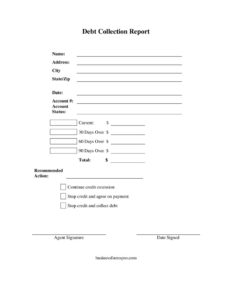
Debt Collection Report
Track overdue accounts and recommend next steps with our free Debt Collection Report template, available as a free download in PDF and DOCX.
PDF
DOCX
4 downloads
0
likes
Download Files
- DOCX
A Debt Collection Report is a document used to track an overdue account, summarize how far past due the balance has aged, and recommend a specific next step for recovering the money. Businesses most often use it to organize collection efforts on a single customer or account and to support internal decisions about whether to continue or freeze credit. You can download this Debt Collection Report free in PDF and DOCX, with no signup required.
What Is a Debt Collection Report?
A Debt Collection Report is an internal record that captures the current state of a debtor’s account and the action a credit or collections agent recommends. It is typically prepared by an accounts receivable clerk, a collections agent, or a credit manager who is reviewing an account that has fallen behind. The report documents the debtor’s identity and contact details, breaks the outstanding balance into aging buckets (current, 30, 60, and 90 days overdue), states the account status, and concludes with a signed recommendation. Unlike a customer-facing invoice or demand letter, this form is meant for the business’s own files, helping decision-makers see the full picture and agree on how to proceed.
When Do You Need a Debt Collection Report?
This report becomes useful whenever an account moves from routine billing into active follow-up. Common situations include:
- A customer’s invoice has slipped past its due date and you need to log the overdue amount before contacting them.
- An account has aged into the 60- or 90-day bucket and management wants a written recommendation on next steps.
- You are deciding whether to continue extending credit to a slow-paying client or to put their account on hold.
- A collections agent needs to hand off a case file to a supervisor, a manager, or an external agency.
- You are preparing month-end receivables reviews and want a standardized summary for each problem account.
- You need a documented basis for negotiating a payment arrangement or escalating to formal collection.
What a Debt Collection Report Should Have
A complete report ties together the who, the how much, and the what next. It should clearly identify the debtor by name, address, and account number so the right file is updated. It must break the balance into aging categories so the severity of the delinquency is obvious at a glance. It needs a total that reconciles with your accounting records, a stated account status, and a recommended action that the agent is prepared to stand behind. Finally, it should carry the agent’s signature and the date so there is accountability for the recommendation and a clear timeline of when the assessment was made.
How to Fill Out a Debt Collection Report
- Enter the Date you are preparing the report at the top so the assessment is anchored in time.
- Record the debtor’s Name, Address, City, and State/Zip exactly as they appear on the account.
- Fill in the Account # so the report matches the correct ledger entry.
- List the Current amount (not yet overdue) along with the balances in the 30 Days Over, 60 Days Over, and 90 Days Over columns.
- Add these figures and enter the Total outstanding balance.
- Note the Account Status — for example, active, on hold, or in dispute.
- Choose a Recommended Action: Continue credit extension, Stop credit and agree on payment, or Stop credit and collect debt.
- Sign in the Agent Signature field and enter the Date Signed to authorize the recommendation.
Understanding the Aging Buckets
The heart of this report is the way it divides the debt by age. The Current column holds amounts that are owed but not yet past due. The 30 Days Over, 60 Days Over, and 90 Days Over columns separate the overdue balance into increasingly serious tiers. This structure matters because older debt is generally harder to collect and signals greater risk. An account with most of its balance sitting in the 90-day column tells a very different story than one that is only slightly late. Reviewing the buckets side by side helps you and your team match the right recommended action to the real level of risk, rather than treating every late payment the same way.
Choosing the Right Recommended Action
The form offers three clear paths, and selecting the correct one is the point of the whole exercise. Continue credit extension suits a generally reliable customer whose lateness appears temporary and explainable. Stop credit and agree on payment fits a debtor who is behind but cooperative — you freeze new charges while negotiating a workable schedule to clear the balance. Stop credit and collect debt is the firmest option, reserved for accounts where good-faith repayment seems unlikely and you intend to pursue recovery more aggressively. Document the reasoning behind your choice in your notes so anyone reviewing the file later understands why the path was taken.
Common Mistakes to Avoid
- Leaving the aging columns blank or lumping everything into a single figure, which hides how serious the delinquency really is.
- Recording a Total that does not match the sum of the aging buckets or your accounting system.
- Using an outdated Address or Account #, which can route follow-up to the wrong file or person.
- Selecting a Recommended Action without explaining the reasoning behind it.
- Forgetting the Agent Signature or Date Signed, leaving the recommendation unauthorized and undated.
- Failing to file or share the completed report, so the recommendation never reaches the person who can act on it.
Frequently Asked Questions
What is a Debt Collection Report used for? It is an internal document that summarizes an overdue account, breaks the balance down by how long it has been past due, and records a recommended action. Businesses use it to organize collection efforts and to support decisions about extending or freezing credit.
How do I fill out a Debt Collection Report? Start with the date and the debtor’s name, address, and account number, then enter the current and overdue amounts in their aging columns and total them. Note the account status, choose a recommended action, and sign and date the form to authorize it.
Is a Debt Collection Report legally binding? No. It is an internal assessment and recommendation, not a contract or court document. It can become useful supporting documentation if a dispute escalates, but on its own it does not create or enforce any legal obligation.
Who should sign the report? The collections agent, credit officer, or staff member who prepared the assessment signs in the agent signature field. Some businesses also route it to a manager for approval before any action — such as stopping credit — is taken.
How is this different from a demand letter? A demand letter is sent directly to the debtor to request payment, while a Debt Collection Report stays inside your organization. The report informs your decision; a demand letter may be one of the steps you take after deciding to pursue the debt.
How much does this template cost? Nothing. The Debt Collection Report template is available as a free download in both PDF and DOCX formats, with no signup required, so you can use it as-is or adapt it to your own collection process.
This Debt Collection Report template is provided as a general example for informational purposes only and does not constitute legal, financial, or tax advice. Debt collection rules and disclosure requirements vary by jurisdiction. Consult a qualified attorney or financial professional before relying on this document for any specific situation.
Official resource: for the rules that apply to your situation, see the Consumer Financial Protection Bureau.
Related Forms
- School Cash Envelope
- Roommate Expense Tracker
- Why Denied Credit letter
- Simple Payroll Cost Report
- Daily Sales Commission Tracker
- Payroll Budget Estimate
Browse more in Money.