
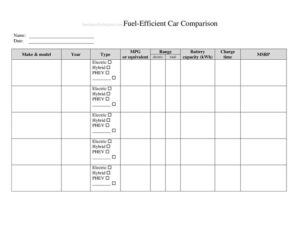
Electric Or Hybrid Car Comparison
Compare electric and hybrid vehicles side by side with our free Electric or Hybrid Car Comparison template—free download in PDF and DOCX, no signup.
PDF
DOCX
4 downloads
0
likes
Download Files
- DOCX
An Electric or Hybrid Car Comparison is a worksheet that lets you evaluate two or more electric and hybrid vehicles side by side—weighing price, range, charging, efficiency, and ownership costs—so you can choose the right car with confidence. People most often use it when they’re shopping for a greener vehicle and want an apples-to-apples view instead of juggling tabs and brochures. It’s free to download in PDF and DOCX, with no signup required.
What Is an Electric or Hybrid Car Comparison?
An Electric or Hybrid Car Comparison is a structured document that gathers the most important specifications and cost figures for competing vehicles into one easy-to-scan layout. Buyers, families, and fleet managers use it to organize research on battery electric vehicles (BEVs), plug-in hybrids (PHEVs), and conventional hybrids (HEVs). Rather than documenting a sale, it documents decision criteria—what each car offers, what it costs to buy and run, and how the options stack up. By filling in the same fields for every vehicle, you remove guesswork and emotion from the process and create a clear written record you can revisit, share with a partner, or bring to the dealership.
When Do You Need an Electric or Hybrid Car Comparison?
- You’re cross-shopping a fully electric model against a plug-in hybrid and can’t decide which fits your daily driving.
- You want to estimate real-world running costs—charging or fuel, insurance, and maintenance—before committing to a monthly payment.
- You’re researching available tax credits, rebates, or incentives and need a place to log how each car qualifies.
- A household with two drivers is debating range needs and home-charging access.
- A small business or fleet manager is selecting vehicles and must justify the choice with documented criteria.
- You’re comparing trim levels of the same model to see whether extra range or features are worth the price.
Types of Vehicles You Might Compare
The worksheet works for any electrified powertrain, and naming the type for each entry helps clarify trade-offs. Battery electric vehicles (BEVs) run only on electricity and need charging infrastructure. Plug-in hybrids (PHEVs) offer a limited electric-only range plus a gasoline engine for longer trips. Conventional hybrids (HEVs) never plug in and recharge their small battery through the engine and braking. Listing the type in your comparison reminds you that a BEV’s low fuel cost comes with charging considerations, while a PHEV or HEV trades some efficiency for flexibility.
What an Electric or Hybrid Car Comparison Should Have
A complete comparison captures both the purchase decision and the long-term ownership picture. The most useful elements include:
- Vehicle identity: make, model, year, trim, and powertrain type.
- Price details: MSRP, expected purchase or lease price, and applicable incentives or tax credits.
- Range and efficiency: electric range, total range, and energy economy (MPGe or kWh per 100 miles).
- Charging or fueling: battery size, charge time, connector type, and home-charging needs.
- Running costs: estimated electricity or fuel cost, insurance, and maintenance.
- Features and warranty: seating, cargo, safety tech, and battery warranty terms.
- A notes or verdict line to capture your impressions of each option.
How to Fill Out an Electric or Hybrid Car Comparison
- Label each column. Across the top, enter the make, model, year, and trim of every vehicle you’re comparing—create one column per car.
- Record the powertrain type. Mark each as BEV, PHEV, or HEV so the comparison stays meaningful.
- Enter pricing. Fill in MSRP, your negotiated or lease price, and any rebates or tax credits you expect to claim.
- Add range and efficiency. Write the electric-only range, total range, and efficiency rating (MPGe or kWh/100 mi) from the manufacturer or EPA listing.
- Detail charging. Note battery capacity, charge time on Level 2 and fast charging, and the connector type.
- Estimate running costs. Calculate monthly electricity or fuel cost based on your mileage, then add insurance and maintenance estimates.
- List features and warranty. Capture seating, cargo space, driver-assist tech, and the battery warranty length.
- Write your verdict. Use the notes line to rank each car or jot pros and cons.
Tips for an Accurate, Useful Comparison
Use the same source and the same time period for every figure—mixing manufacturer claims with real-world reviews skews the result. Base your electricity cost on your actual utility rate (cents per kWh) and your daily mileage, not a generic average. If you can’t charge at home, factor in public charging prices and time, which can erase a BEV’s running-cost advantage. Remember that incentives change frequently and may have income or price caps, so verify current eligibility before counting on a credit. Finally, weigh resale value and battery degradation: these are harder to quantify but matter over years of ownership.
How This Differs From a Standard Car Comparison
A conventional car comparison focuses on horsepower, fuel economy, and price. An electric or hybrid comparison adds layers that gasoline shoppers never face: charging speed and connector compatibility, electric-only range, battery warranty, and the gap between sticker price and effective price after incentives. The running-cost math is also different—electricity is billed per kilowatt-hour, maintenance is typically lower for BEVs, and home-charging hardware may be a one-time expense. Capturing these EV-specific fields is exactly why a dedicated worksheet beats a generic one.
Common Mistakes to Avoid
- Comparing different trims unequally—make sure each column reflects a comparable equipment level.
- Assuming advertised range without adjusting for cold weather, highway speeds, or your driving style.
- Counting incentives you don’t qualify for—check income, price, and residency requirements first.
- Ignoring home-charging costs like a Level 2 charger installation or electrical panel upgrades.
- Forgetting insurance and maintenance, which can differ noticeably between models and powertrains.
- Leaving the notes blank, so by the third car you forget your impressions of the first.
Frequently Asked Questions
What is an Electric or Hybrid Car Comparison used for? It’s a worksheet for evaluating two or more electrified vehicles side by side across price, range, charging, and running costs. People use it to make a confident, informed buying decision and to keep a written record of their research. It works equally well for personal shoppers and small fleets.
How do I fill it out? Create one column per vehicle, then enter the make, model, year, trim, and powertrain type. Fill in pricing, range, efficiency, charging details, and estimated running costs for each, and finish with a notes or verdict line. Using identical sources for every car keeps the comparison fair.
Should I compare an EV against a plug-in hybrid? Yes—the template is designed for exactly that, since it includes both electric range and total range fields. A BEV may have lower running costs, while a PHEV offers gasoline flexibility for long trips. Comparing them side by side reveals which fits your driving and charging situation.
Does the comparison account for tax credits and incentives? The worksheet provides a place to log incentives and your effective price after them, but it does not determine your eligibility. Incentive programs change often and may have income, price, or residency limits. Always verify current rules with the relevant authority before relying on a credit.
Is this a binding document? No. It is a personal research and decision tool, not a contract or purchase agreement. Nothing you write in it commits you to buy, and dealers are not bound by figures you record—negotiate and confirm final terms in writing.
How much does the template cost? It is completely free to download here in both PDF and DOCX formats, with no signup or account required. Use the PDF to print and fill by hand, or edit the DOCX to add your own fields and vehicles.
This template is a general example provided for informational purposes only and is not financial, tax, or purchasing advice. Vehicle specifications, pricing, and incentive eligibility vary by region and change over time—verify all figures with manufacturers, dealers, and official sources, and consult a qualified professional before making a major purchase.
Official resource: for the rules that apply to your situation, see your state DMV.
Related Forms
- Motor Vehicle Bill of Sale
- Motorcycle Bill of Sale
- New Car Comparison
- Vehicle Inspection Report
- Auto Transport Bill of Lading
- Used Car Mechanic Checklist
Browse more in Auto Sales.