
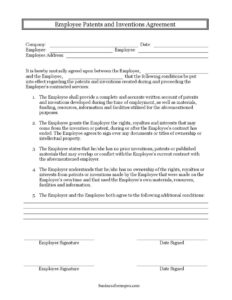
Employee Patents And Inventions Agreement
Download a free Employee Patents and Inventions Agreement template in PDF and DOCX to assign invention rights clearly between employer and employee.
PDF
DOCX
1 downloads
0
likes
Download Files
- DOCX
An Employee Patents and Inventions Agreement is a contract that defines who owns the inventions, patents, and intellectual property an employee creates in connection with their job. Companies most often use it when hiring staff in research, engineering, design, or product roles to make ownership of work-related inventions clear from day one. You can download this template free in PDF and DOCX, with no signup required.
What Is an Employee Patents and Inventions Agreement?
An Employee Patents and Inventions Agreement is a written contract between an employer and an employee that establishes how inventions and patentable work are owned, disclosed, and assigned. It documents that inventions developed using company time, resources, funding, or facilities belong to the employer, while protecting work the employee created independently on their own time. The agreement is typically issued by the company, often as part of an onboarding packet, and signed by both parties at the start of employment. Its purpose is to prevent disputes over intellectual property, set disclosure obligations, and give the employer a clear path to register and commercialize inventions tied to the work it paid for.
When Do You Need an Employee Patents and Inventions Agreement?
- When hiring an engineer, scientist, or developer whose role involves creating new products, processes, or technology.
- When a startup wants clean ownership of intellectual property before seeking investors or filing patents.
- When an employee will use company labs, equipment, software, or funding to develop inventions.
- When you need to formally document that a new hire has no prior inventions that conflict with their role.
- When a company licenses or commercializes innovations and must prove it holds the underlying rights.
- When updating employment paperwork to add a clear IP assignment clause that earlier contracts lacked.
What an Employee Patents and Inventions Agreement Should Have
A complete agreement should clearly name the employer and employee, state the effective date, and identify the inventions and patents it covers. Strong versions include a disclosure obligation requiring the employee to report what they create, an assignment clause transferring rights and royalties to the employer, and a carve-out that excludes inventions made entirely on the employee’s own time with their own resources. It should also include a representation that the employee has no conflicting prior inventions, a space for any additional negotiated conditions, and signature lines with dates for both parties. Clear, specific language in each clause reduces the chance of later disputes over what belongs to whom.
How to Fill Out an Employee Patents and Inventions Agreement
- Enter the Company name and the Date the agreement is being executed.
- Fill in the Employer name and the Employee name in the heading and the opening sentence where blanks appear.
- Add the Employee Address so the individual is clearly identified.
- Review clause 1, which requires the employee to provide a complete written account of inventions developed, along with materials, funding, resources, information, and facilities used.
- Confirm clause 2, under which the employee assigns rights, royalties, and interests to the employer and agrees to sign any documents transferring ownership.
- Read clause 3, where the employee states they have no prior inventions or published materials that conflict with the current role.
- Note clause 4, which confirms the employer claims no ownership of inventions the employee makes on their own time using their own resources.
- Use the additional conditions space in clause 5 to record any negotiated terms, such as specific projects or exclusions.
- Have both parties complete the Employer Signature, Employee Signature, and Date Signed lines.
Understanding the Ownership Carve-Out
One of the most important parts of this agreement is the balance struck in clauses 2 and 4. Clause 2 gives the employer broad rights over inventions tied to the employment relationship, while clause 4 protects the employee’s personal projects developed entirely off the clock without company resources. This carve-out matters because many jurisdictions limit how far an employer can reach into an employee’s private creative work. Some employees attach a list of pre-existing inventions when signing, so there is a clear record of what they owned before joining. Spelling out the boundary up front protects both sides: the company secures the IP it paid to develop, and the employee keeps ownership of unrelated personal innovations.
Disclosure and Assignment Obligations
The agreement does more than transfer ownership; it creates an ongoing duty to disclose. Under clause 1, the employee must keep an accurate account of what they invent and the resources they used. This disclosure makes it possible for the employer to evaluate whether an invention is patentable and to file applications promptly, since patent rights can be lost if filings are delayed or details become public. The assignment language in clause 2 is what allows the employer to be listed as the owner of any resulting patent and to later license or sell those rights. Keeping a signed copy in the employee’s personnel file ensures the chain of ownership is documented if a patent is ever challenged.
Common Mistakes to Avoid
- Leaving the employer or employee name blanks empty, which weakens the contract’s enforceability.
- Skipping the prior-inventions representation in clause 3 or failing to attach a list of pre-existing work.
- Writing assignment language so broadly that it appears to claim personal inventions clause 4 is meant to exclude.
- Forgetting to date the signatures, leaving the effective timeline unclear.
- Not having the employee sign before they begin work, so early inventions fall outside the agreement.
- Ignoring local laws that restrict assignment of inventions made entirely on personal time.
Frequently Asked Questions
What is an Employee Patents and Inventions Agreement? It is a contract that defines who owns inventions and patents an employee develops, typically assigning work-related inventions to the employer while protecting personal projects. Companies use it to secure intellectual property and prevent ownership disputes. It is usually signed when an employee is hired.
How do I fill out the agreement? Enter the company, date, employer, employee name, and employee address, then review each numbered clause covering disclosure, assignment, prior inventions, and the personal-work carve-out. Add any additional conditions in clause 5, and have both parties sign and date the document. Keep a signed copy on file for both sides.
Does this agreement need to be notarized or witnessed? Notarization is generally not required for an employment IP agreement to be valid, since it is a contract between two parties. However, some companies add witnesses or notarization for extra evidentiary weight on high-value inventions. Requirements vary by jurisdiction, so check your local rules.
Is an Employee Patents and Inventions Agreement legally binding? Yes, when both parties sign voluntarily and the terms are lawful, it generally creates a binding contract. Enforceability can depend on local laws that limit how broadly an employer may claim employee inventions, especially those made on personal time. Having clear, reasonable terms improves the chance it will hold up.
Can the employee keep rights to inventions made on their own time? Yes. Clause 4 of this template confirms the employer claims no ownership of inventions the employee creates entirely on their own time using their own materials, resources, and facilities. To avoid confusion, employees often list those personal projects so the boundary is documented.
How much does this template cost? This Employee Patents and Inventions Agreement template is completely free to download from Business Forms Pro in both PDF and DOCX formats, with no signup required. You can edit the DOCX version to fit your company’s needs. There are no hidden fees or subscriptions.
This template is a general example provided for informational purposes only and is not legal, financial, or tax advice. Intellectual property and employment laws vary by jurisdiction, and an agreement valid in one place may not be enforceable elsewhere. Consult a qualified attorney before using this document to protect important inventions or patents.
Official resource: for the rules that apply to your situation, see the U.S. Department of Labor.
Related Forms
- Consent to Release Personnel Information
- Tarjeta De Tiempo Manual Miniatura
- Arrival And Departure Record
- Employee Appraisal
- Employee Self Evaluation
- Employee Turnover Rate
Browse more in Employment.