
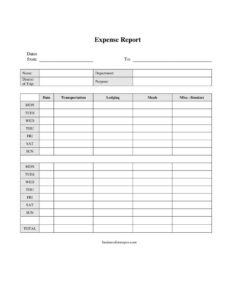
Expense Report Weekly
Track and submit weekly business spending fast with our free Weekly Expense Report template, organized by day and category—free download in PDF and DOCX.
PDF
DOCX
7 downloads
0
likes
Download Files
- DOCX
A Weekly Expense Report is a simple form employees use to record and submit their business-related spending for a single work week, broken down day by day and by category. The most common reason people reach for one is to get reimbursed for travel and out-of-pocket costs while giving the finance team a clear, itemized record. You can download this Weekly Expense Report free in both PDF and DOCX formats—no signup required.
What Is a Weekly Expense Report?
A Weekly Expense Report is a structured document that summarizes an individual’s reimbursable business expenses over a seven-day period. It is typically completed by an employee or contractor and submitted to a manager or accounting department for review and payment. The form captures who incurred the costs, the department they belong to, the dates and purpose of any trip, and a grid that organizes spending by category—such as transportation, lodging, and meals—across each day of the week. By consolidating a week’s worth of receipts into one tidy summary, the report makes approval faster, supports accurate bookkeeping, and creates a paper trail for tax and audit purposes.
When Do You Need a Weekly Expense Report?
This form fits almost any situation where someone spends their own money on behalf of an employer and expects reimbursement. Common scenarios include:
- Recurring business travel—a sales rep on the road Monday through Friday logging mileage, hotels, and client meals.
- Project or client site work—a consultant tracking transportation and lodging for a week spent at a customer location.
- Conferences and training—an employee attending a multi-day event who needs to capture registration-adjacent costs, meals, and travel.
- Field service teams—technicians who incur fuel, parking, and supply costs across several job sites each week.
- Departmental budget tracking—managers who want a consistent weekly snapshot of spending by category and team member.
- Per diem reconciliation—staff comparing actual daily meal and lodging spend against an allowance.
Because the layout breaks costs out by day, it is especially useful when reimbursement policies cap certain categories on a daily basis.
What a Weekly Expense Report Should Have
A complete and useful weekly report includes a few essential elements so it can be approved without back-and-forth. At minimum it should identify the employee and their department, state the date range the report covers, and explain the business purpose of the spending. The body should present expenses by category and by day, with a clear total. Itemized notes for miscellaneous costs help reviewers understand anything that doesn’t fit a standard line. Finally, the report should leave room for receipts to be attached and for signatures or approval, so the numbers can be verified before payment is issued.
How to Fill Out a Weekly Expense Report
- Dates from / to: Enter the start and end dates of the week the report covers, so finance knows the exact reporting period.
- Name: Write your full name as it appears in payroll records to ensure reimbursement reaches the right person.
- Department: List your team or cost center so the expense is charged to the correct budget.
- Date(s) of trip: Record the specific days you traveled, if the spending relates to a trip.
- Purpose: Briefly describe the business reason—for example, “client visit” or “regional sales conference.”
- Date: Note the date you are completing or submitting the report.
- Category rows: Use the transportation, lodging, meals, and misc. (itemize) lines to classify each cost; spell out details for miscellaneous items.
- Daily columns (Mon–Sun): Enter the amount spent in each category under the correct day of the week.
- Total: Add each row and column, then enter the grand total you are requesting for reimbursement.
Tips for Faster Approval and Accurate Records
The difference between a report that’s approved in minutes and one that bounces back usually comes down to detail. Keep every receipt as you go rather than reconstructing the week from memory—staple or scan them and reference them on the report. When you fill the misc. line, always itemize: “parking $14, Wi-Fi $9” tells the reviewer far more than a single lump sum. Be consistent about how you split shared costs, like a group dinner, and note who attended for meals. Round nothing; enter exact amounts. If your company has daily caps on meals or lodging, check each day’s column against the limit before you submit so you aren’t surprised by a partial reimbursement.
How the Weekly Report Differs From a Monthly One
A weekly expense report and a monthly report serve the same purpose but suit different rhythms. The weekly version, with its Monday-through-Sunday grid, shines for road warriors and field staff who want quick turnaround and tighter cash flow—submitting every week means waiting days, not weeks, for reimbursement. It also keeps receipts manageable and details fresh. A monthly report consolidates more activity into one submission, which reduces paperwork frequency but can make individual costs harder to recall and slower to repay. Many organizations let employees choose based on travel frequency, or require weekly reports during heavy travel periods and monthly summaries otherwise.
Common Mistakes to Avoid
- Skipping the purpose field—without a stated business reason, finance can’t confirm an expense is reimbursable.
- Lumping costs in “misc.”—failing to itemize miscellaneous items is the top cause of rejected reports.
- Mismatched dates—daily amounts that fall outside the “from/to” range create confusion and delay.
- Missing receipts—submitting amounts with no documentation makes the report impossible to verify.
- Math errors—a total that doesn’t match the rows and columns undermines trust in the whole report.
- Mixing personal and business spend—including non-reimbursable items can trigger a full review and slow payment.
Frequently Asked Questions
What is a Weekly Expense Report used for? It is used to record and submit business-related spending for one work week so an employee can be reimbursed. It organizes costs by category and by day, giving managers and accounting a clear, itemized summary to review and approve.
How do I fill out the daily columns? Match each expense to its category row—transportation, lodging, meals, or misc.—and enter the amount under the day it was incurred (Mon through Sun). Then add across rows and down columns to reach the total reimbursement you’re requesting.
Do I need to attach receipts? Most employers require receipts to verify amounts, especially for lodging and larger purchases. Even when small expenses don’t strictly need a receipt, attaching or itemizing them in the misc. line speeds approval and protects you during audits.
Is a Weekly Expense Report a legal document? It is a business record rather than a legal contract, but it can become important supporting documentation for tax filings, audits, and reimbursement disputes. Accuracy matters, so report only genuine business expenses and keep your copies.
Can I edit this template to match our company policy? Yes. The DOCX version is fully editable, so you can add categories, insert your logo, adjust the day labels, or include an approval signature line to fit your organization’s reimbursement rules.
How much does this template cost? It is completely free to download in both PDF and DOCX formats, with no signup or account required. Use it as-is or customize it for your team at no charge.
This Weekly Expense Report template is provided as a general example for informational purposes only and does not constitute legal, financial, or tax advice. Reimbursement rules, recordkeeping standards, and tax requirements vary by employer and jurisdiction—consult your company policy or a qualified professional before relying on this form.
Related Forms
- Travel Expense Report
- Expense Reimbursement Request Report
- Mileage Reimbursement Form
- Check Register
- Travel Expenses
- Event Budget Worksheet
Browse more in Expense Reports.