
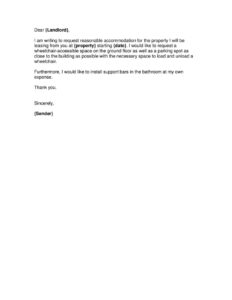
Reasonable Accommodation Request Wheelchair
Download a free Reasonable Accommodation Request Wheelchair letter template in PDF and DOCX to formally ask your landlord for accessibility changes.
PDF
DOCX
1 downloads
0
likes
Download Files
- DOCX
A Reasonable Accommodation Request Wheelchair is a written letter a tenant or applicant sends to a landlord or housing provider asking for a change to a policy, practice, or physical feature so a wheelchair user can fully use and enjoy their home. People most often use it to request things like an accessible parking space, a ramp, or permission to widen a doorway. You can download this template free in both PDF and DOCX formats, with no signup required.
What Is a Reasonable Accommodation Request Wheelchair?
A Reasonable Accommodation Request Wheelchair is a formal communication, usually a letter or short form, in which a person with a mobility disability asks a property owner, property manager, or homeowners association to adjust rules or premises to remove a barrier. It documents the specific accommodation needed, explains the connection between the disability and the request, and creates a written record of when the request was made. Under fair housing principles, housing providers are generally expected to consider reasonable requests from residents who use wheelchairs. The form does not have to be complicated, but putting the request in writing protects both the tenant and the landlord by clearly stating what is being asked and why.
When Do You Need a Reasonable Accommodation Request Wheelchair?
This letter is useful any time a standard policy or building feature makes a unit harder to use for someone who relies on a wheelchair. Common situations include:
- Requesting a designated accessible parking space close to the building entrance.
- Asking permission to install a ramp at an entryway or to add grab bars in a bathroom.
- Seeking approval to widen a doorway or lower countertops and cabinets for wheelchair access.
- Requesting a transfer to a ground-floor or elevator-accessible unit when current housing is inaccessible.
- Asking the provider to waive a “no modifications” rule so accessibility changes can be made.
- Requesting that a no-pets policy be relaxed for a trained service animal that assists with mobility.
In each case, the written request starts a conversation and gives the housing provider the information they need to respond. Some accommodations involve changes the landlord pays for, while others may be modifications the tenant arranges and funds — the letter is the appropriate first step regardless.
What a Reasonable Accommodation Request Should Have
A complete request letter is short and clear. To be effective it should include the date, the tenant’s name and unit or property address, and the name of the landlord, manager, or HOA the request is directed to. The heart of the letter is a plain statement of the specific accommodation being requested and a brief explanation that the change is needed because of a mobility disability. You generally do not need to disclose detailed medical information — only enough to connect the disability to the request. It helps to suggest how the change could work, offer to provide supporting documentation if reasonable, and include a polite request for a written response by a certain date. Always keep a copy for your records.
How to Fill Out a Reasonable Accommodation Request Wheelchair
- Enter the date at the top of the letter so there is a clear record of when you submitted the request.
- Add the recipient’s name and title — for example, the landlord, property manager, or HOA board — along with their mailing address.
- Fill in your full name, unit number, and property address so the provider can identify your tenancy.
- State clearly in the opening line that you are making a reasonable accommodation request related to a disability that affects mobility and your use of a wheelchair.
- Describe the specific accommodation you need, such as an accessible parking spot, a ramp, a wider doorway, or a unit transfer.
- Briefly explain the connection between your disability and the requested change without sharing unnecessary medical detail.
- Note whether you are willing to provide supporting documentation from a medical or service provider if the housing provider needs it.
- Request a written response by a reasonable date and provide your phone number or email for follow-up.
- Add your signature and printed name, then save a dated copy before sending.
Reasonable Accommodation Versus Reasonable Modification
It helps to understand the difference between two related terms. A reasonable accommodation usually refers to a change in rules, policies, or services — for example, assigning an accessible parking space or waiving a pet restriction for a service animal. A reasonable modification refers to a physical change to the unit or common areas, such as building a ramp, installing grab bars, or widening a doorway. Both can be requested using a letter like this one. Who pays for the change and whether the tenant must restore the property afterward can vary depending on the type of housing and the rules that apply, so it is worth asking the provider to confirm the arrangement in writing before any work begins.
Tips for Submitting Your Request
Deliver the letter in a way you can document — certified mail, email with a read receipt, or an in-person handoff with a signed acknowledgment all work well. Keep your wording calm, factual, and specific; a focused request is easier for a provider to evaluate and approve. If your first request is denied or no response arrives, you can follow up referencing your original dated letter. Many housing providers and fair housing agencies offer an interactive process to find a workable solution, so be open to discussing alternatives that still meet your accessibility needs.
Common Mistakes to Avoid
- Being vague about what you actually need — name the specific change rather than just stating you have a disability.
- Oversharing medical details when only a brief connection between the disability and the request is necessary.
- Not keeping a copy of the dated letter and proof of delivery.
- Skipping the written form and relying only on verbal conversations that leave no record.
- Forgetting a response deadline or contact information, which can slow down a reply.
- Assuming approval and starting modifications before the provider confirms the arrangement in writing.
Frequently Asked Questions
What is a Reasonable Accommodation Request Wheelchair? It is a written letter a wheelchair user sends to a landlord, property manager, or HOA asking for a change to a rule or to the physical premises so they can fully use their home. Common requests include accessible parking, ramps, grab bars, or wider doorways. The letter documents the request and the reason behind it.
How do I fill out the request? Add the date, the recipient’s details, and your name and unit address, then clearly state the specific accommodation you need and briefly connect it to your mobility disability. Offer to provide supporting documentation if reasonable, ask for a written reply by a set date, and sign the letter. Keep a copy for your records.
Does the landlord have to grant my request? Housing providers are generally expected to consider reasonable requests from residents with disabilities, but specific obligations and exceptions vary by the type of housing and applicable rules. A provider may discuss alternatives through an interactive process. If you have questions about your rights, contact a local fair housing agency or qualified professional.
Do I have to disclose my medical condition? No — you generally only need to explain enough to show the connection between your disability and the accommodation you are requesting. You usually do not have to share a diagnosis or detailed medical history. A provider may, in some cases, ask for limited verification when the disability or need is not obvious.
Does this letter need to be notarized? Notarization is typically not required for a reasonable accommodation request letter. A clear, dated, and signed letter is usually sufficient. Keeping proof that you sent it, such as a certified mail receipt or email confirmation, is more important than notarization.
Is this template free to download? Yes. You can download this Reasonable Accommodation Request Wheelchair template free in both PDF and DOCX formats with no signup required. You can fill it out by hand or edit the DOCX version to match your situation before sending it.
This template is a general example provided for informational purposes only and is not legal advice. Fair housing rules and accommodation requirements vary by jurisdiction and by the type of housing involved. Consult a qualified attorney or your local fair housing agency for guidance on your specific situation.
Official resource: for the rules that apply to your situation, see HUD.
Related Forms
- Open House Sign In Sheet
- Closed Sales Tracker
- Neighborhood Checklist
- Lease Extension Rejection
- Covid Eviction Moratorium Tenant
- Reasonable Accommodation Request Deaf
Browse more in Rental and Real Estate.