
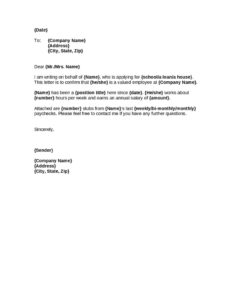
Salary Verification Letter
Confirm an employee's income with a Salary Verification Letter that lenders and landlords trust, available as a free download in PDF and DOCX.
DOCX
1 downloads
0
likes
Download Files
- DOCX
A Salary Verification Letter is a short, official document from an employer that confirms an employee’s job title, employment status, and earnings. People most often request one when applying for a mortgage, rental, loan, or visa and a third party needs proof of income. You can download a free Salary Verification Letter template here in both PDF and DOCX formats, with no signup required.
What Is a Salary Verification Letter?
A Salary Verification Letter is a formal statement, usually written on company letterhead and signed by an authorized person such as an HR manager, supervisor, or payroll officer. It documents that a named individual works (or worked) for the organization and states how much they earn. Banks, landlords, government agencies, and other lenders rely on it to independently confirm that an applicant has the income they claim. Unlike a pay stub, which the employee produces, this letter carries the employer’s direct endorsement, making it a more authoritative form of verification. It is typically brief, factual, and limited to the specific details the requesting party needs.
When Do You Need a Salary Verification Letter?
Employees ask for this letter whenever an outside party wants official confirmation of their earnings. Common situations include:
- Mortgage or home loan applications — lenders verify income before approving a borrower.
- Apartment rentals — landlords confirm a prospective tenant can afford the rent.
- Auto loans or personal loans — financial institutions assess repayment ability.
- Visa, immigration, or relocation paperwork — agencies require documented proof of stable employment and income.
- Credit card or credit limit increase requests — issuers confirm earning capacity.
- Government assistance or benefit eligibility — programs often require verified income figures.
In each case the goal is the same: an objective, employer-signed statement that the figures the applicant provided are accurate.
What a Salary Verification Letter Should Have
A complete and credible letter includes several core elements. Without them, a lender or agency may reject the document and request a corrected version:
- Company name, address, and official letterhead or logo.
- The date the letter is written.
- The recipient’s name or organization, when known (or “To Whom It May Concern”).
- The employee’s full legal name and job title.
- Employment status (full-time, part-time, contract) and start date.
- The salary amount and pay frequency (annual, monthly, or hourly).
- A signature, printed name, title, and contact details of the person verifying.
How to Fill Out a Salary Verification Letter
Follow these steps to complete the template accurately:
- Add company details. Place your organization’s name, address, and logo at the top so the letter clearly comes from a legitimate employer.
- Insert the date. Use the actual date you sign the letter; many recipients require a recent date, often within 30 days.
- Address the recipient. Name the bank, landlord, or agency if you know it; otherwise use “To Whom It May Concern.”
- State the employee’s name and title. Use the employee’s full legal name and exact job title as it appears in your records.
- Confirm employment details. Note the employment type and the date the employee began working for you.
- Enter the salary. Write the precise figure and specify whether it is annual, monthly, or hourly, and the pay frequency.
- Add optional context. Mention bonuses or consistent overtime only if relevant and accurate.
- Sign and provide contact information. The authorized signer adds their name, title, phone number, and email so the recipient can verify authenticity.
Who Should Sign and Issue the Letter
The letter should come from someone with the authority to confirm payroll information. In most companies that is a human resources representative, a payroll administrator, or the employee’s direct manager. The signer is vouching for the accuracy of the numbers, so they should pull figures directly from official payroll records rather than estimating. Smaller businesses without a dedicated HR department may have the owner or office manager sign. Whoever signs should include a direct phone number or email, because lenders and agencies frequently call to confirm the letter is genuine before relying on it.
How It Differs From a Pay Stub or Employment Verification Letter
These documents are related but not identical. A pay stub is generated by payroll for each pay period and shows gross and net amounts plus deductions; it is employee-held and detailed. An employment verification letter confirms that a person works for the company and may state their title and tenure, but does not always include salary. A Salary Verification Letter specifically focuses on income and is signed by the employer, combining the confirmation of employment with a clear statement of earnings. Some requesting parties will ask for more than one of these together, so confirm exactly what the recipient needs before sending only one.
Tips for a Smooth Verification Process
To avoid delays, ask the employee which specific figures the recipient requires before drafting the letter. Keep the language factual and concise; extra commentary can raise unnecessary questions. Print the letter on official letterhead and use a wet or verified electronic signature where accepted. Finally, keep a copy on file in case the recipient calls to confirm details.
Common Mistakes to Avoid
- Listing inaccurate salary figures — always pull numbers from official payroll records.
- Forgetting the date — many institutions reject letters older than 30 days.
- Leaving off letterhead — a plain document looks less credible and may be refused.
- Omitting contact information — recipients often call to verify; missing details cause delays.
- Including unverified extras — only mention bonuses or overtime if they are accurate and documented.
- Having the wrong person sign — the signer must be authorized to confirm payroll data.
Frequently Asked Questions
What is a Salary Verification Letter used for? It is used to officially confirm an employee’s income to a third party such as a lender, landlord, or government agency. The letter provides employer-backed proof that the applicant earns what they claim. It is most commonly requested during mortgage, rental, loan, and visa applications.
Who can write and sign a Salary Verification Letter? Someone authorized to confirm payroll information should write it, typically an HR representative, payroll administrator, or a direct manager. In smaller businesses the owner or office manager may sign. The signer should use accurate figures from official records and include their contact details.
Does a Salary Verification Letter need to be notarized? In most cases notarization is not required, since the employer’s signature and letterhead provide credibility. However, some agencies, especially for immigration or international purposes, may request a notarized copy. Check the specific requirements of the requesting party before submitting.
How recent does the letter need to be? Many lenders and landlords require a letter dated within the last 30 days to ensure the income information is current. Always confirm the recipient’s timeframe and issue a freshly dated letter for each request rather than reusing an old one.
What is the difference between this letter and a pay stub? A pay stub is generated by payroll and shows detailed earnings and deductions for a single pay period. A Salary Verification Letter is an employer-signed statement confirming overall salary and employment status. Some recipients ask for both, so verify what is required.
Is this Salary Verification Letter template free to download? Yes, you can download this template completely free in PDF and DOCX formats with no signup required. The DOCX version is fully editable so you can add your company letterhead and the relevant details, then print or sign as needed.
This Salary Verification Letter template is a general example provided for informational purposes only and is not legal, financial, or tax advice. Requirements vary by jurisdiction and by the institution requesting the document; consult a qualified professional or your HR and legal advisors to ensure your letter meets applicable standards.
Official resource: for the rules that apply to your situation, see the U.S. Department of Labor.
Related Forms
- Candidate Evaluation
- Monthly Time Card With Approval
- Consent To Drug Test
- Shift Trade Request
- Consent to Release Personnel Information
- Comp Time Request Form
Browse more in Employment.