
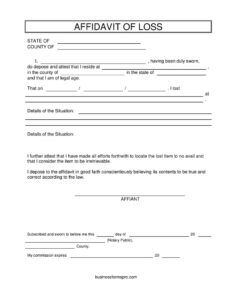
Affidavit Of Loss
Download a free Affidavit of Loss template to legally declare a lost document or item under oath—free PDF and DOCX download, no signup required.
PDF
DOCX
7 downloads
0
likes
Download Files
- DOCX
An Affidavit of Loss is a sworn written statement in which you formally declare that a specific document or item has been lost and cannot be recovered. People most often use it to request a replacement for something valuable—like a lost certificate, license, passbook, stock certificate, or company ID—when the issuing authority requires proof of the loss before reissuing it. You can download this Affidavit of Loss free in both PDF and DOCX formats, with no signup required.
What Is an Affidavit of Loss?
An Affidavit of Loss is a legal document signed by an affiant (the person making the statement) and notarized to confirm, under oath, that an item was lost. It documents who lost the item, what was lost, when and where it went missing, and that the affiant made genuine efforts to find it before concluding it is irretrievable. Banks, government agencies, schools, employers, and corporations frequently require an Affidavit of Loss before issuing a duplicate document or releasing a replacement. Because it is sworn before a notary public, the affidavit carries legal weight: making a false statement in it can expose the affiant to penalties for perjury, which is why accuracy matters.
When Do You Need an Affidavit of Loss?
An Affidavit of Loss is commonly requested whenever an organization needs documented proof before replacing something. Typical situations include:
- Lost identification or credentials — replacing a misplaced driver’s license, company ID, professional license, or membership card.
- Missing financial documents — reporting a lost bank passbook, ATM card, check, certificate of deposit, or stock certificate to a bank or financial institution.
- Lost academic records — requesting a duplicate diploma, transcript, or certificate from a school or university.
- Misplaced government or legal documents — declaring the loss of a title, permit, registration, or official receipt to a government office.
- Lost property or valuables — supporting an insurance claim or replacement request for items such as jewelry, electronics, or important paperwork.
- Lost vehicle documents — obtaining a replacement plate, sticker, or ownership document from a motor vehicle agency.
In each case, the receiving party uses the affidavit as a formal, signed record that absolves them of liability and justifies issuing a duplicate.
What an Affidavit of Loss Should Have
A complete Affidavit of Loss includes several essential elements that establish its validity. It names the state and county where it is executed, identifies the affiant by full name and residential address, and confirms the affiant is of legal age. It clearly describes the item that was lost, the date of the loss, and the location or circumstances. A strong affidavit also includes a detailed narrative of how the loss occurred, an attestation that diligent efforts were made to recover the item, and a good-faith statement that the contents are true. Finally, it must contain the affiant’s signature and a notary acknowledgment block confirming the statement was sworn before a notary public.
How to Fill Out an Affidavit of Loss
- State and county: At the top, enter the state and county where you are signing the affidavit. These should match the location of the notary who will witness your signature.
- Affiant name: Write your full legal name in the blank that begins “I, ____,” so it is clear who is making the sworn statement.
- Residence details: Enter your street address, then the county and state where you reside. This confirms your identity and that you are of legal age.
- Date of loss: Fill in the exact date you lost the item, or your best honest estimate if the precise date is unknown.
- Item lost: Describe specifically what was lost—for example, “my original college diploma” or “bank passbook no. 12345.”
- Location of loss: State where you lost it or where you last had it in your possession.
- Details of the situation: Use this space to explain the circumstances of the loss in your own words, including any efforts to recover it.
- Signature: Sign on the AFFIANT line—but only in front of the notary, not before.
- Notary section: Leave the day, month, year, notary signature, county, and commission-expiration blanks for the notary public to complete.
Why Notarization Matters
An Affidavit of Loss is a sworn statement, so it must be notarized to be effective. The closing line—”Subscribed and sworn to before me”—is completed by a notary public who verifies your identity, watches you sign, and administers the oath. Do not sign the document ahead of time; the notary must observe your signature for the acknowledgment to be valid. Bring a current government-issued photo ID to your notary appointment. Many banks, libraries, shipping stores, and law offices offer notary services, and online notarization is available in some jurisdictions. Once notarized, keep the original and make copies, since the organization requesting the affidavit may keep the original for its records.
Tips for a Stronger Affidavit
The more specific and factual your affidavit, the more readily it will be accepted. Identify the lost item with as much detail as possible, including any serial numbers, account numbers, or reference numbers. Be honest about what you remember and avoid guessing; if you are unsure of a date, say so plainly rather than inventing one. Confirm in advance with the agency or institution that will receive the affidavit whether they require specific language, attachments such as a police report, or additional supporting documents. A clear, truthful narrative reduces the chance of follow-up questions and speeds up the replacement process.
Common Mistakes to Avoid
- Signing before the notary: The affidavit must be signed in the notary’s presence; pre-signing can invalidate it.
- Vague item descriptions: Writing “my card” instead of identifying the exact document and number can lead to rejection.
- Leaving blanks empty: Incomplete fields—especially state, county, or the date of loss—weaken the document.
- Mismatched information: Names or addresses that don’t match your ID can cause the notary or recipient to reject the affidavit.
- Overstating the search: Only attest that you made genuine efforts to locate the item if that is truthful, since this is a sworn statement.
- Forgetting to confirm requirements: Some institutions have their own affidavit format—check before submitting this one.
Frequently Asked Questions
What is an Affidavit of Loss used for? It is a sworn statement declaring that a specific document or item has been lost and cannot be recovered. Organizations such as banks, schools, and government offices typically require it before they will issue a duplicate or replacement.
Does an Affidavit of Loss need to be notarized? Yes. The document includes a “Subscribed and sworn to before me” section that a notary public completes after witnessing your signature and administering an oath. Without notarization, most institutions will not accept it.
Is an Affidavit of Loss legally binding? It is a sworn legal statement, meaning you are attesting to its truth under oath. Providing false information can expose you to penalties for perjury, so accuracy is essential.
How much does an Affidavit of Loss cost? The template here is completely free to download in PDF and DOCX with no signup. You may pay a small notary fee, which varies by location and provider.
Do I need witnesses in addition to a notary? Most Affidavits of Loss require only the affiant’s signature and a notary acknowledgment. Some jurisdictions or institutions may request additional witnesses, so confirm requirements with the recipient beforehand.
Can I use this affidavit to get a replacement document? In many cases, yes—it is often the proof an issuer needs. Always check with the specific bank, agency, or institution to confirm they accept this format and whether they require supporting documents.
This Affidavit of Loss template is a general example provided for informational purposes only and is not legal advice. Requirements for affidavits and notarization vary by jurisdiction. Consult a qualified attorney or your local notary or issuing authority to ensure your document meets applicable requirements.
Related Forms
- Affidavit Of Title
- Affidavit Of Gift
- Non-Cash Contribution Letter
- Affidavit Of Correction
- Affidavit Of Identity
- Affidavit Of Domicile
Browse more in Affidavits.