
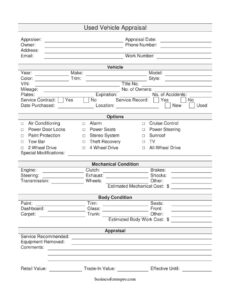
Used Vehicle Appraisal
Document a car's condition and value with our free Used Vehicle Appraisal form template, available as a free download in PDF and DOCX.
PDF
DOCX
13 downloads
0
likes
Download Files
- DOCX
A Used Vehicle Appraisal form is a structured document used to record a pre-owned vehicle’s identity, condition, equipment, and estimated value. People most often use it to establish a fair trade-in or retail figure before buying, selling, or accepting a vehicle on trade. It’s free to download here in both PDF and DOCX, with no signup required.
What Is a Used Vehicle Appraisal?
A Used Vehicle Appraisal is a written evaluation that captures everything a dealer, appraiser, or private party needs to assign a value to a used car, truck, or SUV. It is typically completed by a trained appraiser at a dealership, by a buy-here-pay-here lot, or by an independent inspector. The form documents the vehicle’s make, model, year, mileage, and VIN alongside a detailed assessment of mechanical and body condition. It also notes equipment, options, accident history, and any reconditioning costs. The end result is a record that supports a stated Trade-In Value and Retail Value, helping both parties negotiate transparently and keeping a paper trail for the transaction.
When Do You Need a Used Vehicle Appraisal?
This form is useful any time a vehicle’s worth needs to be documented in writing rather than guessed. Common situations include:
- A dealership appraising a customer’s car as a trade-in toward a new or used purchase.
- A private seller wanting an objective, written valuation before listing a vehicle.
- A buyer seeking a third-party assessment of condition and fair price before paying.
- An insurance or claims scenario where a vehicle’s pre-loss value must be established.
- A fleet or rental company evaluating units for resale or auction.
- A lender or financing office verifying collateral value before approving a loan.
In each case, the appraisal turns a verbal estimate into a dated, detailed record that everyone can refer back to.
What a Used Vehicle Appraisal Should Have
A complete appraisal ties together vehicle identity, condition, and value. Vehicle identity covers Year, Make, Model, Trim, Style, Color, VIN, Title No., Plates, and Mileage. Condition spans Body Condition and Mechanical Condition, plus specific items like Engine, Transmission, Brakes, Steering, Shocks, Exhaust, Clutch, Paint, Glass, Carpet, Seats, and Dashboard. Equipment and options — Air Conditioning, Cruise Control, Sunroof, Power Steering, Power Door Locks, Power Seats, Stereo System, Alarm, and more — affect value and should be checked off accurately. History fields such as No. of Owners, No. of Accidents, Service Record, and Date Purchased add context. Finally, the valuation section ties it all together with Estimated Body Work Cost, Estimated Mechanical Cost, Trade-In Value, and Retail Value, signed and dated by the Appraiser.
How to Fill Out a Used Vehicle Appraisal
- Enter the Owner details: name, Address, Phone Number, Work Number, and Email so the appraisal ties to the right person.
- Record vehicle identity — Year, Make, Model, Trim, Style, Color, VIN, Title No., Plates, and Mileage — and mark New / Used and the drivetrain (2 Wheel Drive, 4 Wheel Drive, or All-Wheel Drive).
- Note ownership history: Date Purchased, No. of Owners, No. of Accidents, and whether a Service Record or Service Contract exists.
- Rate Mechanical Condition item by item: Engine, Transmission, Clutch, Brakes, Steering, Shocks, Exhaust, and Wheels.
- Rate Body Condition: Paint, Glass, Carpet, Seats, Dashboard, Trunk, and Front.
- Check off Options and Equipment present, such as Air Conditioning, Cruise Control, Sunroof, Power Seats, Power Door Locks, Power Steering, Stereo System, TV, Alarm, Tow Bar, and Paint Protection. Note any Equipment Removed or Special Modifications.
- Estimate reconditioning: Estimated Body Work Cost and Estimated Mechanical Cost, plus Service Recommended.
- Assign the Trade-In Value and Retail Value, add Comments, then complete the Appraiser name, Location, Appraisal Date, and Effective Until / Expiration.
Reading the Valuation Fields
The two key numbers are Trade-In Value and Retail Value, and they are rarely the same. Trade-In Value reflects what a dealer expects to pay the owner, accounting for reconditioning and resale margin. Retail Value reflects the price the vehicle could realistically command once it’s cleaned, repaired, and listed for sale. The Estimated Body Work Cost and Estimated Mechanical Cost fields explain the gap between the two — a vehicle needing new tires, brake work, or paint repair will show a lower trade figure. Recording these costs separately keeps the appraisal transparent and lets the owner understand exactly why a number was assigned rather than feeling shortchanged.
Why Documenting History and Equipment Matters
Two otherwise identical vehicles can appraise very differently based on history and equipment. Fields like No. of Accidents, No. of Owners, Theft Recovery, and Service Record signal how the vehicle was treated and whether hidden risk exists. Equipment such as a Sunroof, premium Stereo System, Paint Protection, or factory Options can raise value, while Special Modifications or Equipment Removed may lower it. The Effective Until and Expiration fields matter because used-car values shift with market conditions and mileage accrues over time — an appraisal is only valid for a defined window, so always note when it stops applying.
Common Mistakes to Avoid
- Leaving the VIN or Title No. blank, which makes it impossible to verify the exact vehicle later.
- Skipping the Mileage reading or recording it inaccurately — mileage is one of the largest factors in value.
- Overlooking reconditioning costs, so the Trade-In and Retail Values don’t reflect needed Body Work or Mechanical repairs.
- Failing to note prior accidents, modifications, or removed equipment that materially affect the figure.
- Forgetting the Appraisal Date and Effective Until window, leaving an open-ended value that may no longer be accurate.
- Not signing as Appraiser or listing the Location, which weakens the document’s credibility.
Frequently Asked Questions
What is a Used Vehicle Appraisal form used for? It is used to document a pre-owned vehicle’s identity, condition, equipment, and estimated value in writing. Dealers, private sellers, buyers, and lenders rely on it to support a fair trade-in or retail figure and to keep a clear record of the assessment.
How do I fill out a Used Vehicle Appraisal? Start with owner and vehicle identification, including VIN, Year, Make, Model, and Mileage. Then rate the mechanical and body condition, check off options and equipment, estimate any repair costs, and finish by assigning Trade-In and Retail Values with the appraiser’s name and date.
What’s the difference between Trade-In Value and Retail Value? Trade-In Value is what a dealer expects to pay the owner, factoring in reconditioning and resale margin. Retail Value is the higher price the vehicle could sell for once repaired and listed. The estimated body work and mechanical costs explain the gap between the two.
Does a Used Vehicle Appraisal need to be notarized? No, an appraisal generally does not require notarization or witnesses. It is an evaluation document, not a transfer of ownership. The appraiser’s signature, location, and date are typically what give it credibility.
How long is a vehicle appraisal valid? Validity depends on the Effective Until or Expiration date entered on the form. Because used-car values shift with the market and mileage keeps accruing, many appraisals are intended to remain current only for a short window, often a matter of days or weeks.
How much does this Used Vehicle Appraisal template cost? The template on this page is completely free to download in PDF and DOCX with no signup required. You can fill it out digitally or print it, and reuse it for as many vehicle evaluations as you need.
This Used Vehicle Appraisal template is a general example provided for informational purposes only and is not legal, financial, or tax advice. Vehicle valuation practices and disclosure requirements vary by jurisdiction and situation. Consult a qualified professional or licensed appraiser for guidance specific to your circumstances.
Official resource: for the rules that apply to your situation, see your state DMV.
Related Forms
- Electric Or Hybrid Car Comparison
- Motor Vehicle Bill of Sale
- Vehicle Options Form
- Auto Estimate Form
- Car Bill of Sale
- Fuel Tracker
Browse more in Auto Sales.