
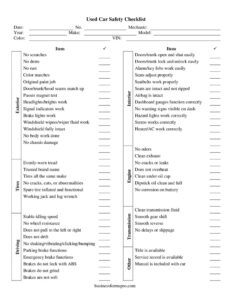
Used Car Mechanic Checklist
Download a free Used Car Mechanic Checklist template to inspect a vehicle's body, brakes, engine and tires before you buy — free PDF and DOCX download.
PDF
DOC
2 downloads
0
likes
Download Files
- DOC
A Used Car Mechanic Checklist is a structured inspection sheet used to evaluate a pre-owned vehicle’s condition before purchase, covering everything from body and paint to brakes, tires, fluids and engine performance. Most people use it to spot hidden damage and avoid costly surprises before signing a bill of sale. You can download this checklist free in both PDF and DOCX formats with no signup required.
What Is a Used Car Mechanic Checklist?
A Used Car Mechanic Checklist is a point-by-point inspection form that a mechanic, dealer, or careful buyer uses to assess a used vehicle’s mechanical and cosmetic condition. It documents the car’s identity — year, make, model, color and VIN — alongside dozens of checkpoints such as paint consistency, tire wear, braking performance and fluid quality. The form serves as a written record of what was inspected, who inspected it, and on what date. Buyers use it as leverage during negotiation, sellers use it to demonstrate transparency, and mechanics use it to deliver a consistent, professional pre-purchase inspection. Because it covers safety-critical systems like seatbelts, airbags and brakes, it doubles as a basic roadworthiness review.
When Do You Need a Used Car Mechanic Checklist?
This checklist is useful any time a vehicle changes hands or needs a thorough condition review. Common scenarios include:
- Buying from a private seller where there is no dealer warranty and you need an objective assessment of the car’s true condition.
- Shopping at a used car lot and wanting to verify the salesperson’s claims about accident history, repairs and mileage.
- Hiring a mechanic for a pre-purchase inspection so they can report findings in a clear, organized format.
- Selling your own vehicle and wanting to provide buyers with documented proof of its mechanical health.
- Evaluating an auction or estate-sale car sold as-is, where careful inspection is the only protection you have.
- Checking a teen driver’s first car or a fleet addition to confirm all safety systems function correctly.
What a Used Car Mechanic Checklist Should Have
A complete checklist groups inspection points into logical categories so nothing is overlooked. At minimum it should cover vehicle identification (VIN, year, make, model), exterior and bodywork, paint and frame integrity, lighting and signals, tires and emergency equipment, driving and braking behavior, interior and safety systems, climate and electronics, engine and fluids, transmission, and documentation. Each line should be a clear pass/fail or check-off item, and there should be space for the inspector’s name and the inspection date. Good checklists also confirm paperwork — the title, service records and owner’s manual — since these affect both value and legal transfer. The more granular the items, the more reliable the final picture of the car.
How to Fill Out a Used Car Mechanic Checklist
- Enter the Date, a reference No. for your records, and the name of the Mechanic or person performing the inspection.
- Record vehicle identity: Year, Make, Model, Color and the full VIN so the report is tied to a specific car.
- Walk the exterior and check the body items — no scratches, no dents, no rust, color matches, original paint job, and that door, trunk and hood seams line up. Use the magnet test to detect filler.
- Test all lighting: headlights/brights, signal indicators, brake lights, hazard lights, and the windshield wipers and fluid; confirm the windshield is fully intact.
- Inspect tires for even tread, matching trusted brands, no cracks or cuts, plus a properly inflated spare, jack and lug wrench.
- Drive the car to evaluate idling, steering pull, drift, vibration, and every braking item, then check interior, fluids, transmission and documentation before signing.
Understanding the Inspection Categories
The checklist is organized so you can move logically around and through the car. The bodywork section — including the magnet test and seam alignment — is designed to reveal prior collision repairs that a fresh coat of paint can hide. The tire and emergency-equipment section tells you about both wear patterns (which can signal alignment or suspension problems) and whether you could safely change a flat on the roadside. The driving section captures how the car behaves under real conditions: a vehicle that pulls to one side, drifts, shakes, clicks or vibrates is flagging issues you would never notice while parked. The brake checks are among the most important: confirm the parking and emergency brakes hold, that ABS does not cause lockup, and that the pedal is neither soft nor grinding.
Engine, Fluids and Paperwork
Under the hood, the checklist guides you to look for a clean exhaust, no cracks or leaks, no overheating, and clean residue under the oil cap and on the dipstick. Sludge or a milky film can indicate serious internal problems. You also verify the battery shows no corrosion, the transmission fluid is clean, and gear shifts — forward and reverse — are smooth with no delays or slippage. Finally, confirm the title is available, that service records exist, and that the owner’s manual is included. Missing documentation can complicate registration and signals gaps in the car’s maintenance history.
Common Mistakes to Avoid
- Skipping the test drive — many problems with steering pull, drift, vibration or transmission slippage only appear when the car is moving.
- Ignoring the magnet test and seam alignment, which means you might miss expensive past collision repairs.
- Inspecting on a wet or dirty car, which hides scratches, rust, dents and paint mismatches.
- Forgetting the cold-start checks — testing oil, idling and overheating after the engine is already warm can mask issues.
- Overlooking documentation like the title and service records, which affect both value and your ability to register the vehicle.
- Treating the checklist as optional on an as-is sale, where you have little recourse after the purchase is complete.
Frequently Asked Questions
What is a Used Car Mechanic Checklist? It is an inspection form used to systematically evaluate a pre-owned vehicle’s body, tires, brakes, engine, interior and paperwork before purchase. It records the car’s identity and dozens of pass/fail checkpoints. The result helps buyers make an informed decision and negotiate from a position of knowledge.
Do I need a professional mechanic to use this checklist? No — a careful buyer can complete many items independently, such as inspecting paint, tires, lights and interior. However, a qualified mechanic adds value for the engine, transmission, brakes and underbody items, and can perform a more thorough diagnostic. For an expensive purchase, a professional pre-purchase inspection is strongly recommended.
How long does a used car inspection take? A thorough inspection using this checklist typically takes 30 to 60 minutes, including a test drive. Cold-start checks should be done before the engine warms up, so plan to inspect the car first thing. Rushing increases the chance of missing important defects.
Is the checklist legally binding? The checklist itself is an inspection record, not a contract — it does not transfer ownership or create warranty obligations on its own. The legal agreement is the bill of sale or purchase contract. The checklist is best used as supporting documentation and a negotiation tool.
What is the magnet test on the checklist? The magnet test involves placing a magnet against body panels to detect areas filled with body filler, which is non-magnetic. Weak or no magnetic attraction often indicates prior collision repair beneath the paint. It is a quick, low-tech way to reveal hidden damage.
How much does this checklist cost? This Used Car Mechanic Checklist template is completely free to download from Business Forms Pro in both PDF and DOCX formats, with no signup required. You can print it for an in-person inspection or edit the DOCX to add your own checkpoints. There is no cost or registration to use it.
This template is provided as a general example for informational purposes only and does not constitute legal, financial, or professional mechanical advice. Vehicle inspection standards, disclosure rules, and title transfer requirements vary by jurisdiction, and no checklist can guarantee a vehicle’s condition. Consult a qualified mechanic and review your local regulations before buying or selling a used car.
Official resource: for the rules that apply to your situation, see your state DMV.
Related Forms
- Miles Per Gallon Comparison
- Motor Vehicle Bill of Sale
- Auto Estimate Form
- Vehicle Deal Jacket
- Electric Or Hybrid Car Comparison
- Used Car Comparison
Browse more in Auto Sales.